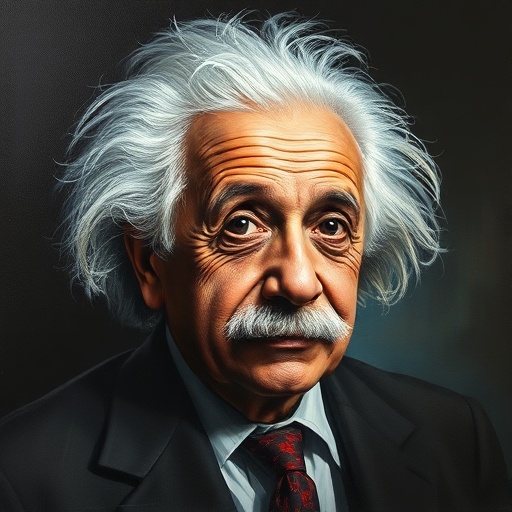
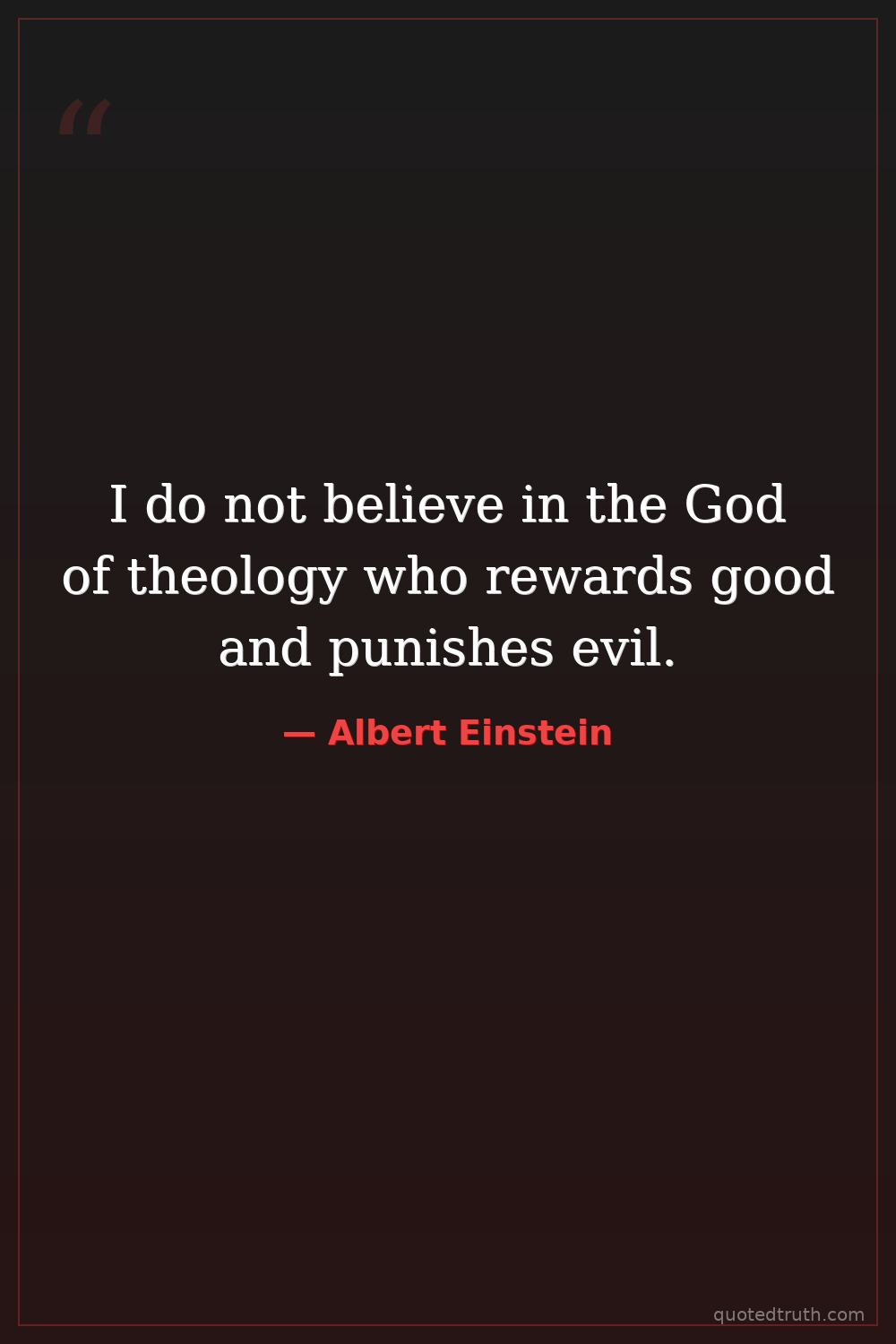
Albert Einstein — "I do not believe in the God of theology who rewards good and punishes evil."
I do not believe in the God of theology who rewards good and punishes evil.
I do not believe in the God of theology who rewards good and punishes evil.
Click any product to generate a realistic preview. Up to 3 at a time.
* Initial load can take up to 90 seconds — revising the preview in another color is nearly instant.
"I have reached an age when if someone tells me to wear socks, I don't have to."
"The only thing that interferes with my learning is my education."
"If I were not a physicist, I would probably be a musician. I often think in music. I live my daydreams in music."
"Life without playing music is inconceivable for me. I live my daydreams in music. I see my life in terms of music. I get most joy in life out of music."
"If A is a success in life, then A equals x plus y plus z. Work is x; y is play; and z is keeping your mouth shut."
Found in 1 providers: deepseek
1 source checked
Einstein rejects the idea of a personal God who acts as a cosmic judge, handing out rewards to the righteous and punishments to the wicked. He finds this theistic framework intellectually untenable. Rather than endorsing atheism, he expressed belief in what he called Spinoza's God—a divine presence embedded in natural law and universal order, not an interventionist deity who tracks human behavior and dispenses moral justice accordingly.
Einstein was Jewish by heritage but deeply skeptical of organized religion. He famously described his spirituality as belief in Spinoza's God—the God expressed through natural harmony, not personal providence. As a physicist who revealed the universe's mathematical elegance through relativity, he found meaning in cosmic order rather than moral theology. He consistently pushed back against anthropomorphic conceptions of God throughout his life and published correspondence.
Einstein lived through the early-to-mid 20th century, when science and traditional religion were in open conflict. Darwin's evolution had already destabilized biblical literalism. Two World Wars shook belief in divine moral order—if God punished evil, how did the Holocaust occur? Secular humanism and logical positivism were rising. Physics itself was dismantling intuitive reality, making theological certainty increasingly difficult to maintain among educated thinkers of the era.
AI-generated insights based on extensive research and information for context. Factual errors? Email [email protected].
Your cart is empty