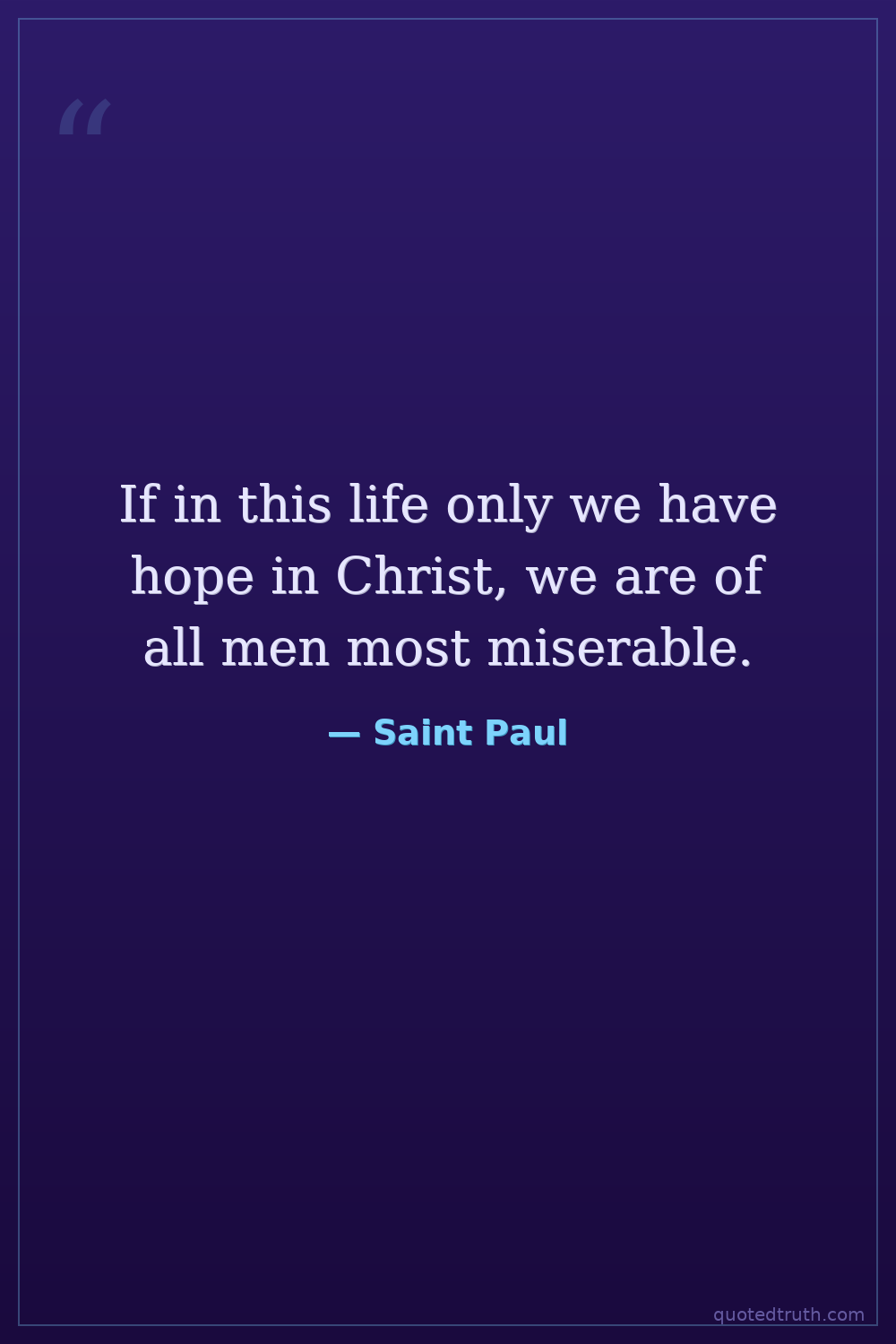
Saint Paul — "If in this life only we have hope in Christ, we are of all men most miserable."
If in this life only we have hope in Christ, we are of all men most miserable.
If in this life only we have hope in Christ, we are of all men most miserable.
Click any product to generate a realistic preview. Up to 3 at a time.
* Initial load can take up to 90 seconds — revising the preview in another color is nearly instant.
"I have fought the good fight, I have finished the race, I have kept the faith."
"For we are not as many, which corrupt the word of God: but as of sincerity, but as of God, in the sight of God speak we in Christ."
"I can do all things through him who strengthens me."
"I thank my God, I speak with tongues more than ye all."
"And if they will learn any thing, let them ask their husbands at home: for it is a shame for women to speak in the church."
Found in 1 providers: gemini
1 source checked
If our faith in Christ only helps us in this earthly life and nothing follows after death, then believers are the most pitiable people alive. We endure hardship, sacrifice, and persecution based on the promise of resurrection and eternal life. Without that future hope, all the suffering we accept for our beliefs is pointless, and we would be worse off than those who simply enjoy life without religious commitments.
Paul wrote this defending the bodily resurrection to skeptical Corinthians. His entire life pivoted on encountering the risen Christ on the Damascus road, transforming him from persecutor to apostle. He endured beatings, shipwrecks, imprisonment, and eventual martyrdom specifically because he believed death was not final. Without resurrection, his abandonment of status as a Pharisee and his suffering missionary life would have been a tragic mistake.
Written around 55 AD to Corinth, a Greek city where Hellenistic philosophy rejected bodily resurrection as absurd, preferring ideas of the soul escaping the body. Some Corinthian Christians were denying physical resurrection while keeping Christ's teachings. Meanwhile, Roman society offered pleasure-focused philosophies like Epicureanism. Paul confronted a culture that found resurrection intellectually embarrassing, insisting Christianity collapses entirely without it, distinguishing the faith from mere ethical philosophy.
AI-generated insights based on extensive research and information for context. Factual errors? Email [email protected].
Your cart is empty