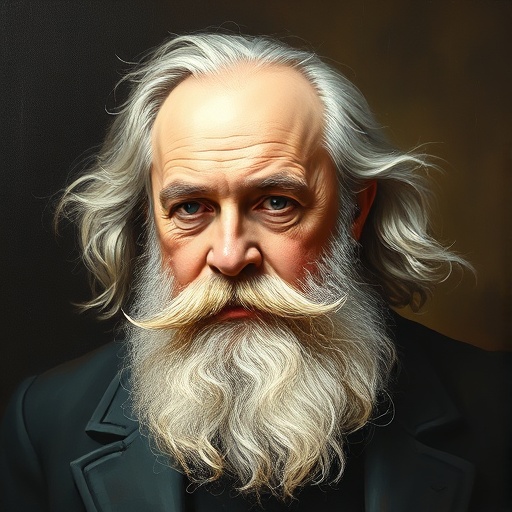
Dmitri Mendeleev — "I have been called a charlatan, a madman, and a dreamer, but I have always pursu…"
I have been called a charlatan, a madman, and a dreamer, but I have always pursued the truth.
I have been called a charlatan, a madman, and a dreamer, but I have always pursued the truth.
Click any product to generate a realistic preview. Up to 3 at a time.
* Initial load can take up to 90 seconds — revising the preview in another color is nearly instant.
"The periodic law is the most important generalization in chemistry, and it has no equal in any other branch of science."
"The knowledge of the properties of the elements is the foundation of all chemistry."
"The elements, if arranged according to their atomic weights, exhibit an apparent periodicity of properties."
"I love only science, and my children, and my wife, and my work, and the motherland."
"There are no limits to the perfectibility of human knowledge, and it is in this spirit that the periodic system was conceived."
Found in 1 providers: grok
1 source checked
The speaker admits that others have mocked him as a fraud, a lunatic, and a fantasist, yet insists none of that ridicule deterred him. What mattered was the steady pursuit of what is actually true, not how that pursuit looked to outsiders. Criticism and reputation are treated as noise; the search for verifiable reality is treated as the only worthwhile standard by which to measure a life's work.
Mendeleev faced exactly this scorn when he published his 1869 periodic table and boldly left gaps, predicting undiscovered elements like gallium and germanium with specific properties. Colleagues called the leaps speculative until those elements were found and matched his numbers. A restless polymath who also studied petroleum, agriculture, and metrology, he was denied the Nobel in 1906 partly due to rivals, yet never abandoned his conviction that nature's patterns were real.
Nineteenth-century Russian science was provincial and underfunded, overshadowed by German and French chemistry. Atomic theory itself was still contested, atomic weights were inconsistent, and Karlsruhe 1860 had only just begun standardizing them. Visionary classification schemes were dismissed as numerology. Meanwhile Tsarist Russia distrusted independent thinkers; Mendeleev clashed with the Education Ministry and resigned from St. Petersburg University in 1890 after defending student petitioners, making intellectual persistence genuinely costly.
AI-generated insights based on extensive research and information for context. Factual errors? Email [email protected].
Your cart is empty