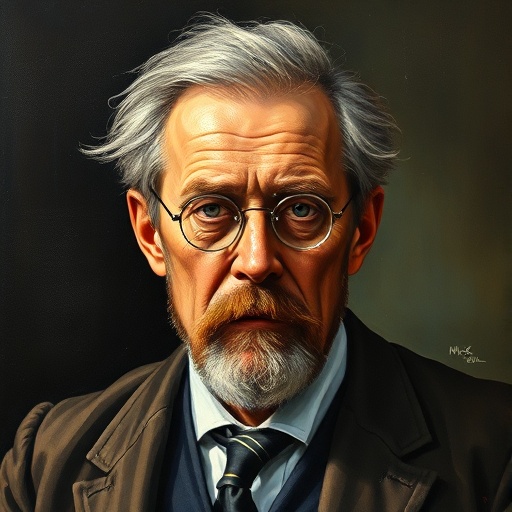
Max Planck — "The pioneer in a new field of knowledge is never a popular man."
The pioneer in a new field of knowledge is never a popular man.
The pioneer in a new field of knowledge is never a popular man.
Click any product to generate a realistic preview. Up to 3 at a time.
* Initial load can take up to 90 seconds — revising the preview in another color is nearly instant.
"The creative scientist has to be a man of faith. He must have faith in his results, and in the laws of nature."
"There can never be any real opposition between religion and science; for the one is the complement of the other."
"The universe is not only stranger than we imagine, it is stranger than we can imagine."
"It is not the truth that matters, but the search for it."
"We have no right to assume that any physical laws exist, or if they have existed up to now, that they will continue to exist in a similar manner in the future."
Found in 1 providers: grok
1 source checked
Breaking new intellectual ground rarely wins applause. People resist ideas that overturn what they already accept, so whoever goes first faces skepticism, ridicule, or hostility rather than praise. Recognition tends to arrive only after the rest of the field catches up, often long after the original breakthrough. The quote acknowledges that genuine originality carries a social cost, and anyone willing to challenge prevailing thinking should expect isolation before acceptance.
Planck lived this firsthand. When he introduced energy quanta in 1900 to solve blackbody radiation, he disrupted the classical physics he himself revered, and he described his own discovery as an act of desperation. Colleagues resisted quantization for years, and even Planck struggled to accept its full implications. His famous remark that science advances one funeral at a time reflects the same weary awareness that new truths win acceptance slowly, through generational turnover rather than persuasion.
Planck worked during a period when classical mechanics and thermodynamics seemed nearly complete, and German physics prized order, rigor, and continuity. Introducing discrete energy packets in 1900, followed by Einstein's 1905 photon and relativity papers, shattered that confidence and opened decades of turmoil leading to quantum mechanics. Planck also endured Nazi persecution of Jewish colleagues, the execution of his son, and the collapse of German science, sharpening his sense that pioneering thought exacts a personal price.
AI-generated insights based on extensive research and information for context. Factual errors? Email [email protected].
Your cart is empty