What it means
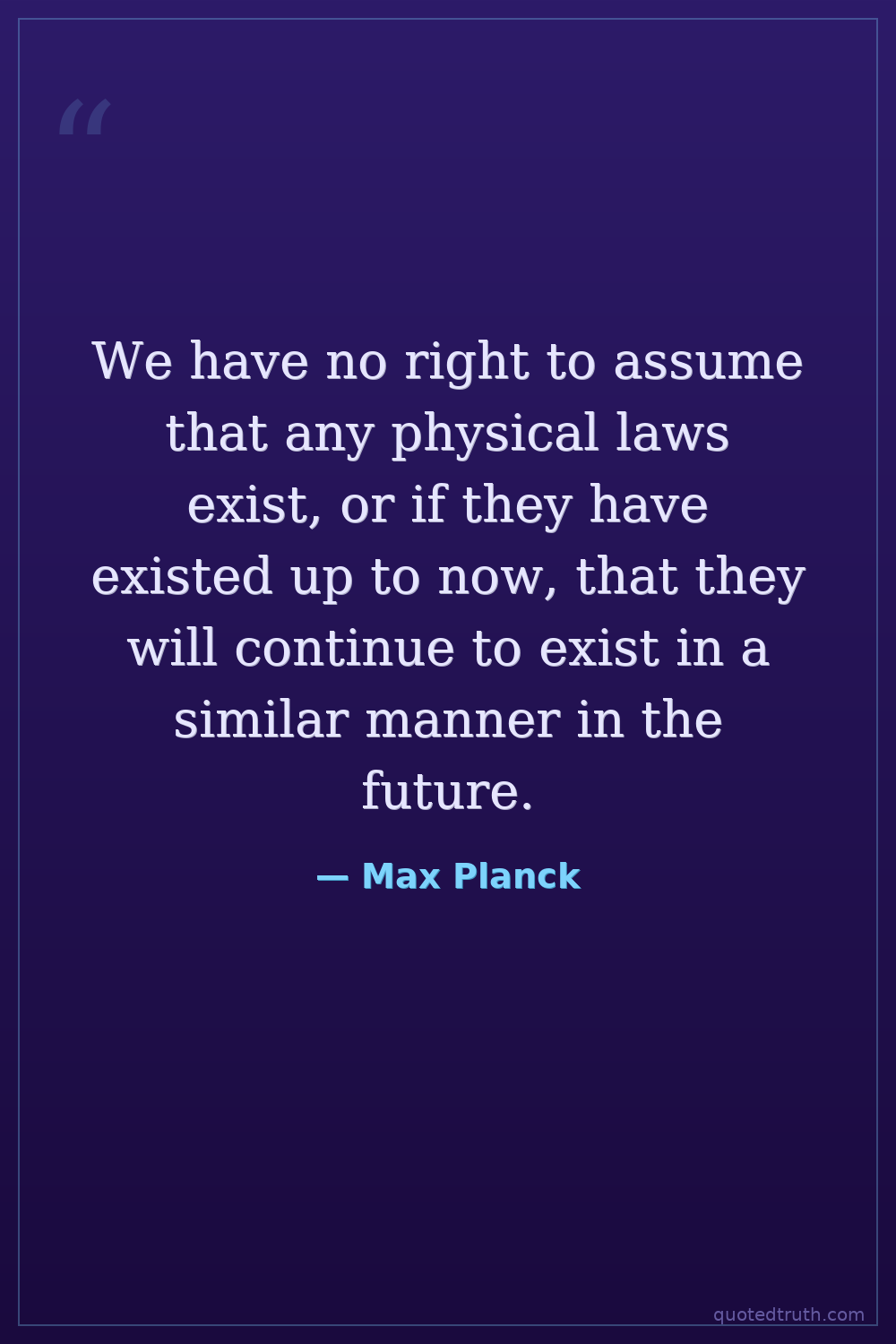
Planck argues we cannot take for granted that nature follows fixed rules, or that rules observed so far will keep holding. What we call physical laws are patterns inferred from past observations, not guaranteed truths about reality. The future behavior of the universe is not logically required to match the past. Confidence in scientific laws rests on induction and trust, not proof, and must remain open to revision.
Relevance to Max Planck
Planck spent his career formulating one of physics' most fundamental laws, the quantization of energy, yet watched classical mechanics crumble as quantum theory rewrote its foundations. Having personally overturned supposedly universal Newtonian assumptions, he knew firsthand how settled laws could collapse. A deeply philosophical and religious thinker, Planck repeatedly warned that science rests on faith in nature's intelligibility, an assumption no experiment can fully justify, only provisionally confirm.
The era
Planck worked amid the early twentieth century's scientific revolution, when relativity and quantum mechanics shattered the Newtonian worldview that had reigned for two centuries. Absolute space, time, and determinism all fell. Two world wars, the collapse of empires, and the rise of logical positivism forced thinkers to reexamine what counted as certain knowledge. In this climate of upheaval, Planck's caution about assuming permanent natural laws reflected both personal experience and a broader cultural crisis of certainty.
AI-generated insights based on extensive research and information for context. Factual errors? Email [email protected].