What it means
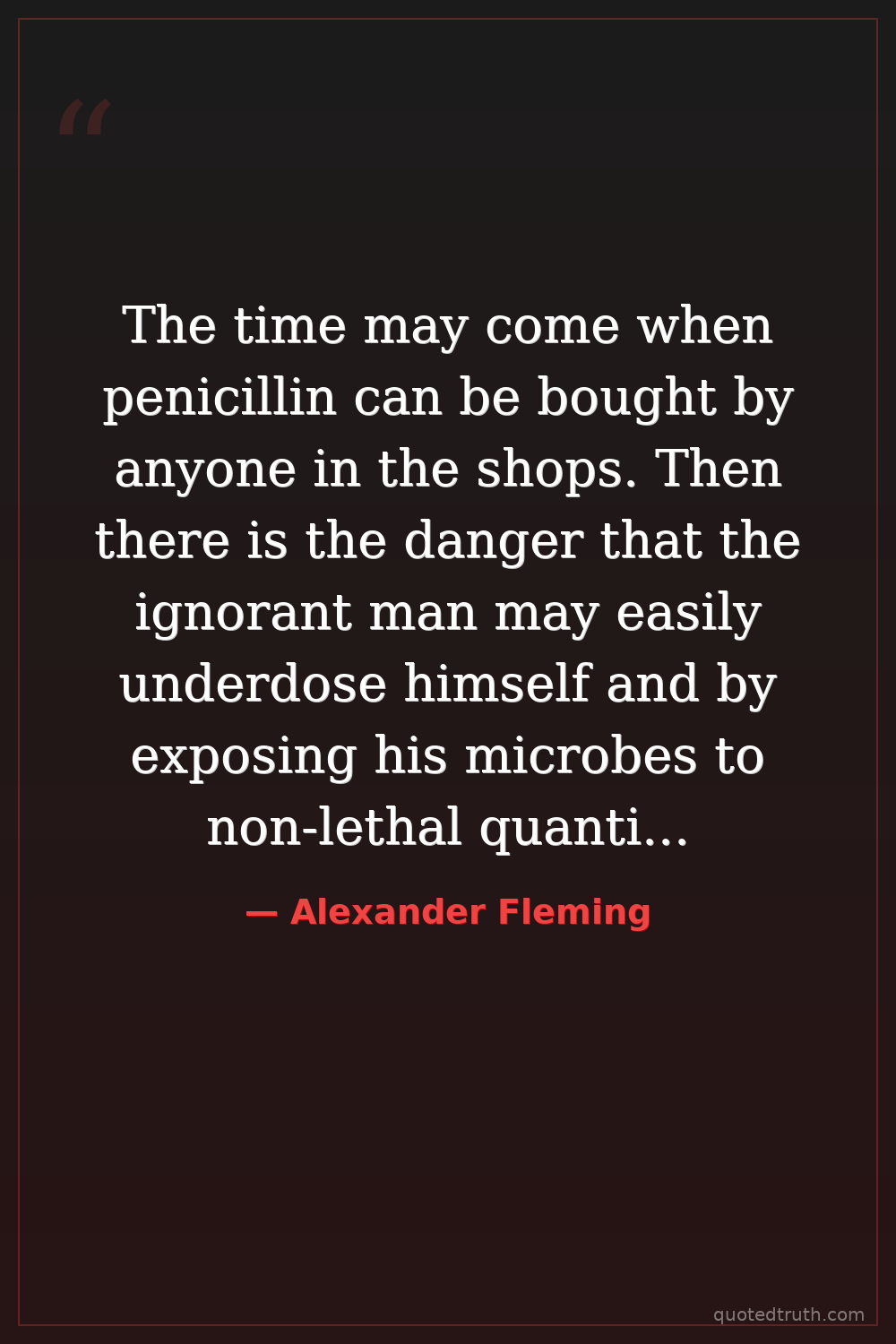
Fleming warns that easy access to penicillin creates a dangerous paradox: people without medical training might take too little, exposing bacteria to doses too weak to kill them. Surviving bacteria adapt, becoming resistant. This isn't just one person's problem — resistant strains spread, potentially making the antibiotic useless for everyone. The cure itself, carelessly misused, could breed the very threat it was designed to defeat.
Relevance to Alexander Fleming
Fleming discovered penicillin in 1928 by accident and spent decades championing its careful use. As a bacteriologist, he had watched microbes adapt and survive firsthand. He delivered this precise warning in his 1945 Nobel Prize acceptance speech — proving the man who gave the world its first antibiotic was already foreseeing how human carelessness and ignorance could unravel that extraordinary gift.
The era
Fleming spoke in 1945 as penicillin transitioned from scarce wartime military medicine to mass civilian production. The drug had seemed almost miraculous, saving soldiers from infected wounds. Pharmaceutical companies were scaling output rapidly and consumer access was imminent. Public understanding of antibiotic resistance was essentially zero. His warning proved prophetic: antimicrobial resistance now kills hundreds of thousands annually and is considered one of medicine's gravest ongoing global crises.
AI-generated insights based on extensive research and information for context. Factual errors? Email [email protected].