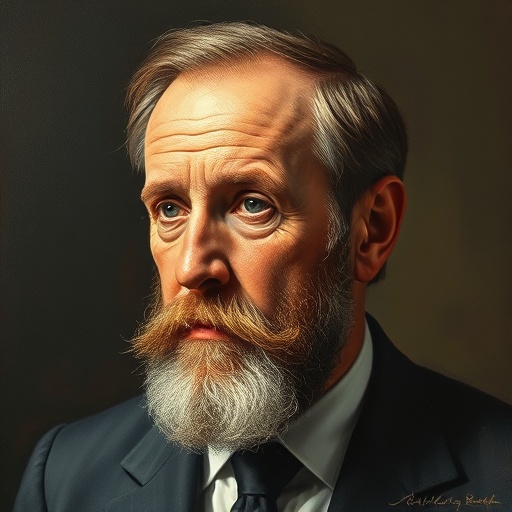
Niels Bohr — "Anyone who is not shocked by quantum theory has not understood it."
Anyone who is not shocked by quantum theory has not understood it.
Anyone who is not shocked by quantum theory has not understood it.
Click any product to generate a realistic preview. Up to 3 at a time.
* Initial load can take up to 90 seconds — revising the preview in another color is nearly instant.
"The goal of science is to explain the world, not to describe it."
"Accuracy and clarity of expression are a matter of degree."
"The very act of observing changes the observed."
"The electron is not a thing but an abstraction."
"The atom is a tiny planetary system. The electrons revolve around the nucleus just as the planets revolve around the sun."
Attributed, often quoted by colleagues like Werner Heisenberg
Date: Approx. 1920s-1930s
EducationalFound in 1 providers: grok
1 source checked
Quantum physics describes reality in ways that violate ordinary intuition: particles behave like waves, observation changes outcomes, and certainty is replaced by probability. If someone studies these ideas and feels no astonishment or disorientation, they have only memorized equations without grasping what those equations actually say about the world. True comprehension requires confronting how strange nature fundamentally is at the smallest scales, and accepting that common sense fails there.
Bohr spent his career wrestling with quantum mechanics, developing the Copenhagen interpretation and the complementarity principle. His atomic model introduced quantized electron orbits, directly defying classical physics. He famously debated Einstein for decades over whether reality was truly probabilistic. This quote captures his philosophical stance: that quantum theory demands a complete revision of how humans conceive of causality, measurement, and existence itself, something he insisted required genuine intellectual shock.
The early twentieth century saw physics overturned within a single generation. Planck's quanta, Einstein's relativity, Heisenberg's uncertainty principle, and Schrodinger's wave equation emerged between 1900 and 1927, dismantling the Newtonian worldview that had reigned for two centuries. Bohr spoke during an era when scientists were personally disturbed by their own discoveries, debating the meaning of measurement and reality at Solvay conferences while the wider public grappled with a universe that no longer behaved sensibly.
AI-generated insights based on extensive research and information for context. Factual errors? Email [email protected].
Your cart is empty