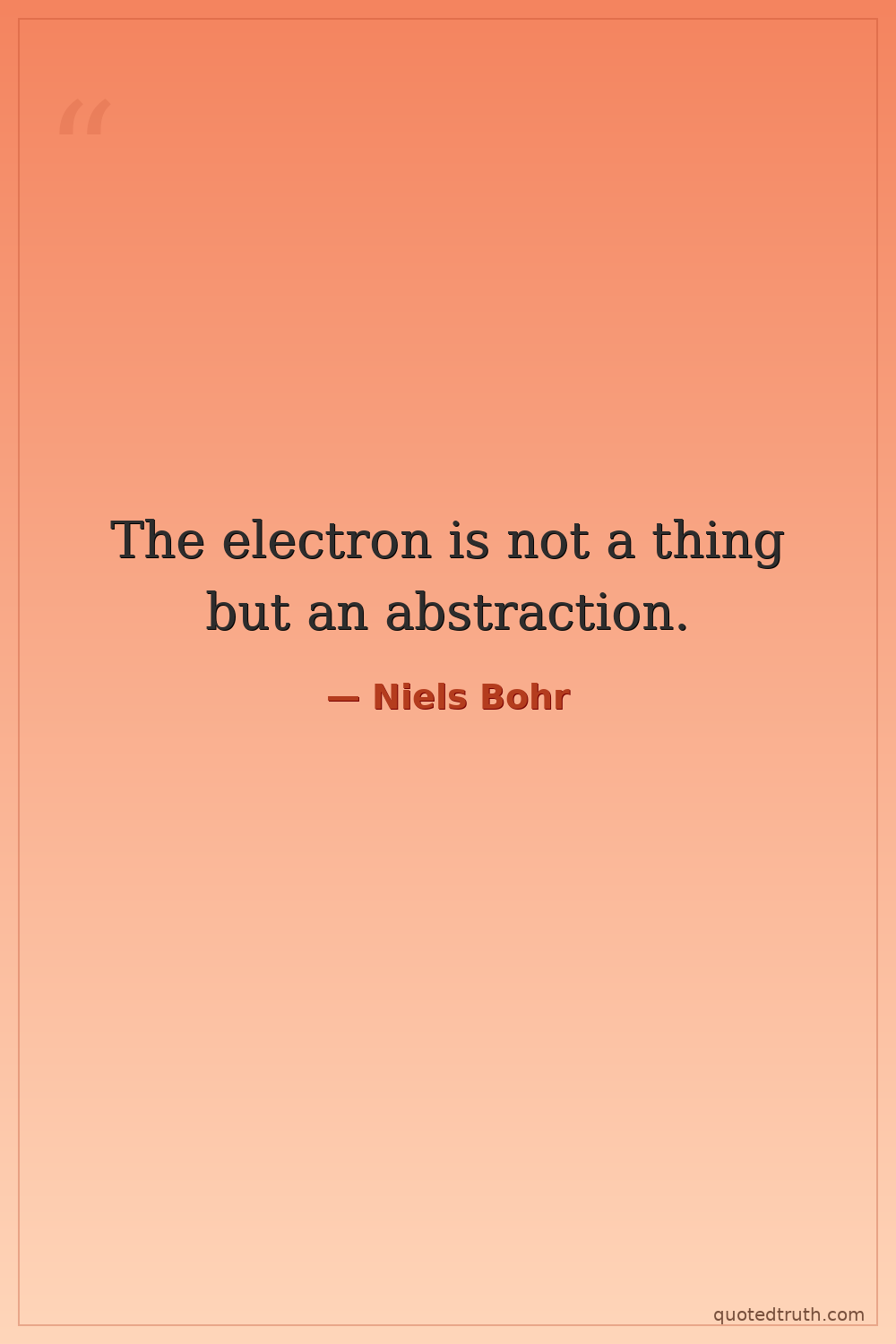
Niels Bohr — "The electron is not a thing but an abstraction."
The electron is not a thing but an abstraction.
The electron is not a thing but an abstraction.
Click any product to generate a realistic preview. Up to 3 at a time.
* Initial load can take up to 90 seconds — revising the preview in another color is nearly instant.
"The role of consciousness in quantum mechanics is still a mystery."
"The fundamental problem of all science is the description of the world."
"The electron is not a 'thing' in the ordinary sense, but a 'tendency to exist'."
"It is not the job of science to tell us how the world is, but what we can say about it."
"Stop telling God what to do with his dice."
From discussions on the wave-particle duality and the nature of quantum entities.
Date: Mid 20th century
GeneralFound in 1 providers: grok
1 source checked
The quote challenges our instinct to treat subatomic particles as concrete, physical objects like tiny billiard balls. Instead, it argues that an electron is a mental construct — a useful mathematical tool we use to describe patterns of behavior and measurement outcomes. Reality at the quantum level doesn't consist of things in the classical sense; it consists of probabilities, interactions, and observations organized through abstraction.
Bohr co-developed the Copenhagen Interpretation, which holds that quantum systems exist as wave functions — not definite states — until observed. He famously debated Einstein over whether particles have real properties independent of observation. His 1913 atomic model replaced physical orbits with quantized energy levels, already treating electron behavior as rule-governed rather than tangible motion. This quote crystallizes his lifelong conviction that quantum concepts are tools for prediction, not portraits of hidden physical reality.
In the early 20th century, physics was undergoing a revolution. Classical Newtonian mechanics — which described a deterministic universe of tangible objects — was being overturned. The 1920s and 1930s saw fierce public debates between Bohr and Einstein about quantum reality. As nuclear science advanced toward atomic weapons, questions about what matter fundamentally is carried both philosophical and political weight. Abstraction wasn't merely academic; it was the conceptual foundation reshaping civilization and warfare.
AI-generated insights based on extensive research and information for context. Factual errors? Email [email protected].
Your cart is empty