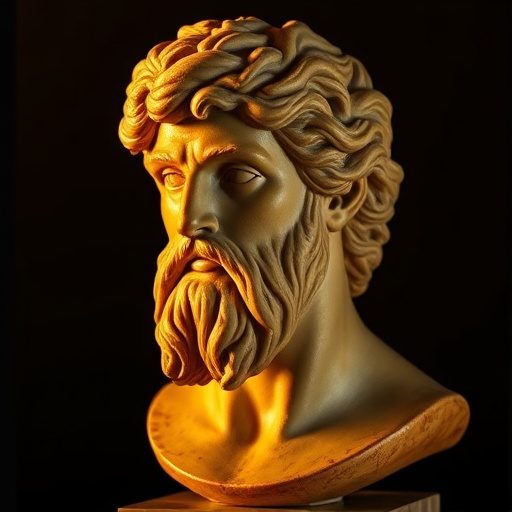
Pythagoras — "Numbers rule the universe."
Numbers rule the universe.
Numbers rule the universe.
Click any product to generate a realistic preview. Up to 3 at a time.
* Initial load can take up to 90 seconds — revising the preview in another color is nearly instant.
"The soul of man is immortal and that it changes into other kinds of animals."
"Sooner throw a pearl at hazard than an idle or useless word; and do not say a little in many words, but a great deal in a few."
"Abstain from the flesh of beasts that die of themselves."
"Declining from the public ways, walk in unfrequented paths."
"Concern should drive us into action and not into a depression. No man is free who is not master of himself."
Greek philosopher and mathematician whose school in Croton combined geometry (the Pythagorean theorem), number-mysticism, and a religious-vegetarian way of life. Closely associated with Thales of Miletus (earlier pre-Socratic and the first philosopher). For an intellectual contrast, see Heraclitus, pre-Socratic Greek philosopher of flux — Heraclitus called Pythagoras 'the chief of swindlers' — among the founding insults of the philosophical-rivalry tradition. Their 'all is flux' vs 'all is number' poles still organize the philosophy of mathematics today (Platonist vs anti-realist).
Found in 3 providers: deepseek,grok,gemini
3 sources checked
Everything in existence can be understood through mathematical relationships. Patterns, ratios, and numerical order govern nature — from planetary orbits to musical harmonics. Reality has an underlying mathematical structure discoverable by human reason. This is not mysticism but the foundational claim that the universe operates by fixed, knowable rules, and that mastering those rules means mastering nature itself. Mathematics is not a human invention — it is the universe's native language.
Pythagoras founded a religious-philosophical brotherhood in Croton where mathematics was treated as sacred practice. He discovered that musical consonance depends on whole-number string-length ratios, directly linking numbers to physical reality. His theorem proved geometric truth follows numerical law. He believed the soul had a mathematical nature and that studying numbers was a path toward divine understanding — making this quote not a metaphor but the literal organizing principle of his life's work.
Around 570–495 BCE, Greek thinkers were abandoning mythological explanations and seeking rational principles underlying nature — the pre-Socratic revolution. Thales argued water was the primal substance; Heraclitus claimed fire. Pythagoras proposed number. Greek city-states were advancing trade, astronomy, and architecture, all demanding practical mathematics. The radical claim that an abstract concept could govern concrete physical reality set the trajectory for Western science and prefigured modern physics by two millennia.
AI-generated insights based on extensive research and information for context. Factual errors? Email [email protected].
Your cart is empty