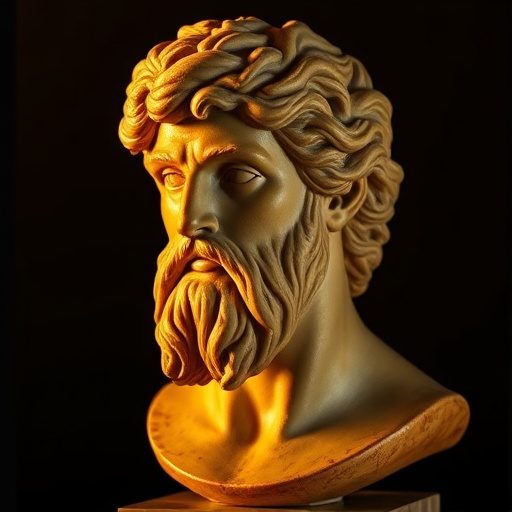
Pythagoras — "Every man has been made by God in order to acquire knowledge and contemplate."
Every man has been made by God in order to acquire knowledge and contemplate.
Every man has been made by God in order to acquire knowledge and contemplate.
Click any product to generate a realistic preview. Up to 3 at a time.
* Initial load can take up to 90 seconds — revising the preview in another color is nearly instant.
"Do not go to bed until you have gone over the day three times in your mind. What wrong did I do? What good did I accomplish? What did I forget to do?"
"Abstain from animals."
"No one is free who has not obtained the empire of himself."
"It is better to be silent than to utter words that are not true."
"Spit upon the parings of your nails, and the clippings of your hair."
Greek philosopher and mathematician whose school in Croton combined geometry (the Pythagorean theorem), number-mysticism, and a religious-vegetarian way of life. Closely associated with Thales of Miletus (earlier pre-Socratic and the first philosopher). For an intellectual contrast, see Heraclitus, pre-Socratic Greek philosopher of flux — Heraclitus called Pythagoras 'the chief of swindlers' — among the founding insults of the philosophical-rivalry tradition. Their 'all is flux' vs 'all is number' poles still organize the philosophy of mathematics today (Platonist vs anti-realist).
A teleological view of human purpose, emphasizing intellectual and spiritual pursuit.
Date: c. 5th Century BCE
PhilosophicalFound in 1 providers: gemini
1 source checked
Human existence has a built-in purpose: to learn and to think carefully about what we learn. We aren't here merely to eat, work, or reproduce. Our defining activity is using the mind to investigate the world and reflect on what it reveals. Knowledge-gathering and sustained contemplation are not hobbies for the lucky few but the core assignment given to every person, regardless of status or circumstance.
Pythagoras founded a school where disciples took vows of silence, studied mathematics, music, and astronomy, and treated inquiry as a spiritual discipline. He believed the soul was purified through intellectual contemplation, and his followers lived communally to pursue it. Crediting God as the source of this mandate fits his theological view that numerical order underlies reality, and that understanding that order brings humans closer to the divine mind that designed it.
In 6th-century BCE Greece, most people worked farms or trades and left thinking to priests and poets reciting Homer. Pythagoras lived as pre-Socratic philosophy was emerging in Ionia and southern Italy, when thinkers first argued the cosmos could be explained through reason rather than myth. Declaring contemplation every person's divine purpose was radical: it dignified intellectual life, challenged aristocratic gatekeeping of wisdom, and helped lay groundwork for the Athenian philosophical tradition that followed.
AI-generated insights based on extensive research and information for context. Factual errors? Email [email protected].
Your cart is empty