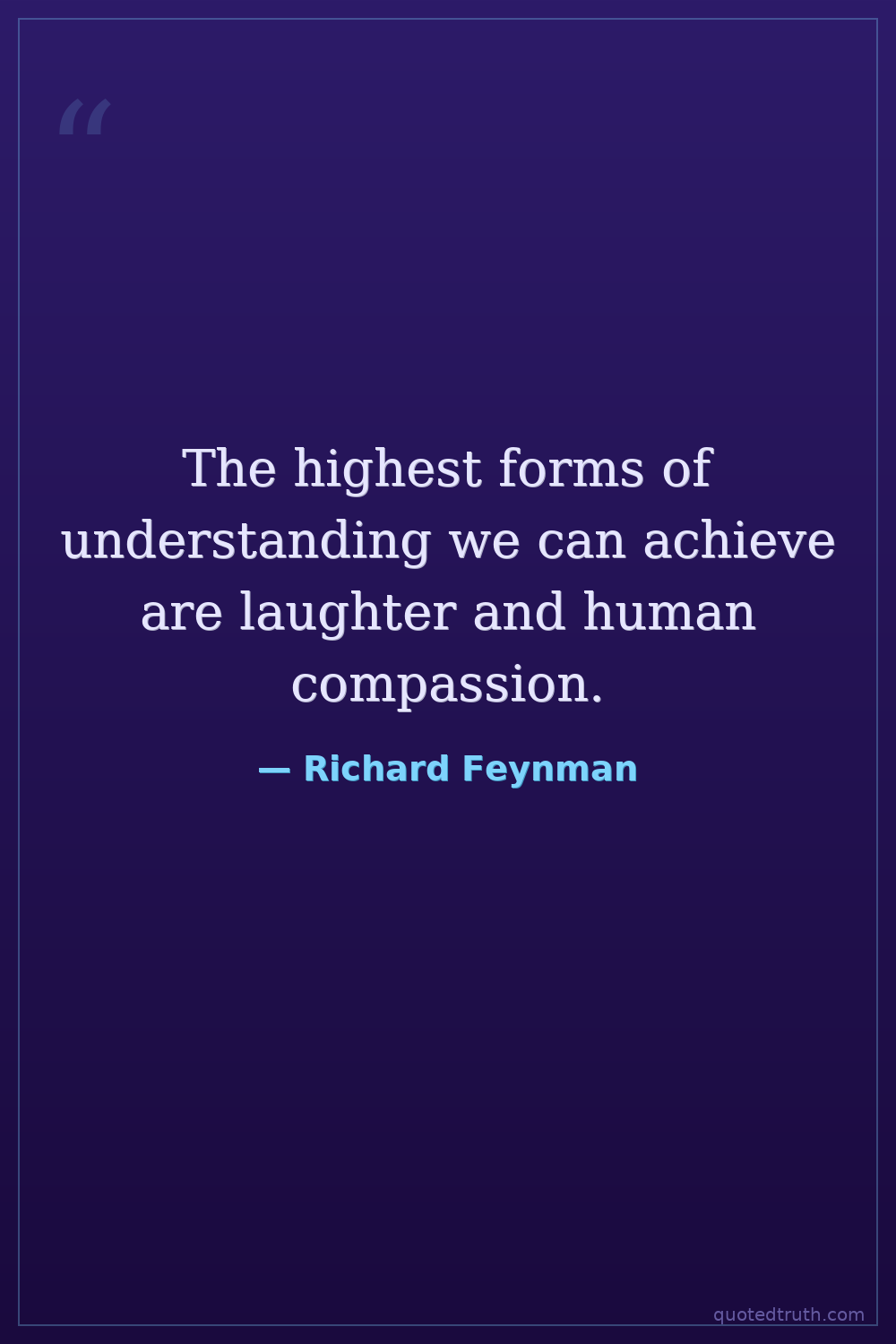
Richard Feynman — "The highest forms of understanding we can achieve are laughter and human compass…"
The highest forms of understanding we can achieve are laughter and human compassion.
The highest forms of understanding we can achieve are laughter and human compassion.
Click any product to generate a realistic preview. Up to 3 at a time.
* Initial load can take up to 90 seconds — revising the preview in another color is nearly instant.
"If you thought that science was certain — well, that is just an error on your part."
"I object to having my fun regulated."
"Yeah, I took the door."
"I actually did not have to learn a thing for my thesis. It was all stuff I already knew."
"I guess I'm just mischievous. I just love to do that to people. Well especially when they're so gleefully happy that it's been going to cost 13 signatures haha."
American theoretical physicist who shared the 1965 Nobel for QED, developed Feynman diagrams, and wrote the Feynman Lectures on Physics. Closely associated with Julian Schwinger (co-Nobelist for QED) and Murray Gell-Mann (Caltech rival and Eightfold-Way physicist). For an intellectual contrast, see Deepak Chopra, physician and quantum-mysticism author — Feynman's Caltech 'cargo cult science' commencement address is the precise template for what he saw as misuse of physics terminology — Chopra-style appropriation of quantum vocabulary for metaphysical claims is the canonical example of what Feynman called 'fooling yourself'.
Found in 1 providers: grok
1 source checked
True understanding isn't cold or abstract — it shows up as laughter, the recognition of absurdity and surprise, and as compassion, the ability to feel another person's reality. Knowing facts or mastering systems isn't the peak of human comprehension; being moved, amused, and genuinely connected to others is. Intellect without warmth is incomplete.
Feynman was a Nobel-winning physicist famous for making quantum electrodynamics rigorous, but equally known for bongo drumming, safe-cracking, and irreverent humor. He taught physics through vivid stories, not authority. His Challenger investigation exposed bureaucratic dishonesty with plain-spoken clarity. His autobiographical books reveal a man who valued curiosity and human connection as deeply as equations.
Feynman worked through the Cold War nuclear age, when science carried immense destructive weight — he'd witnessed Trinity firsthand. Mid-20th-century physics culture prized detached rigor. Against that backdrop, insisting that laughter and compassion outrank formal knowledge was a deliberate humanist counterweight to the era's worship of technical power divorced from moral feeling.
AI-generated insights based on extensive research and information for context. Factual errors? Email [email protected].
Your cart is empty