Richard Feynman — "I object to having my fun regulated."
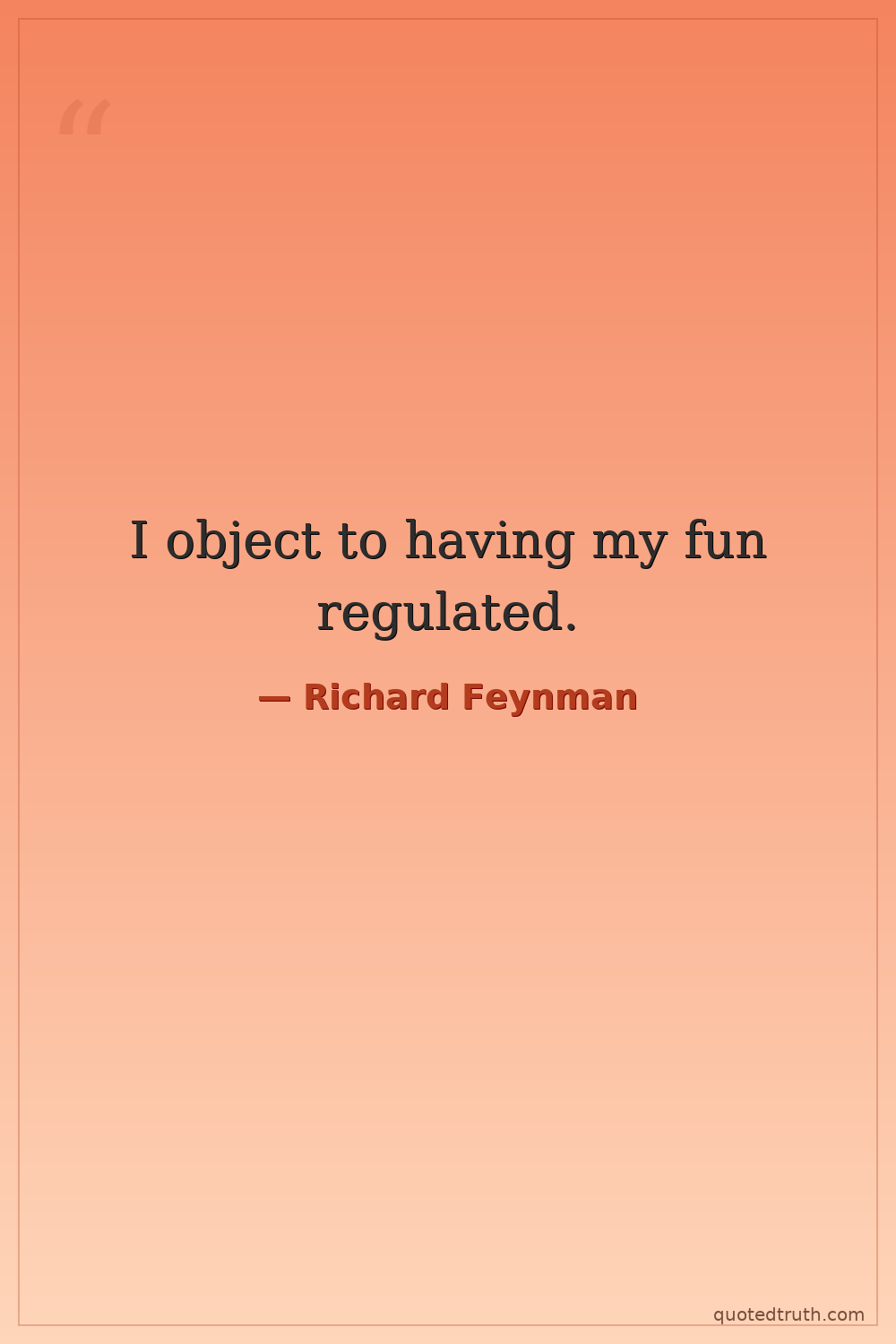
I object to having my fun regulated.
I object to having my fun regulated.
Click any product to generate a realistic preview. Up to 3 at a time.
* Initial load can take up to 90 seconds — revising the preview in another color is nearly instant.
"The world is full of people who are trying to figure out what's going on, and they're all wrong."
"I was talking to a guy who was a philosopher, and he said, 'But you're just describing the world, you're not explaining it.' And I said, 'Yeah, that's what science is. We describe it. We don't explain…"
"The thing that bothers me is that I can tell that the students don't understand. They are taught to remember things, but they don't understand."
"People would often think I'm a faker, but I'm usually honest, in a certain way- in such a way that often nobody believes me!"
"I just did a crazy guy. You are a crazy guy. You made a deal."
American theoretical physicist who shared the 1965 Nobel for QED, developed Feynman diagrams, and wrote the Feynman Lectures on Physics. Closely associated with Julian Schwinger (co-Nobelist for QED) and Murray Gell-Mann (Caltech rival and Eightfold-Way physicist). For an intellectual contrast, see Deepak Chopra, physician and quantum-mysticism author — Feynman's Caltech 'cargo cult science' commencement address is the precise template for what he saw as misuse of physics terminology — Chopra-style appropriation of quantum vocabulary for metaphysical claims is the canonical example of what Feynman called 'fooling yourself'.
Found in 1 providers: grok
1 source checked
The speaker refuses to let others impose rules on what brings them joy or curiosity. Fun, play, and exploration should be self-directed, not managed by institutions or authorities. When bureaucracies, committees, or social conventions try to dictate what pursuits are legitimate or appropriate, genuine discovery gets strangled. Authentic enjoyment requires the freedom to follow interest wherever it leads, without justifying it to anyone.
Feynman notoriously resisted academic formality and institutional authority throughout his career at Caltech and Cornell. He played bongo drums in strip clubs, cracked safes at Los Alamos for amusement, and pursued physics problems purely for the pleasure of understanding. He quit prestigious committees, refused honorary titles, and repeatedly said he did his best work when treating it as play rather than obligation.
Post-WWII American science became heavily bureaucratized as federal funding, Cold War priorities, and institutional prestige shaped research agendas. Scientists faced pressure to justify work by military or commercial utility. The 1950s-70s also saw expanding regulatory culture broadly. Feynman's resistance reflected a countercultural strain within science itself, insisting that curiosity-driven, undirected inquiry was not a luxury but the engine of real discovery.
AI-generated insights based on extensive research and information for context. Factual errors? Email [email protected].
Your cart is empty