What it means
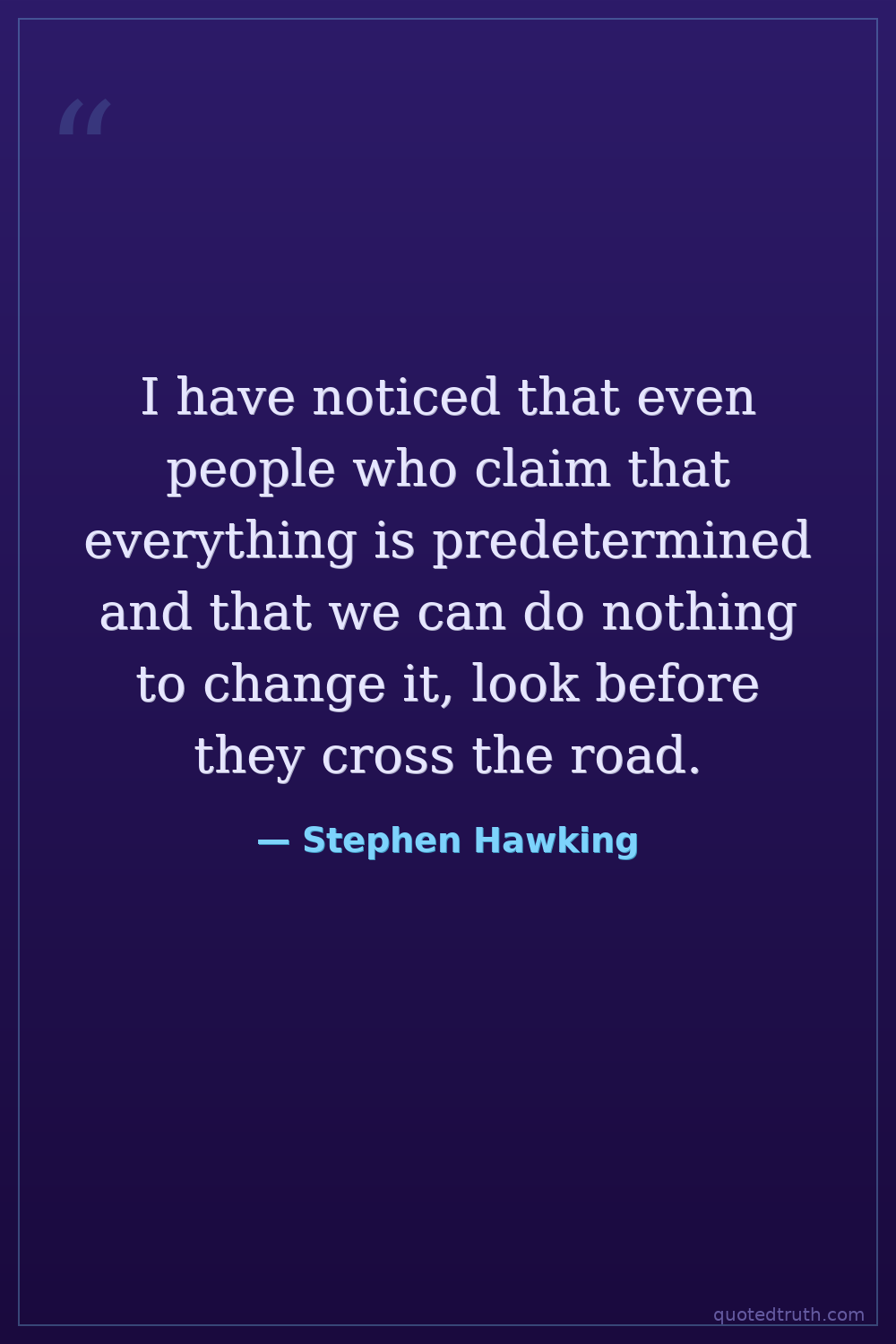
People who theorize that fate controls everything still instinctively act as if their choices matter — they look both ways before crossing a street. The quote exposes a contradiction between philosophical determinism and lived behavior. If outcomes were truly fixed, caution would be pointless. The act of checking for traffic reveals that even committed fatalists trust their actions can alter what happens to them.
Relevance to Stephen Hawking
Hawking operated at physics' frontier, where determinism is a genuine scientific question — quantum mechanics, thermodynamics, and cosmology all grapple with it. Despite his own body's total imprisonment by ALS, he never surrendered agency intellectually, continuing to produce, travel, and provoke. His wit here mirrors his life: acknowledging constraints while refusing to stop acting. The observation is both philosophical argument and self-portrait.
The era
Hawking flourished during late 20th-century debates over free will, fueled by advances in neuroscience, computing, and quantum physics. Deterministic thinking was gaining cultural ground as brain-scanning technology suggested decisions precede conscious awareness. Meanwhile, religious fatalism remained widespread globally. Hawking's quip cuts across both secular and religious camps, using an everyday image — crossing a road — to deflate grand claims about human powerlessness.
AI-generated insights based on extensive research and information for context. Factual errors? Email [email protected].