Stephen Hawking — "So my friend tried to call me the other week... but all he was getting was an au…"
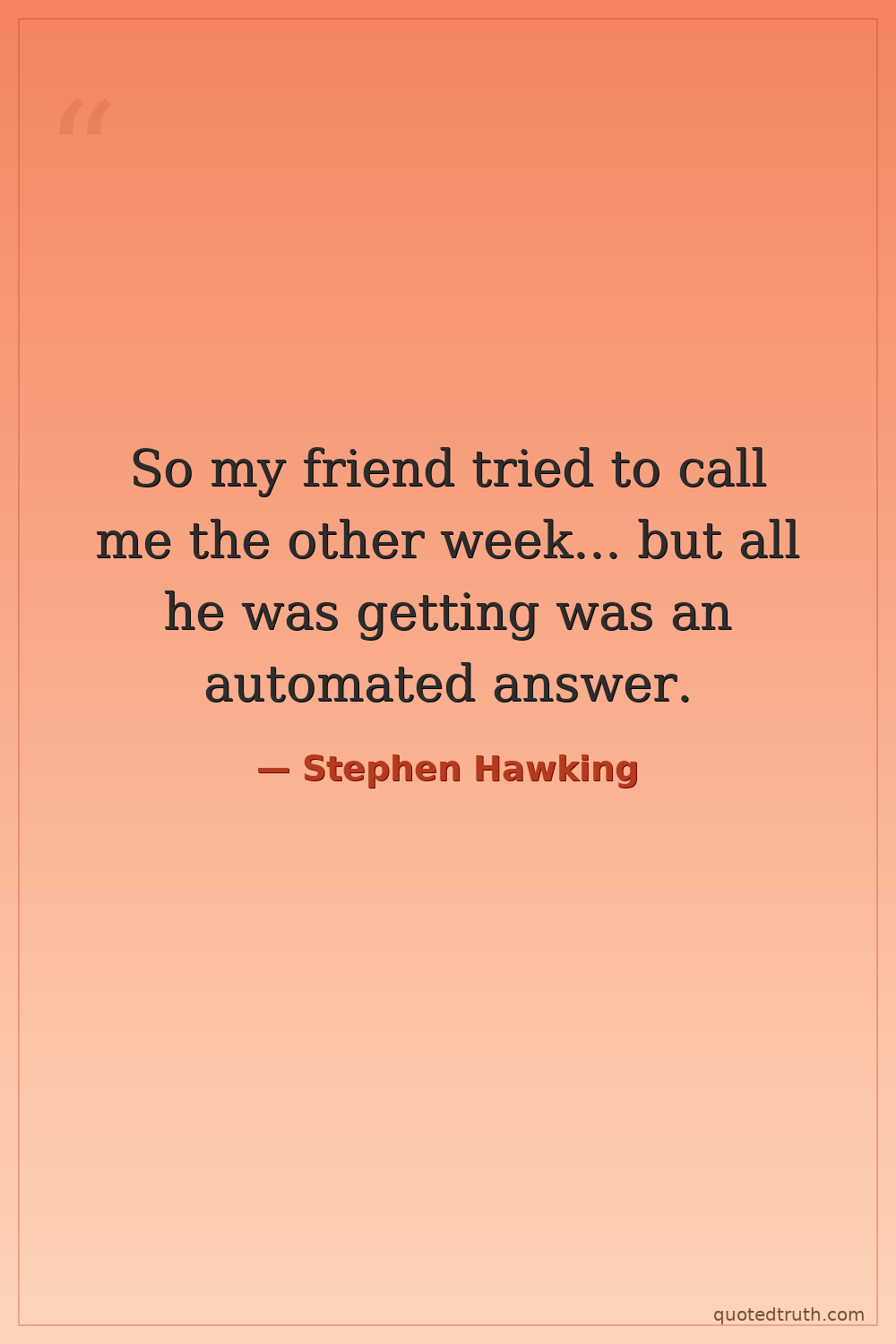
So my friend tried to call me the other week... but all he was getting was an automated answer.
So my friend tried to call me the other week... but all he was getting was an automated answer.
Click any product to generate a realistic preview. Up to 3 at a time.
* Initial load can take up to 90 seconds — revising the preview in another color is nearly instant.
"There are no unique, independent, isolated events. Everything is connected to everything else."
"It is a matter of common sense to take a method and try it. If it fails, admit it frankly and try another. But above all, try something."
"The universe is a grand design, but it's not designed by a grand designer."
"I have lived with the prospect of an early death for the last 49 years. I'm not afraid of death, but I'm in no hurry to die. I have so much I want to do first."
"In the proof stage, I nearly cut that last sentence of the book. Had I done so, the sales might have been halved."
British theoretical physicist whose Hawking radiation work and A Brief History of Time (1988) brought black-hole physics to a mass audience while he lived with ALS for 55 years. Closely associated with Roger Penrose (his collaborator on singularity theorems) and Carl Sagan (fellow popularizer who wrote Brief History's foreword). For an intellectual contrast, see William Lane Craig, American philosopher of religion — Craig's Kalam cosmological argument depends on the Big Bang requiring a divine first cause; Hawking's no-boundary proposal was specifically designed to remove the moment that would require one — the cleanest cosmology-vs-natural-theology contrast in modern thought.
Found in 1 providers: gemini
1 source checked
This is a self-deprecating joke built on a double meaning. Hawking's friend called and kept hearing what sounded like an automated phone system — but it was actually Hawking himself responding through his computerized speech synthesizer. The humor turns on the irony that his assistive communication device, a robotic text-to-speech voice, was indistinguishable from the impersonal automated answering systems that had become a fixture of everyday life.
Hawking developed ALS in his early twenties, progressively losing motor function and eventually his natural voice after a 1985 tracheotomy. He communicated using a speech synthesizer — a flat, robotic American-accented voice that became one of the most recognizable sounds in science. Despite severe physical disability, Hawking was celebrated for sharp wit and self-deprecating humor, regularly joking about his condition in interviews, television appearances, and public lectures.
By the 1980s and 1990s, automated phone answering systems — IVR technology — had become a defining irritant of modern life, greeting callers with robotic voices before routing them through endless menus. Hawking received his first speech synthesizer in 1986, built on that same era's text-to-speech technology. The joke draws a pointed parallel between soulless corporate phone systems and the machine voice that became his sole means of human communication.
AI-generated insights based on extensive research and information for context. Factual errors? Email [email protected].
Your cart is empty