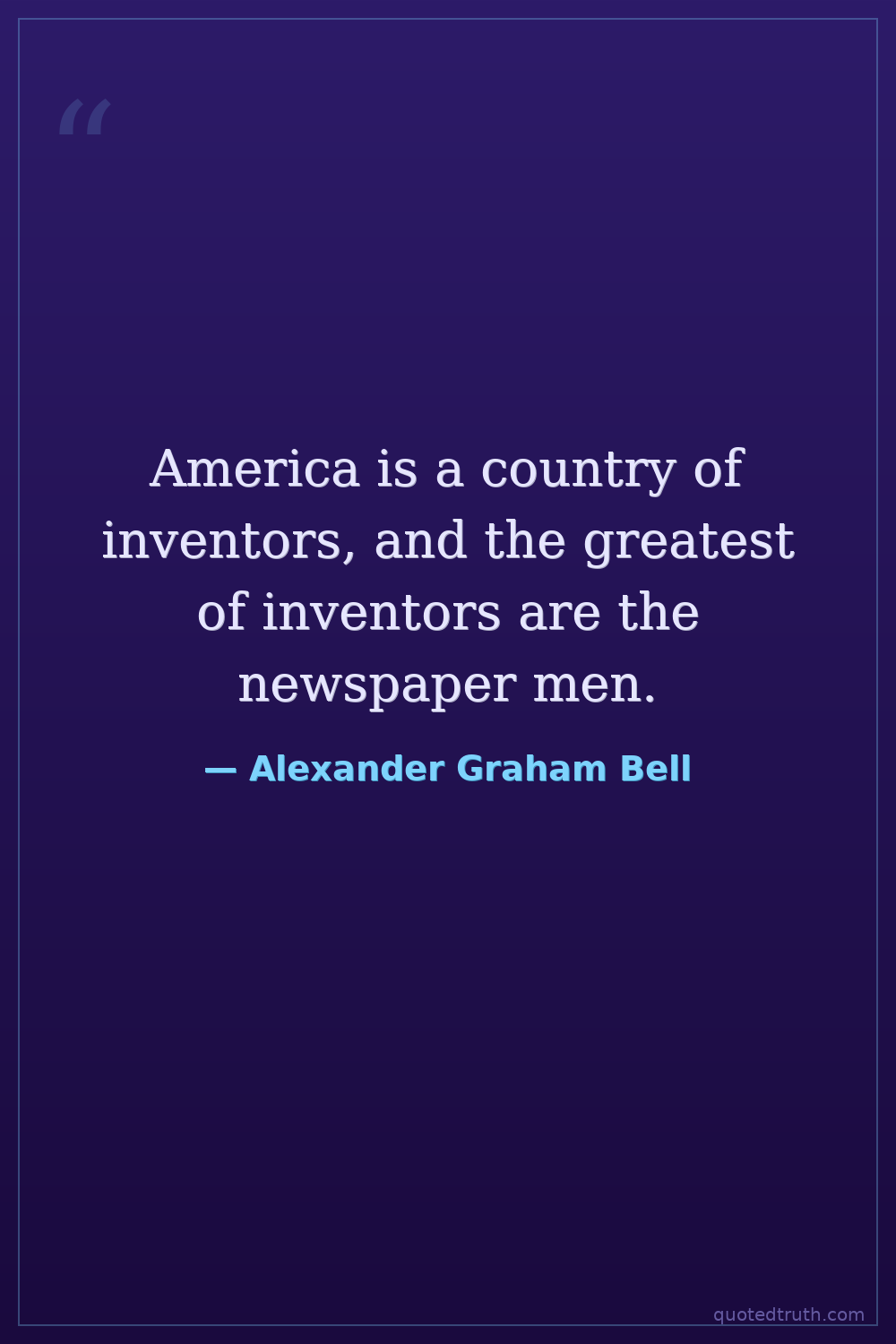
Alexander Graham Bell — "America is a country of inventors, and the greatest of inventors are the newspap…"
America is a country of inventors, and the greatest of inventors are the newspaper men.
America is a country of inventors, and the greatest of inventors are the newspaper men.
Click any product to generate a realistic preview. Up to 3 at a time.
* Initial load can take up to 90 seconds — revising the preview in another color is nearly instant.
"The day will come when the man at the telephone will be able to see the distant person to whom he is speaking."
"The deaf should not intermarry."
"The most important thing for a man to do is to be true to himself."
"Leave the beaten track occasionally and dive into the woods. Every time you do so you will be certain to find something that you have never seen before."
"The most successful men in the end are those whose success is the result of steady accretion."
Found in 1 providers: deepseek
1 source checked
Bell is celebrating America's inventive spirit while making a pointed observation: newspaper journalists don't merely report events, they construct narratives and shape how people understand the world. Calling them inventors elevates the press as a creative force, arguing that crafting compelling stories about reality requires genuine ingenuity comparable to building machines. There is likely an ironic edge — newspapers often distorted or fabricated stories rather than simply inventing ideas.
Bell patented the telephone in 1876 after bitter competition with Elisha Gray, and newspapers both lionized and misrepresented his work throughout those patent wars. He understood firsthand how press narratives determined which inventors became legends. As a man obsessed with communication technology, Bell recognized that spreading information was itself a form of invention — and he was wary of journalists who invented convenient facts alongside legitimate stories.
The late 19th century was the golden age of American newspapers — Hearst and Pulitzer's empires defined yellow journalism while mass-circulation papers reached millions. Invention was national mythology, and Edison, Bell, and Tesla became folk heroes largely because the press made them so. Newspapers held enormous power to canonize or erase inventors, sensationalize patent disputes, and frame technological progress for a public hungry for stories of American ingenuity and industrial triumph.
AI-generated insights based on extensive research and information for context. Factual errors? Email [email protected].
Your cart is empty