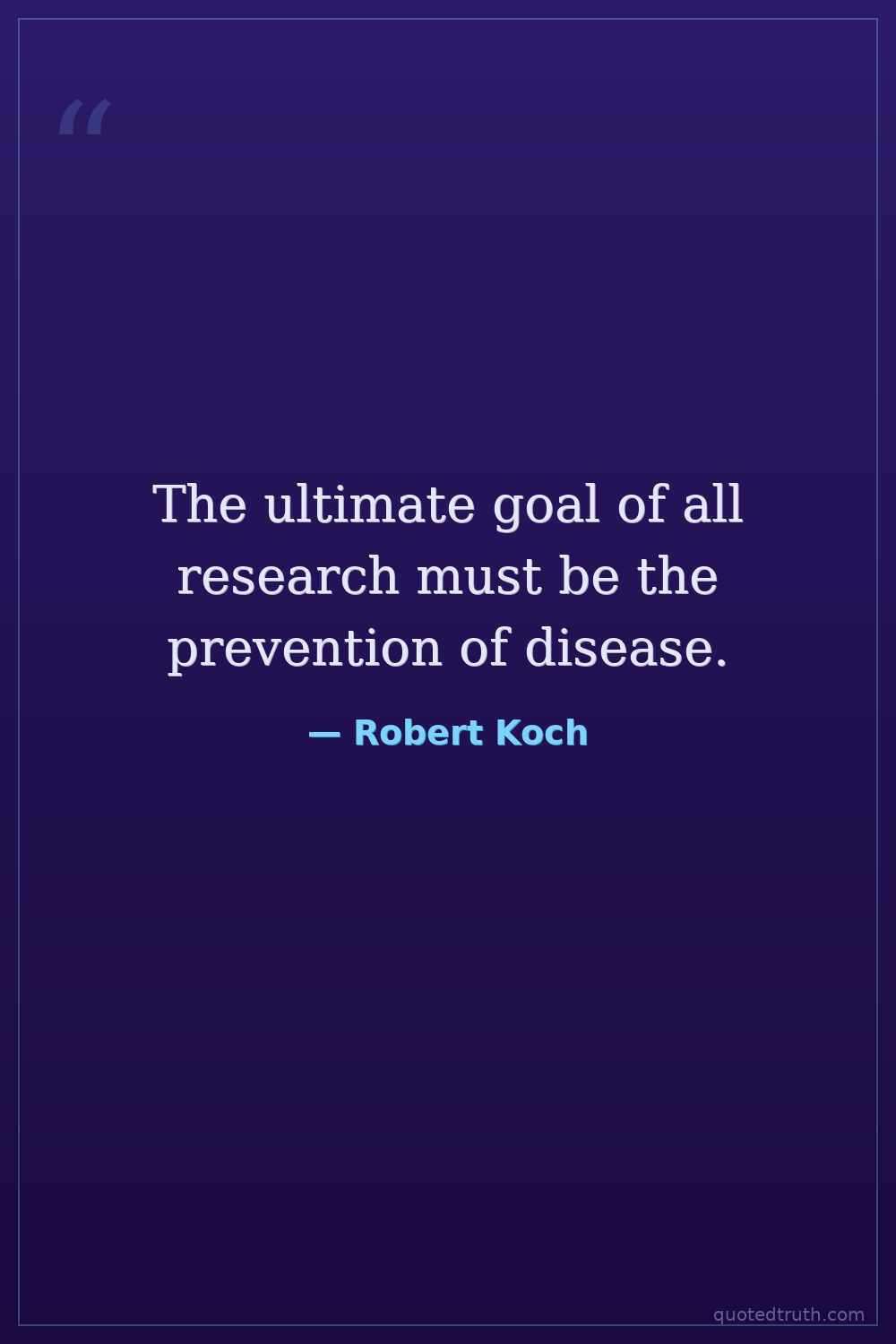
Robert Koch — "The ultimate goal of all research must be the prevention of disease."
The ultimate goal of all research must be the prevention of disease.
The ultimate goal of all research must be the prevention of disease.
Click any product to generate a realistic preview. Up to 3 at a time.
* Initial load can take up to 90 seconds — revising the preview in another color is nearly instant.
"The role of bacteria in disease was a revolutionary concept at the time."
"The battle against infectious diseases is a continuous one."
"The prevention of disease is far more important than its cure."
"My work has shown that specific microorganisms cause specific diseases."
"It is a great responsibility to be a physician, for upon us depends the health of the community."
Found in 1 providers: grok
1 source checked
Scientific research has no purpose if it only produces knowledge — its worth lies in eliminating suffering before it begins. Prevention ranks above cure: stopping a disease from reaching people entirely is more valuable than treating them afterward. This reframes science as a moral project aimed at human welfare, not abstract discovery. The endpoint isn't a published paper or a diagnostic tool, but a world where fewer people get sick at all.
Koch identified the bacteria behind tuberculosis in 1882, cholera in 1883, and anthrax before that, pioneering germ theory when most doctors still blamed foul air. His four postulates were designed to prove causation — not as intellectual exercise but as a foundation for targeted intervention. Having watched TB kill one in seven Europeans, Koch saw discovery as only the first step; the real obligation was turning that knowledge into tools that stopped transmission entirely.
Koch worked as infectious disease killed millions annually across industrializing Europe. Tuberculosis alone claimed one in seven deaths; cholera swept cities in waves. Germ theory had just replaced miasma theory, meaning disease causation was barely understood. Crowded factory cities and contaminated water systems made epidemics routine. The notion that science could systematically prevent illness — rather than merely observe or treat it — was genuinely new and powered the sanitation movement, public health boards, and early vaccines.
AI-generated insights based on extensive research and information for context. Factual errors? Email [email protected].
Your cart is empty