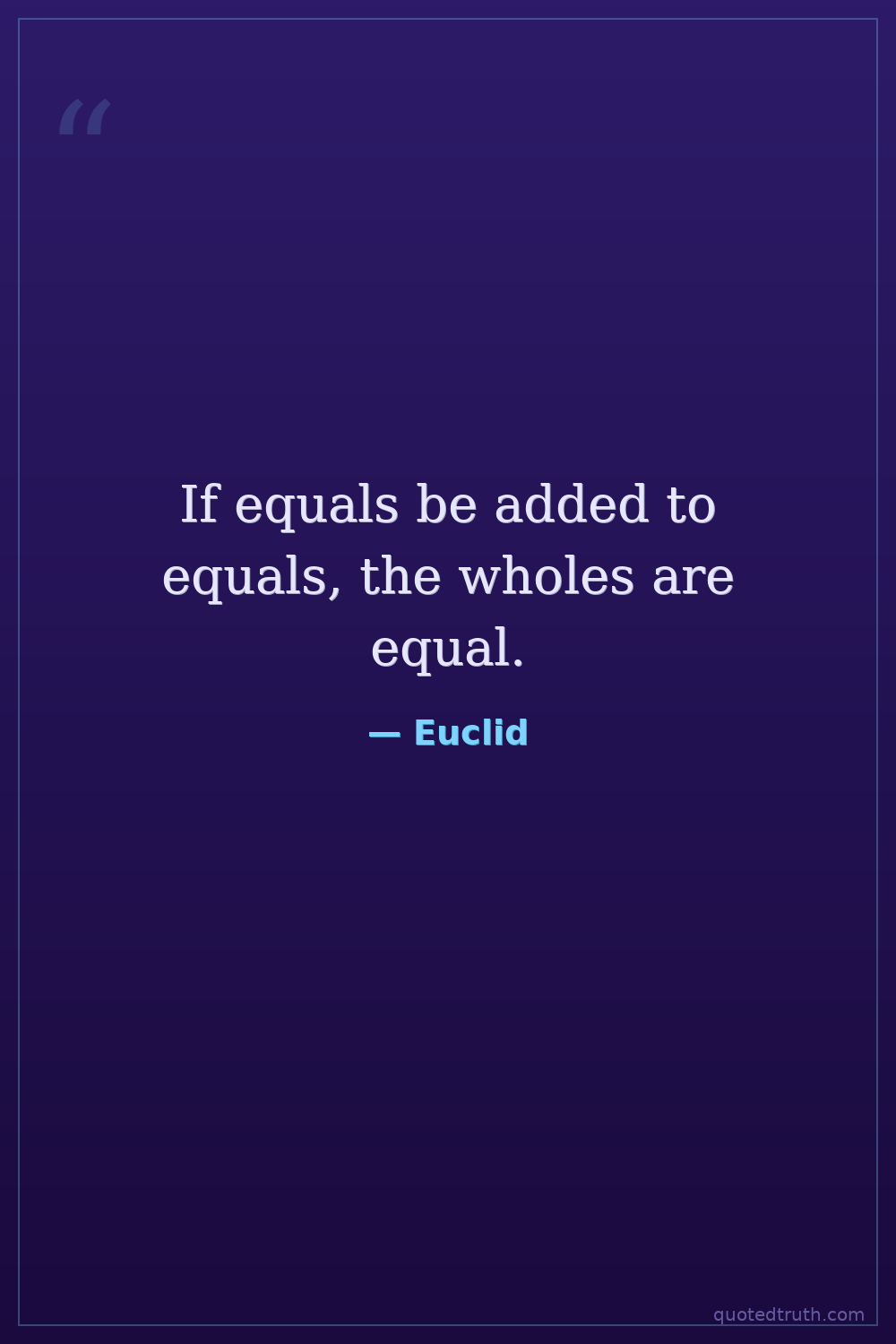
Euclid — "If equals be added to equals, the wholes are equal."
If equals be added to equals, the wholes are equal.
If equals be added to equals, the wholes are equal.
Click any product to generate a realistic preview. Up to 3 at a time.
* Initial load can take up to 90 seconds — revising the preview in another color is nearly instant.
"To construct a regular pentagon in a given circle."
"For the things of the world cannot be made manifest without the knowledge of mathematics."
"A plane surface is a surface which lies evenly with the straight lines on itself."
"If a straight line fall on two parallel straight lines, it makes the alternate angles equal to one another, the exterior angle equal to the interior and opposite angle, and the interior angles on the …"
"A ratio is a sort of relation in respect of size between two magnitudes of the same kind."
Found in 3 providers: grok,deepseek,gemini
3 sources checked
When you add the same amount to two already-equal quantities, the results remain equal. Equality is preserved through identical operations. This is a foundational logical principle: fairness and balance maintained through consistent treatment. It underpins arithmetic, algebra, and formal reasoning — if two things start the same and receive the same, they end the same.
Euclid codified this as Common Notion 2 in his Elements, the axiomatic system he constructed around 300 BCE. Rather than accepting mathematical truths informally, Euclid insisted every conclusion follow from explicit axioms. This quote embodies his core mission: build all of geometry on irrefutable, self-evident starting points, leaving nothing assumed.
In ancient Alexandria under Ptolemaic rule, Greek intellectual culture demanded rigorous argumentation over intuition. Euclid worked at the Library of Alexandria during a period of unprecedented knowledge synthesis. Mathematics was philosophy — proving things beyond doubt mattered deeply. His axiomatic method directly responded to Platonic ideals of absolute truth and influenced every formal system that followed.
AI-generated insights based on extensive research and information for context. Factual errors? Email [email protected].
Your cart is empty