Euclid — "A ratio is a sort of relation in respect of size between two magnitudes of the s…"
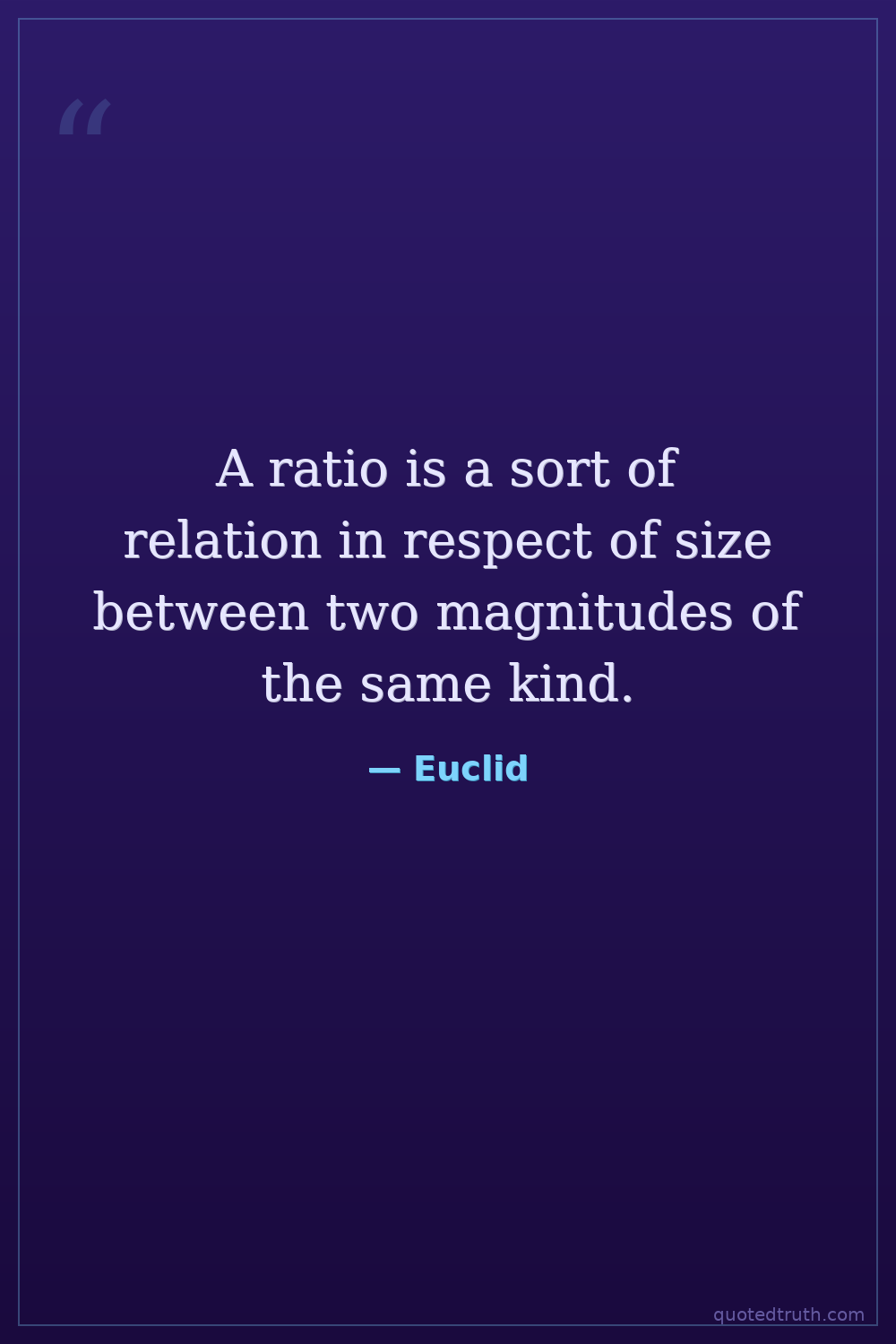
A ratio is a sort of relation in respect of size between two magnitudes of the same kind.
A ratio is a sort of relation in respect of size between two magnitudes of the same kind.
Click any product to generate a realistic preview. Up to 3 at a time.
* Initial load can take up to 90 seconds — revising the preview in another color is nearly instant.
"The elements of geometry are derived from a small set of axioms and postulates."
"If a straight line be cut in extreme and mean ratio, the greater segment is also cut in extreme and mean ratio by the lesser segment."
"And that, if a straight line falling on two straight lines make the interior angles on the same side less than two right angles, the two straight lines, if produced indefinitely, meet on that side on …"
"If a straight line be drawn from the ends of a straight line, it will be a triangle."
"A plane angle is the inclination of the lines to one another, when two lines meet one another, but are not in the same straight line."
Found in 1 providers: grok
1 source checked
A ratio captures how two comparable quantities relate to each other in size — not their individual values, but their proportional relationship. If one line is twice another, that relationship of twofold is the ratio. It only works between things of the same type: lengths to lengths, areas to areas. The concept strips away units and focuses purely on relative magnitude.
Euclid wrote this in Book V of the Elements, building on Eudoxus's theory of proportion. As a systematic geometer, Euclid needed ratios to compare incommensurable magnitudes like the diagonal and side of a square — quantities that share no common unit. His precise definition was foundational to rigorous geometric proof rather than mere intuition.
Greek mathematics around 300 BCE grappled with the crisis of irrational numbers, discovered when Pythagoreans found that √2 cannot be expressed as a fraction. Euclid's careful definition of ratio sidestepped this by avoiding explicit numbers entirely, instead treating proportion geometrically — a brilliant workaround that kept Greek mathematics coherent for nearly two millennia.
AI-generated insights based on extensive research and information for context. Factual errors? Email [email protected].
Your cart is empty