What it means
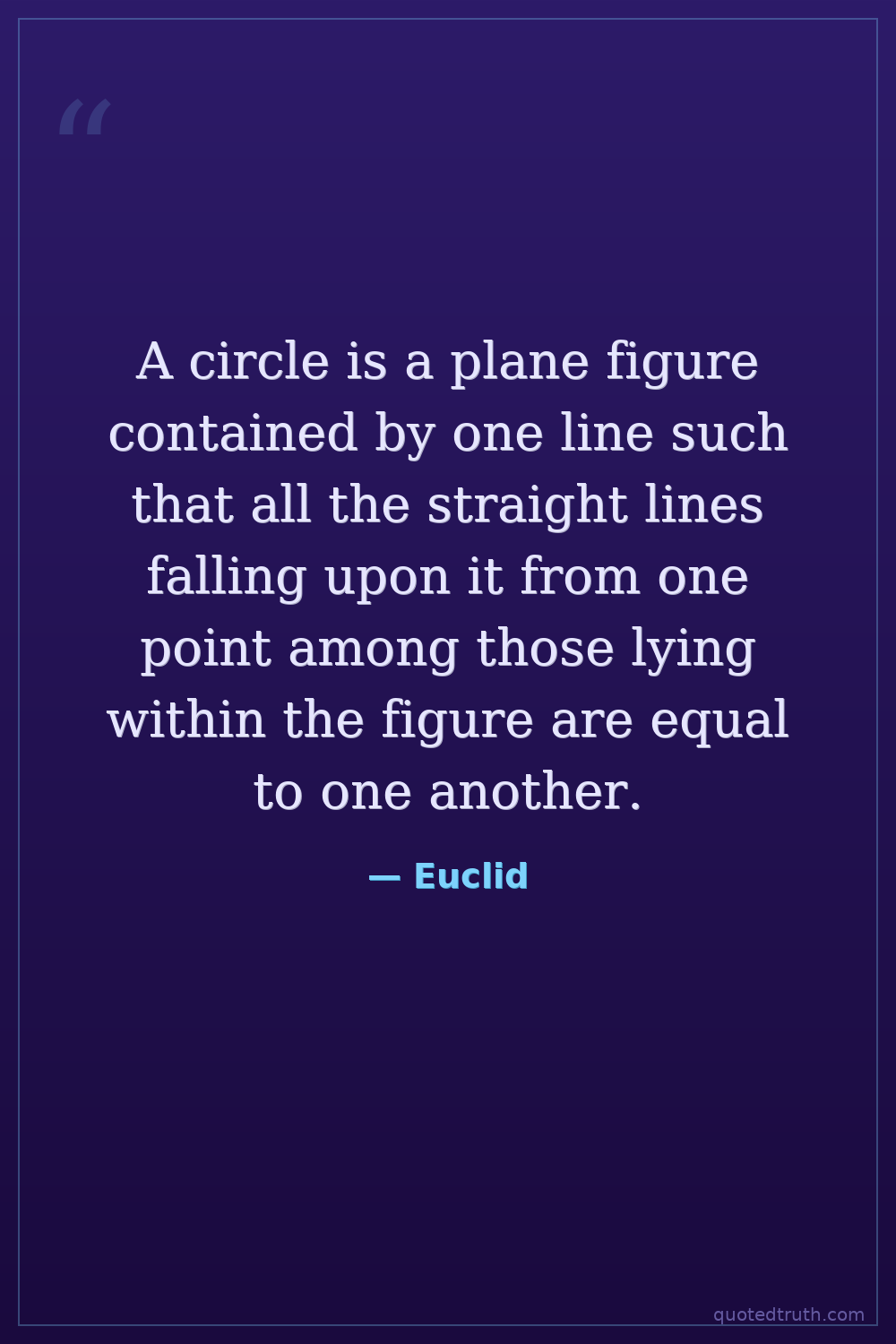
A circle is defined by one continuous boundary where every point sits exactly the same distance from a single interior point — the center. This equal-distance constraint, not mere roundness, is what mathematically constitutes a circle. Every modern circle formula derives from this single rule. Euclid strips the concept down to its irreducible logical core: one line, one center, uniform radius throughout.
Relevance to Euclid
Euclid (~300 BCE) spent his career in Alexandria transforming inherited mathematical knowledge into a logically airtight system. His 'Elements' opens with precise definitions like this one because every proof rests on them. This reflects his core belief: geometry must begin from language so exact that no ambiguity survives. The father of axiomatic proof understood that sloppy definitions produce sloppy mathematics. His work stood as the definitive geometry text for over 2,000 years.
The era
Around 300 BCE, Alexandria was the Mediterranean's intellectual capital under Ptolemy I. Egyptian and Babylonian mathematicians had used circles practically — in astronomy, architecture, land surveying — for millennia, but without formal proof. Plato's Academy had elevated geometry into philosophy, seeking eternal truths through pure reason. Euclid's rigorous definitions responded directly: in an era debating what constitutes real knowledge, his axiomatic method declared mathematics would be built on unambiguous logical foundations, not intuition alone.
AI-generated insights based on extensive research and information for context. Factual errors? Email [email protected].