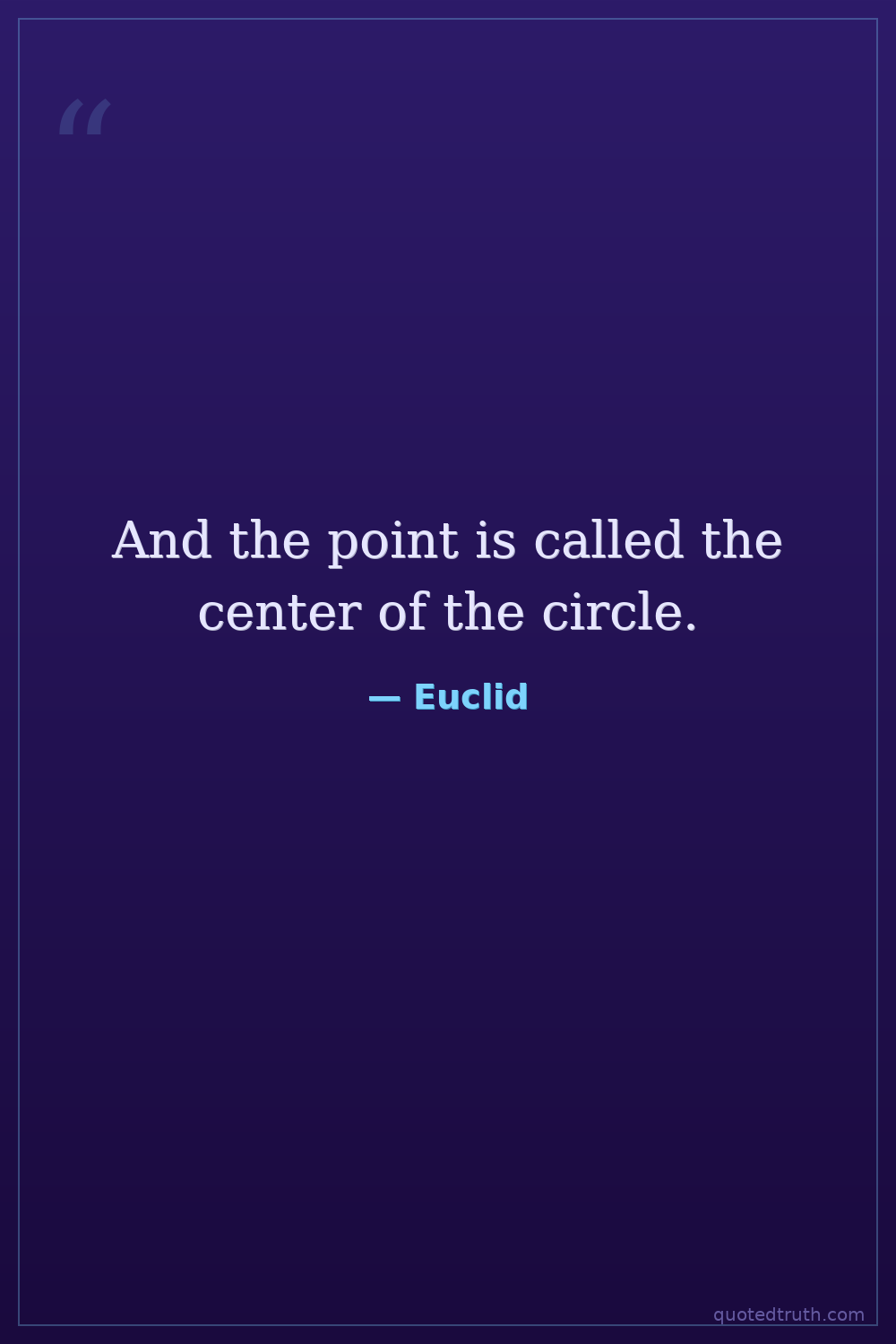
Euclid — "And the point is called the center of the circle."
And the point is called the center of the circle.
And the point is called the center of the circle.
Click any product to generate a realistic preview. Up to 3 at a time.
* Initial load can take up to 90 seconds — revising the preview in another color is nearly instant.
"The greatest common divisor of two numbers can be found by successive division."
"A straight line is a line which lies evenly with the points on itself."
"To draw a straight line from any point to any point."
"If a straight line touch a circle, and from the point of contact there be drawn across in the circle a straight line cutting the circle, the angles which it makes with the tangent will be equal to the…"
"And the greater is a multiple of the less when it is measured by the less."
Found in 2 providers: deepseek,grok
2 sources checked
Every circle has a single fixed point from which all boundary points are equally distant — this is the center. The statement is a geometric definition, not a metaphor, but it conveys something deeper: complex shapes become comprehensible through their most essential reference point. It represents the mathematical idea that clarity comes from naming the irreducible core of any structure, making the abstract precise and the precise universal.
This line appears verbatim in Euclid's Elements, Book I, among his foundational definitions. Euclid's entire method rested on defining terms precisely before constructing proofs — he trusted that mathematics built from clear definitions would stand forever. He worked at Alexandria's Museum under Ptolemy I, and reportedly told the king there was no royal road to geometry. The center of the circle exemplifies his conviction that truth requires exact language, not approximation.
Around 300 BCE, Alexandria under Ptolemy I was the intellectual capital of the Mediterranean world. The great Library and Museum attracted scholars across disciplines. Greek philosophy, particularly Platonic thought, held that mathematical forms were eternal truths underlying all reality. Euclid systematized centuries of fragmented geometric knowledge into one logical structure. Naming the circle's center was part of making geometry teachable, universal, and immune to cultural bias — mathematics as humanity's shared language.
AI-generated insights based on extensive research and information for context. Factual errors? Email [email protected].
Your cart is empty