What it means
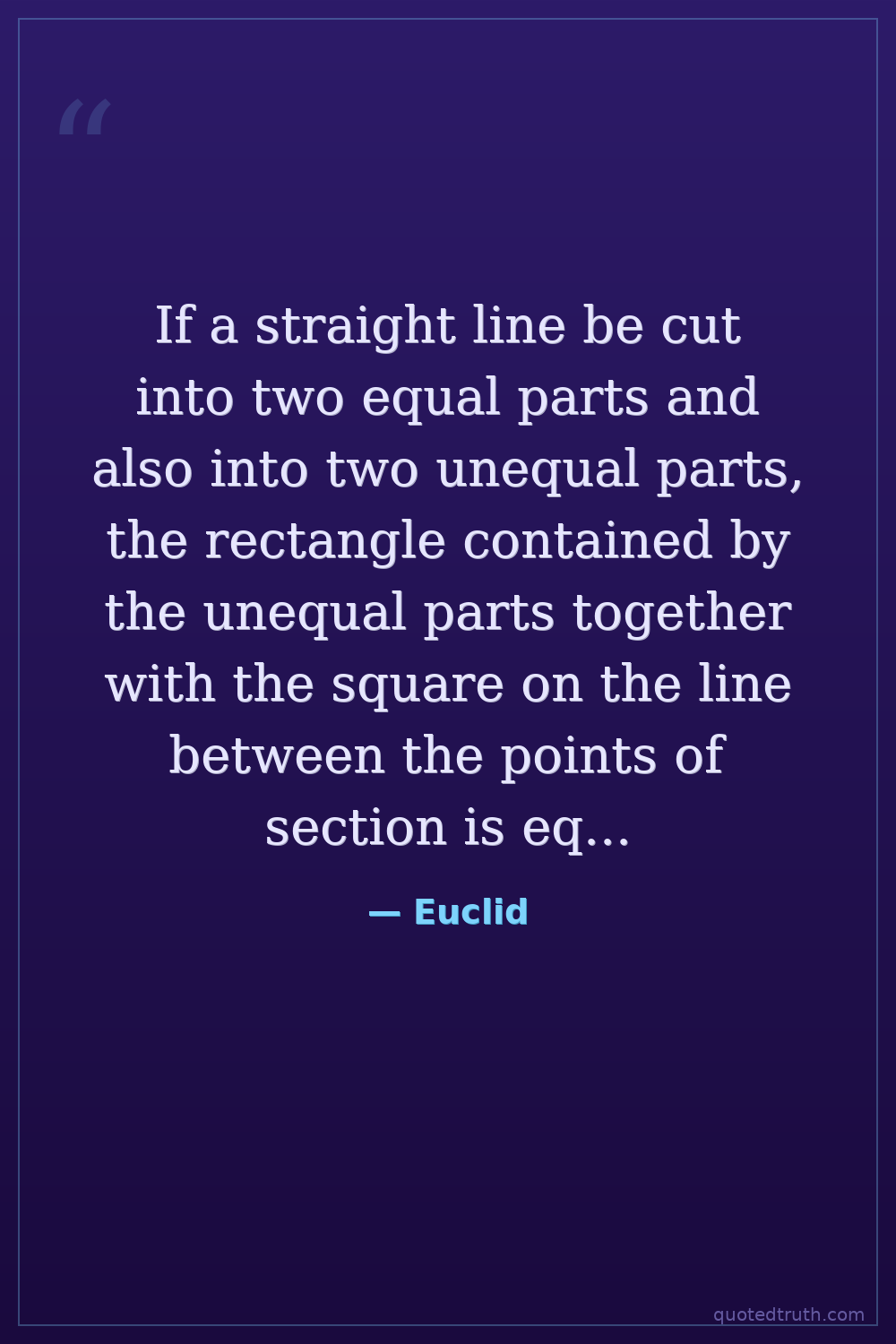
This describes what modern algebra writes as (a+b)(a-b) + b² = a². A line divided at its midpoint and also at a second point creates a rectangle from the two unequal segments and a square from the gap between the two cut-points. Their combined areas always equal the square built on the half-line. Euclid proves an algebraic identity through pure geometry, using only areas and lengths, with no symbols or variables.
Relevance to Euclid
Euclid (~300 BCE) systematized Greek mathematics in the Elements into rigorous logical proofs. This proposition reflects his core method: expressing what we now call algebraic identities purely as geometric area relationships, because symbolic algebra did not yet exist. His teaching in Alexandria and the famous remark that there is no royal road to geometry confirm his conviction that mathematics demands careful, stepwise reasoning — exactly what this meticulous proposition embodies.
The era
Around 300 BCE, Alexandria under Ptolemy I was the Mediterranean world's intellectual hub, home to its great Library. Mathematics was entirely geometric — Babylonians had solved quadratic problems using area models, and Greeks formalized this into proof. No symbolic algebra existed, so relationships between quantities had to be demonstrated through shapes. This proposition gave architects, astronomers, and engineers a rigorous tool for solving proportion and measurement problems central to construction and commerce.
AI-generated insights based on extensive research and information for context. Factual errors? Email [email protected].