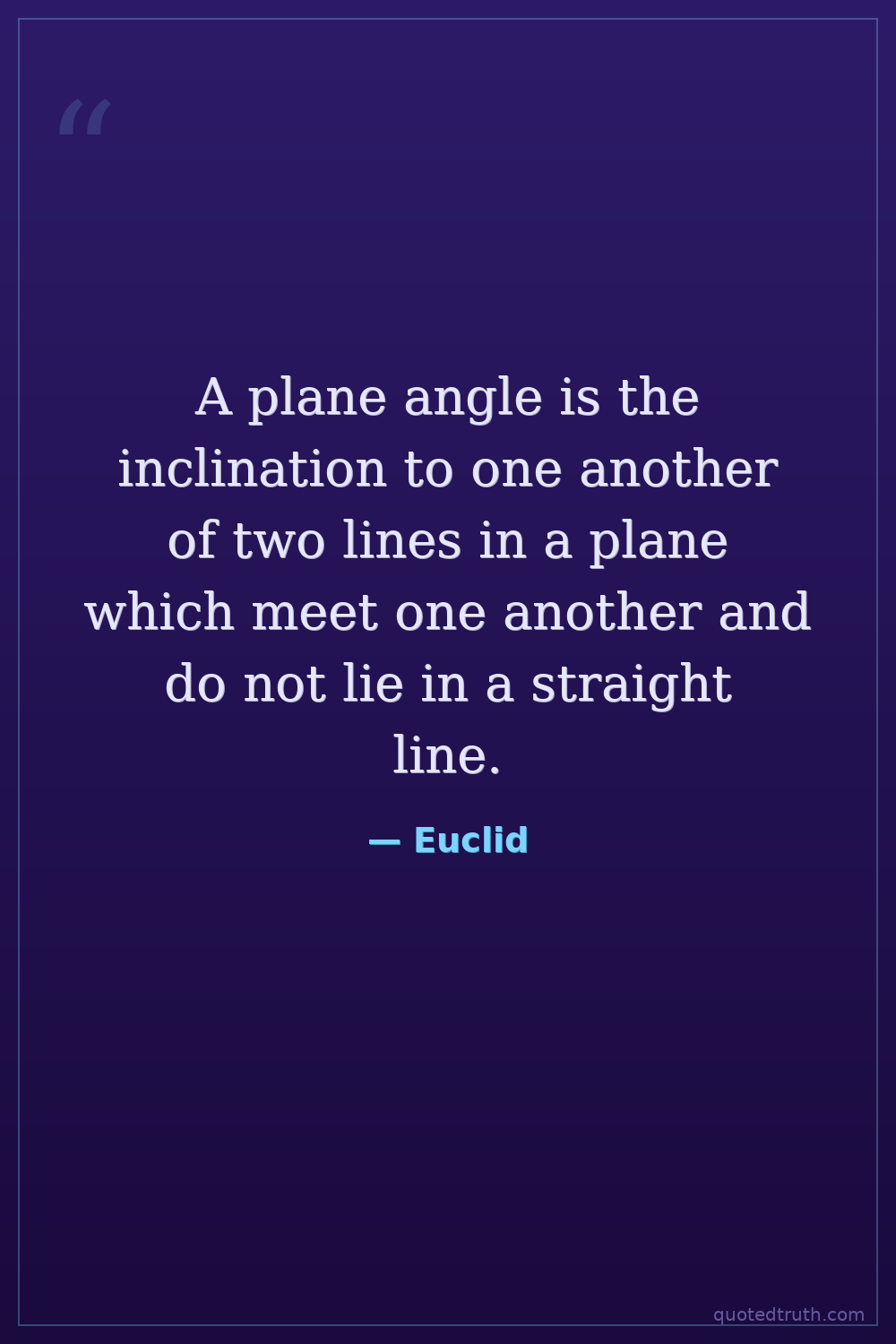
Euclid — "A plane angle is the inclination to one another of two lines in a plane which me…"
A plane angle is the inclination to one another of two lines in a plane which meet one another and do not lie in a straight line.
A plane angle is the inclination to one another of two lines in a plane which meet one another and do not lie in a straight line.
Click any product to generate a realistic preview. Up to 3 at a time.
* Initial load can take up to 90 seconds — revising the preview in another color is nearly instant.
"If a straight line be cut in extreme and mean ratio, the greater segment is also cut in extreme and mean ratio by the lesser segment."
"If a straight line fall on two parallel straight lines, it makes the alternate angles equal to one another, the exterior angle equal to the interior and opposite angle, and the interior angles on the …"
"What do I gain by learning these things?"
"To cut off from the greater of two given unequal straight lines a straight line equal to the less."
"To describe a circle with any centre and radius."
Found in 1 providers: deepseek
1 source checked
An angle forms wherever two lines meet and diverge from each other rather than merging into one straight line. The word 'inclination' captures their lean toward or away from each other — essentially a measure of their separation at the meeting point. Euclid's definition rules out degenerate cases: lines that overlap or are collinear don't form angles. It's geometry's way of precisely naming the space between two rays sharing an endpoint.
Euclid's entire life's work was building geometry from scratch using only definitions, postulates, and logic — this quote is literally the cornerstone of that project. Working in Alexandria around 300 BCE, he compiled and systematized Greek mathematical knowledge into the Elements. His insistence on defining every term before using it — angle, line, point — reflects a philosophical commitment to rigorous proof over intuition. This definition appears as Book I, Definition 8, proving nothing was assumed obvious.
Euclid worked in Alexandria around 300 BCE during the Hellenistic period, when Greek intellectual culture was spreading across Alexander's former empire. Egyptian and Babylonian mathematicians had practiced geometry for millennia but treated it pragmatically — for surveying land and building monuments. Greek philosophers, particularly Plato, elevated abstract reasoning over sense experience. Euclid's rigid definitions reflected this shift: geometry wasn't a craft tool anymore but a system of pure logical truth, mirroring the era's hunger for universal, provable knowledge.
AI-generated insights based on extensive research and information for context. Factual errors? Email [email protected].
Your cart is empty