What it means
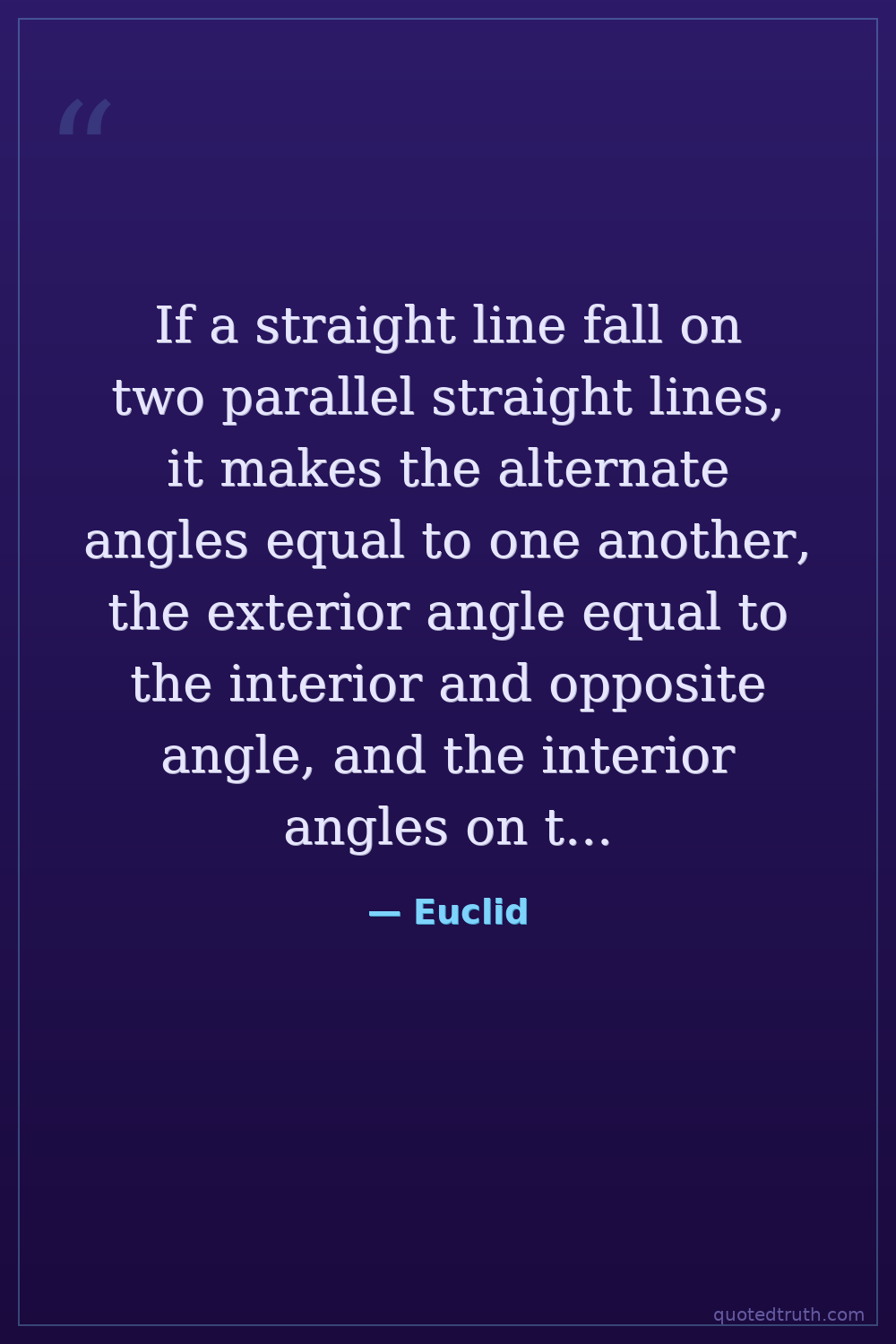
When a line crosses two parallel lines, three angle relationships hold: the alternate angles on opposite sides of the crossing line are equal; the angle outside one parallel line equals the angle inside the other on the opposite side; and angles on the same side between the parallels add up to exactly 180 degrees. These are the foundational rules governing how parallel lines behave when cut by a transversal.
Relevance to Euclid
Euclid spent his career at Alexandria systematically proving geometry from first principles. This proposition appears in Book I of his Elements, the work that organized all prior Greek geometric knowledge into a rigorous logical chain. His defining characteristic was insisting every claim be derived from axioms through proof — this statement is not an observation but a theorem he demonstrated, reflecting his disciplined, deductive approach to mathematical truth.
The era
Around 300 BCE, Alexandria under Ptolemy I was becoming the intellectual capital of the ancient world. Greek thinkers were shifting mathematics from practical surveying — measuring land, building temples — toward abstract, universal truth. Euclid's era demanded geometric proofs that held everywhere, not just in Egypt or Greece. Establishing parallel-line behavior formally was essential for architecture, astronomy, and the broader project of proving the universe followed rational, discoverable laws.
AI-generated insights based on extensive research and information for context. Factual errors? Email [email protected].