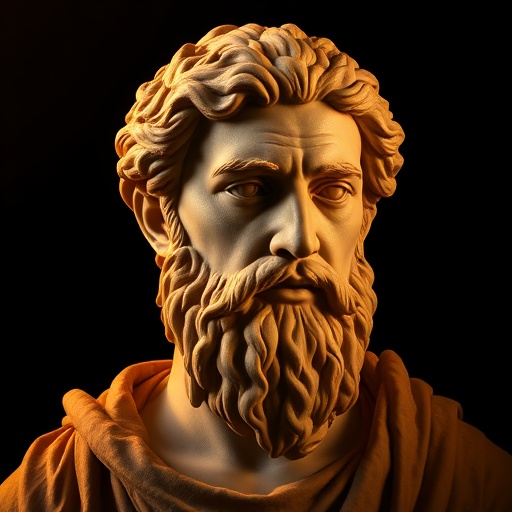
Euclid — "What advantage shall I get by learning these things?"
What advantage shall I get by learning these things?
What advantage shall I get by learning these things?
Click any product to generate a realistic preview. Up to 3 at a time.
* Initial load can take up to 90 seconds — revising the preview in another color is nearly instant.
"A semicircle is the figure contained by the diameter and the circumference cut off by it. And the center of the semicircle is the same as that of the circle."
"And the greater is a multiple of the less when it is measured by the less."
"A surface is that which has length and breadth only."
"A boundary is that which is an extremity of anything."
"Trilateral figures are those contained by three straight lines, quadrilateral those contained by four, and multilateral those contained by more than four straight lines."
Reported response to a student who asked what he would gain from learning geometry, after which Euclid ordered his slave to give the student a small coin, saying, 'Give him three pence, since he must make gain out of what he learns.'
Date: c. 300 BCE
ShockingFound in 1 providers: grok
1 source checked
The quote voices a purely utilitarian attitude toward learning — essentially, what's in it for me? It rejects the idea that knowledge has intrinsic worth, demanding a measurable, practical payoff before investing effort. In modern terms, it's the student who asks about job placement rates before enrolling in philosophy. The question challenges every educator: can you justify abstract learning on its own merits, without promising a paycheck at the end?
Euclid built his entire career on abstract, non-commercial knowledge. His Elements organized geometry into rigorous logical proofs pursued purely for truth and elegance, not profit. A famous anecdote tied directly to this quote shows Euclid instructing a servant to hand the student a coin, since he insisted on making a gain from learning. The dismissal reflects his core conviction: mathematics required no external justification — its internal coherence was the only reward that mattered.
Around 300 BCE in Alexandria, Ptolemy I funded the Mouseion and Great Library, creating an exceptional environment for pure scholarship. Yet most Greek education remained vocational — training soldiers, merchants, and craftsmen. Plato's Academy had already sparked debate over whether abstract knowledge served civic life. Against that backdrop, geometry's lack of obvious practical payoff genuinely provoked skepticism. Euclid's insistence on proof-based mathematics for its own sake was a direct challenge to the era's dominant utilitarian view of learning.
AI-generated insights based on extensive research and information for context. Factual errors? Email [email protected].
Your cart is empty