Euclid — "If four magnitudes be proportional, the rectangle contained by the extremes is e…"
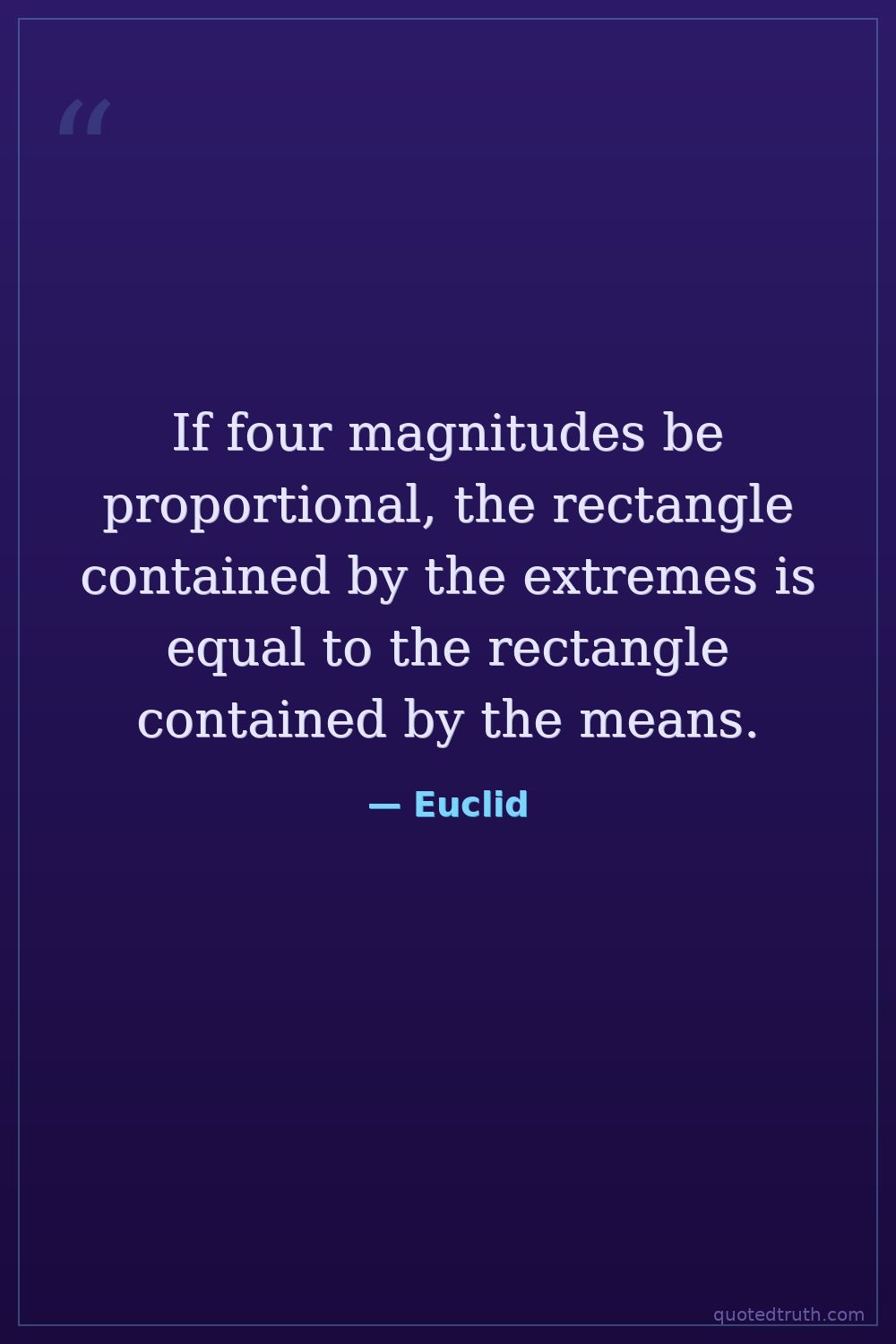
If four magnitudes be proportional, the rectangle contained by the extremes is equal to the rectangle contained by the means.
If four magnitudes be proportional, the rectangle contained by the extremes is equal to the rectangle contained by the means.
Click any product to generate a realistic preview. Up to 3 at a time.
* Initial load can take up to 90 seconds — revising the preview in another color is nearly instant.
"Things which are equal to the same thing are also equal to one another."
"If equals be added to equals, the wholes are equal."
"The elements of geometry are derived from a small set of axioms and postulates."
"A line is breadthless length."
"What do I gain by learning these things?"
Found in 1 providers: grok
1 source checked
When four quantities are in proportion — like a:b = c:d — multiplying the outer pair yields the same product as multiplying the inner pair. In modern terms: cross-multiplication. If 3 apples cost $6, and 5 apples cost $10, the outer products match the inner products. It is the algebraic backbone of ratio and proportion, used today in every field from engineering to finance to everyday problem-solving.
Euclid compiled Greek mathematical knowledge into his Elements (~300 BCE), the most influential mathematics textbook in history. This proposition reflects his defining method: building complex truths from simple axioms through airtight logical proof. Working in Alexandria under Ptolemy I, he organized geometry for absolute certainty, not convenience. This proportion theorem exemplifies his conviction that mathematics must be proven from first principles, never assumed or accepted on intuition alone.
In 300 BCE Alexandria, proportion governed architecture, astronomy, music, and land measurement. Greek mathematicians treated magnitudes geometrically — ratios were relationships between lengths, not abstract numbers — making this theorem essential for scaling temples, dividing estates, and calculating celestial distances. Alexandria's Library drew scholars across the Mediterranean, and Euclid's codification of proportion theory gave engineers and philosophers a shared rigorous language at the height of Hellenistic intellectual flourishing.
AI-generated insights based on extensive research and information for context. Factual errors? Email [email protected].
Your cart is empty