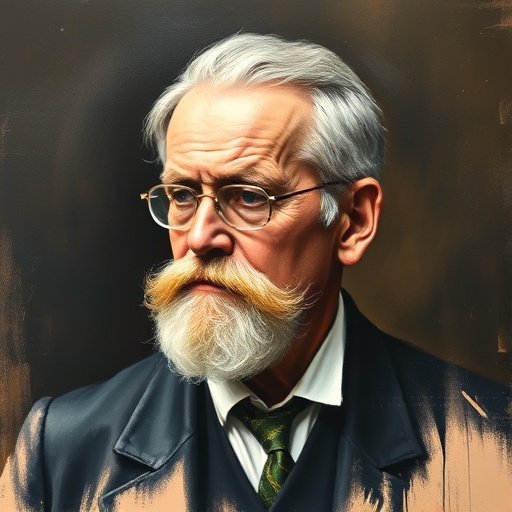
Gregor Mendel — "The future will judge my work more fairly than the present."
The future will judge my work more fairly than the present.
The future will judge my work more fairly than the present.
Click any product to generate a realistic preview. Up to 3 at a time.
* Initial load can take up to 90 seconds — revising the preview in another color is nearly instant.
"Nature loves simplicity and unity."
"The numerical relations of the different forms in the successive generations are constant."
"The inheritance of traits is not a matter of chance but of law."
"The monastery garden is my laboratory, and the pea plants are my teachers."
"The pea hybrids form eggs and pollen cells which, in their constitution, represent in equal numbers all constant forms resulting from the combination of traits united through fertilization."
Found in 1 providers: deepseek
1 source checked
When your work isn't appreciated in your lifetime, it doesn't mean it lacks value — it means the world isn't ready yet. Recognition comes on its own timeline, and what gets dismissed today may define tomorrow. This expresses quiet confidence: the speaker trusts the merit of what they've built and believes time, not contemporary opinion, is the real arbiter of worth.
Mendel published his laws of heredity in 1866 after years of meticulous pea-plant experiments in his Brno monastery garden. He sent copies to prominent scientists, including Darwin, but received no meaningful response. The scientific establishment lacked the framework to grasp particulate inheritance. He died in 1884 largely unrecognized. Sixteen years later, three botanists independently rediscovered his work and named him the founder of genetics — vindicating exactly what this quote anticipates.
Mendel worked during the 1850s–1880s, when Darwin's blending-inheritance model dominated biology and statistical thinking applied to living things was deeply unfamiliar to most naturalists. A monk working in a monastery garden held no standing in the professional scientific hierarchy. European science was reorganizing around universities and learned societies, making outsider contributions easy to overlook. That structural isolation, combined with an era conceptually unprepared for mathematical genetics, made contemporary recognition nearly impossible.
AI-generated insights based on extensive research and information for context. Factual errors? Email [email protected].
Your cart is empty