What it means
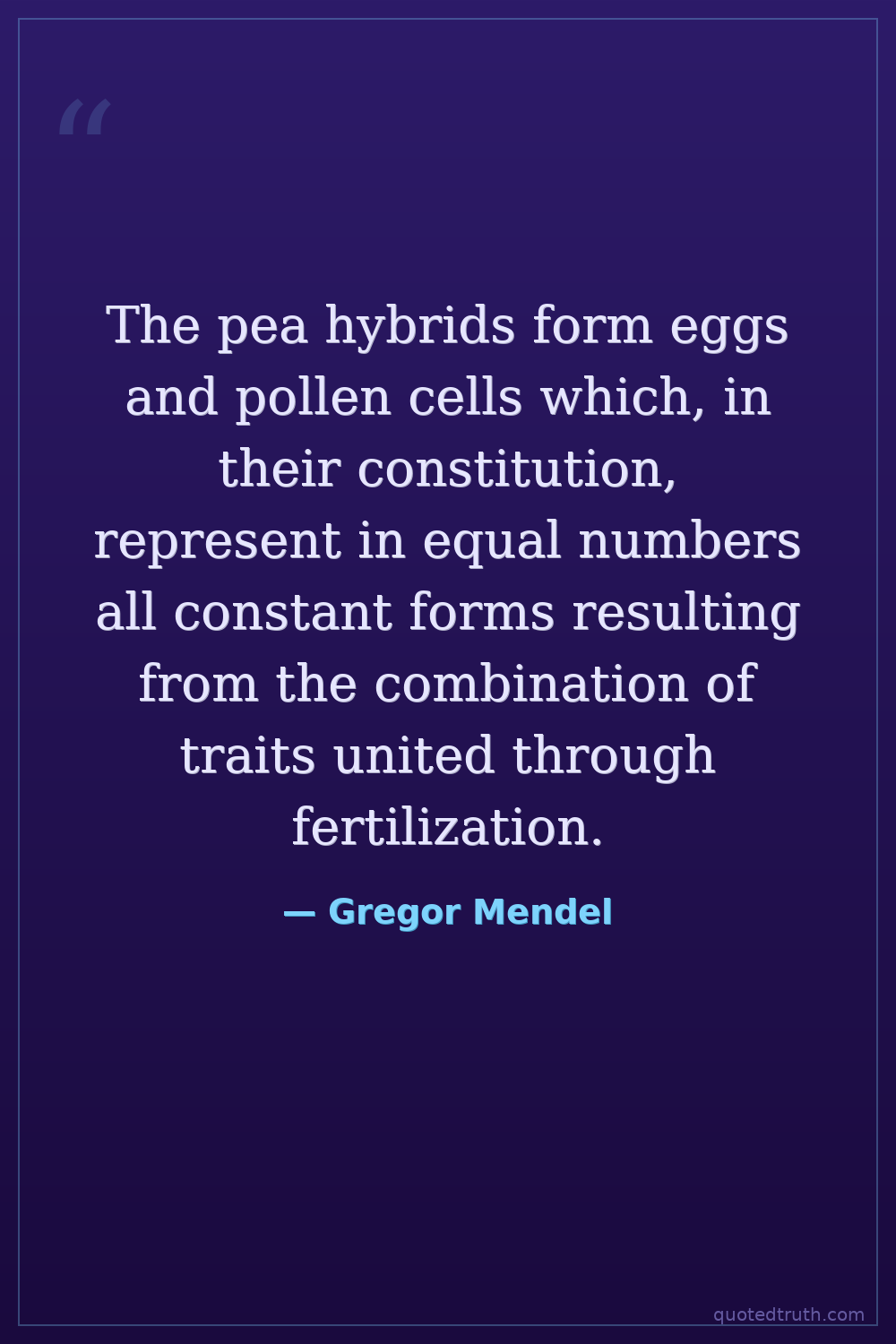
When hybrid pea plants reproduce, they create eggs and pollen cells containing all possible trait combinations in equal proportions. In modern terms: hybrid organisms produce gametes carrying every possible allele pairing in balanced ratios. This reveals that inherited traits don't blend — they segregate cleanly during reproduction. The insight underpins Mendel's Law of Segregation: each parent contributes discrete hereditary units that recombine predictably, making the mathematics of inheritance calculable across generations.
Relevance to Gregor Mendel
Mendel was an Augustinian friar who spent eight years crossbreeding over 29,000 pea plants in the monastery garden in Brno. His mathematical precision — counting and categorizing thousands of offspring — was unusual for his era. This quote captures his core discovery: the predictable arithmetic of heredity. His twin identities as monk and experimenter drove him toward systematic patience. He understood he'd found something profound but died in 1884 without seeing his work recognized.
The era
Published in 1866, just seven years after Darwin's On the Origin of Species, Mendel's work addressed a critical gap: Darwin's evolution theory had no mechanism for how traits were inherited. The prevailing belief was blending inheritance — parental traits simply averaged together. Mendel's particulate, mathematical model contradicted this entirely. His paper was ignored for 34 years until 1900, when three scientists independently rediscovered his laws, launching the field of genetics and finally explaining how Darwinian evolution works.
AI-generated insights based on extensive research and information for context. Factual errors? Email [email protected].