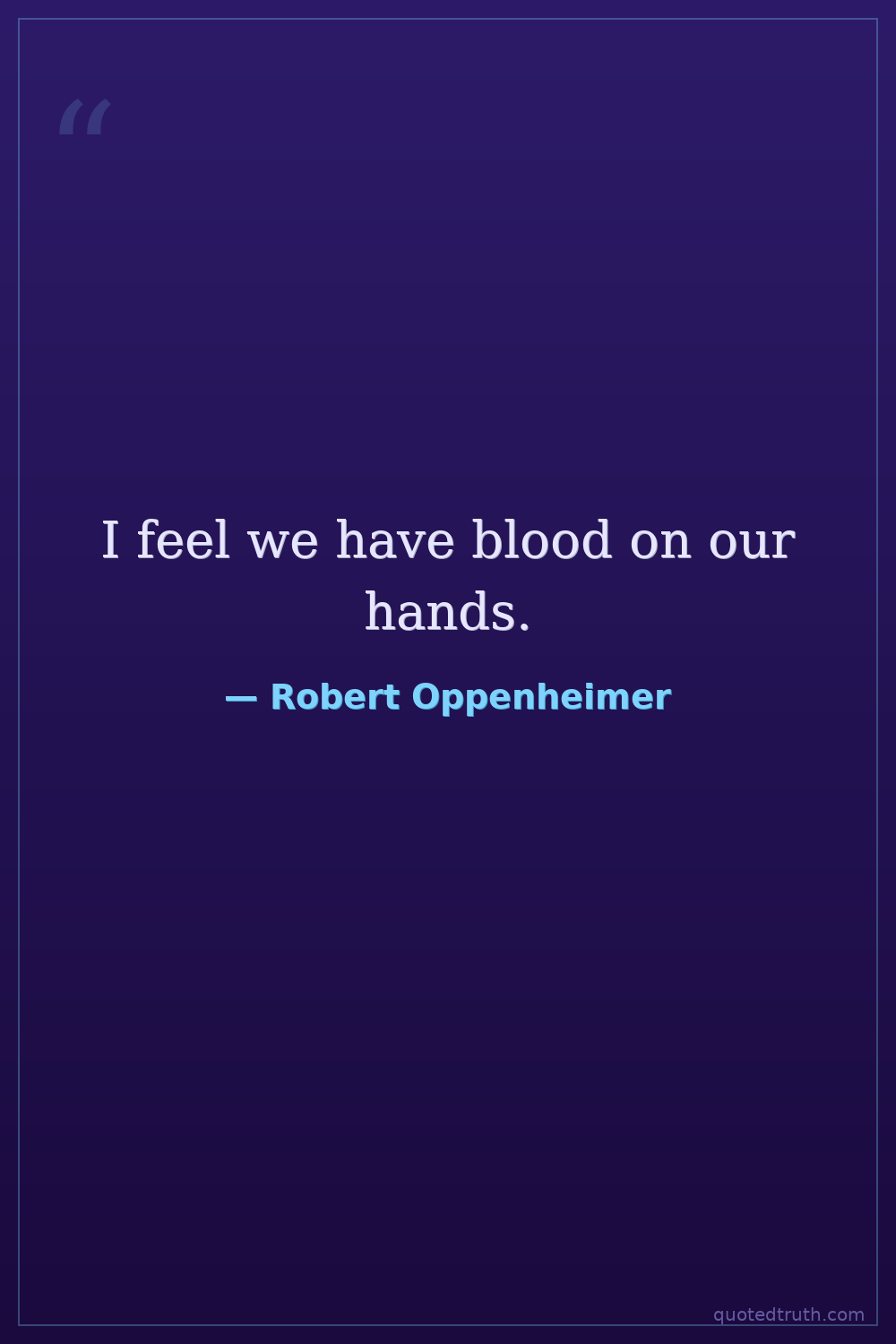
Robert Oppenheimer — "I feel we have blood on our hands."
I feel we have blood on our hands.
I feel we have blood on our hands.
Click any product to generate a realistic preview. Up to 3 at a time.
* Initial load can take up to 90 seconds — revising the preview in another color is nearly instant.
"We are not to be saved by technology, we are to be saved by humanity."
"The only constant in life is change."
"It is a matter of profound gravity that the world has changed, and we must change with it."
"In some sort of crude sense which no vulgarity, no humor, no overstatement can quite extinguish, the physicists have known sin; and this is a knowledge which they cannot lose."
"It is a problem of how to live with the atomic bomb, and not how to live without it."
American theoretical physicist who directed the Manhattan Project's Los Alamos Laboratory and oversaw the atomic bombs; lost his security clearance in 1954. Closely associated with Niels Bohr (Manhattan Project consultant and atomic-policy advisor) and Hans Bethe (Los Alamos theoretical-division chief). For an intellectual contrast, see Edward Teller, Hungarian-American physicist and 'father of the H-bomb' — Teller pushed the H-bomb against Oppenheimer's objections and testified against him at his 1954 security hearing — the precise moment that ended Oppenheimer's career. The canonical 'physicist-of-conscience vs physicist-of-state' pairing in nuclear-age ethics; Christopher Nolan's Oppenheimer (2023) dramatized this rivalry for a mass audience.
Found in 1 providers: grok
1 source checked
Raw moral guilt over being directly responsible for mass death. The speaker refuses institutional distance or 'just following orders' excuses—acknowledging that participation in destructive decisions, however justified in the moment, leaves a permanent stain. Knowing your specific role in causing catastrophic suffering is inescapable. Personal accountability cannot be outsourced to governments, committees, or wartime necessity. The phrase cuts through rationalization to confront complicity directly.
Oppenheimer spoke these words to President Truman shortly after atomic bombs destroyed Hiroshima and Nagasaki in August 1945, killing roughly 200,000 people. Truman dismissed him coldly, reportedly calling him a crybaby. As Los Alamos scientific director, Oppenheimer made the bomb possible. His guilt shaped postwar advocacy for nuclear arms control and opposition to the hydrogen bomb—positions that directly led to his security clearance being stripped in 1954.
The 1945 atomic bombings ended World War II but inaugurated existential dread unlike anything prior. The Soviet Union tested its own bomb in 1949, launching a nuclear arms race capable of civilizational destruction. Scientists who built these weapons faced unprecedented moral reckoning with no historical precedent. The Bulletin of the Atomic Scientists introduced the Doomsday Clock in 1947. Oppenheimer's era forced a permanent rupture between scientific capability and humanity's moral readiness to wield it.
AI-generated insights based on extensive research and information for context. Factual errors? Email [email protected].
Your cart is empty