What it means
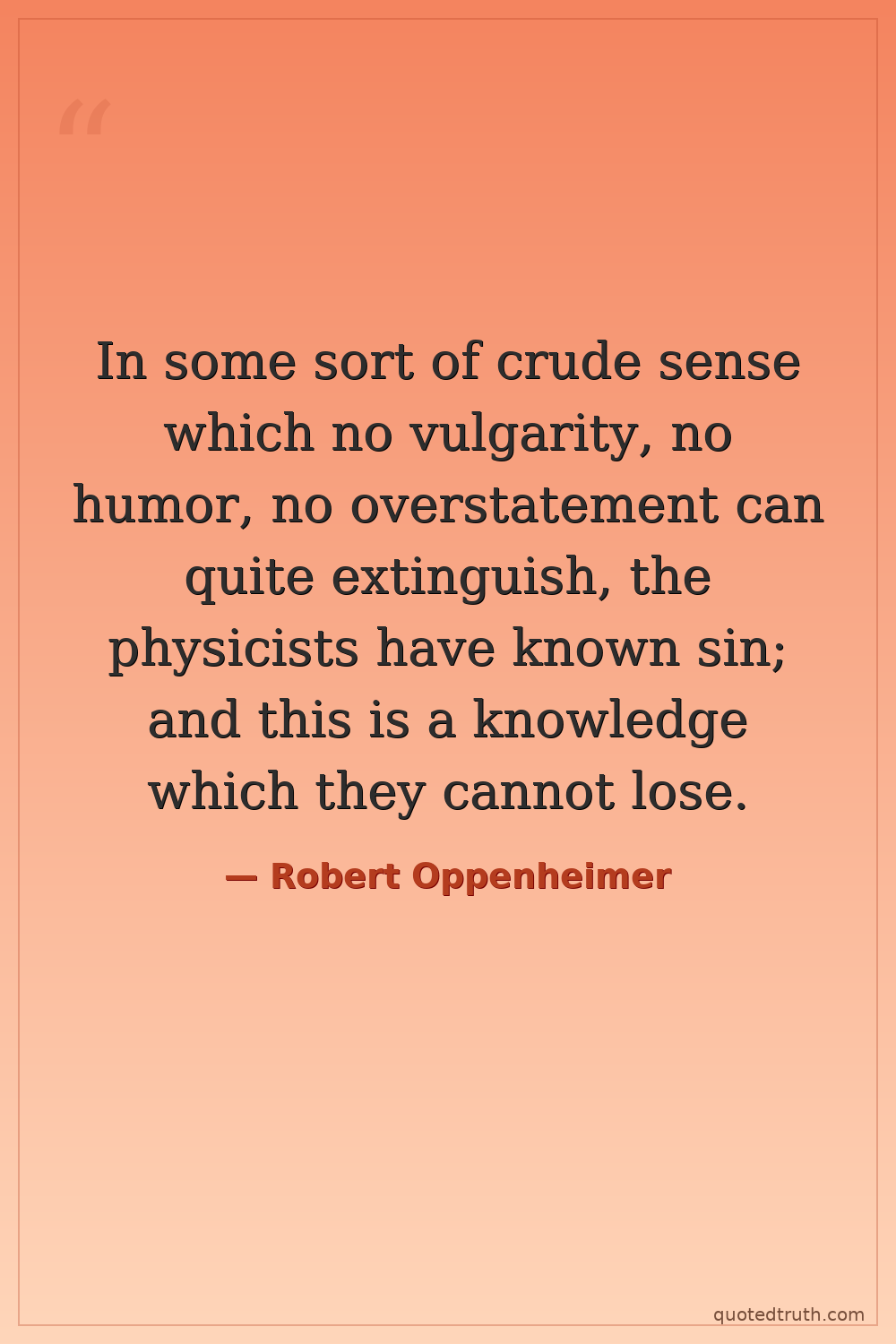
Physicists who built the atomic bomb crossed an irreversible moral threshold. No matter how one tries to minimize it — through crude language, dark humor, or exaggeration — the awareness cannot be erased. They gained firsthand knowledge of enabling mass destruction, and that knowledge is permanent. It uses 'sin' in a near-Biblical sense: not just wrongdoing but a loss of innocence that forever alters one's relationship with existence and responsibility.
Relevance to Robert Oppenheimer
Oppenheimer directed the Manhattan Project at Los Alamos, which produced the bombs that killed over 200,000 people in Hiroshima and Nagasaki. Despite being celebrated as the 'father of the atomic bomb,' he became a vocal critic of nuclear proliferation and opposed developing the hydrogen bomb — a stance that led to his security clearance being revoked in 1954. This statement captures his deep personal guilt and conviction that all contributing physicists share an indelible moral complicity.
The era
Oppenheimer delivered this in 1947, two years after atomic bombs obliterated Hiroshima and Nagasaki. The Cold War was escalating, and the Soviet Union was racing toward its own nuclear test, achieved in 1949. Manhattan Project scientists faced intense public and moral scrutiny over their roles. Nuclear deterrence was hardening into geopolitical doctrine while intellectuals debated whether scientific achievement could be ethically separated from catastrophic application. The atomic age had permanently transformed humanity's capacity for self-annihilation.
AI-generated insights based on extensive research and information for context. Factual errors? Email [email protected].