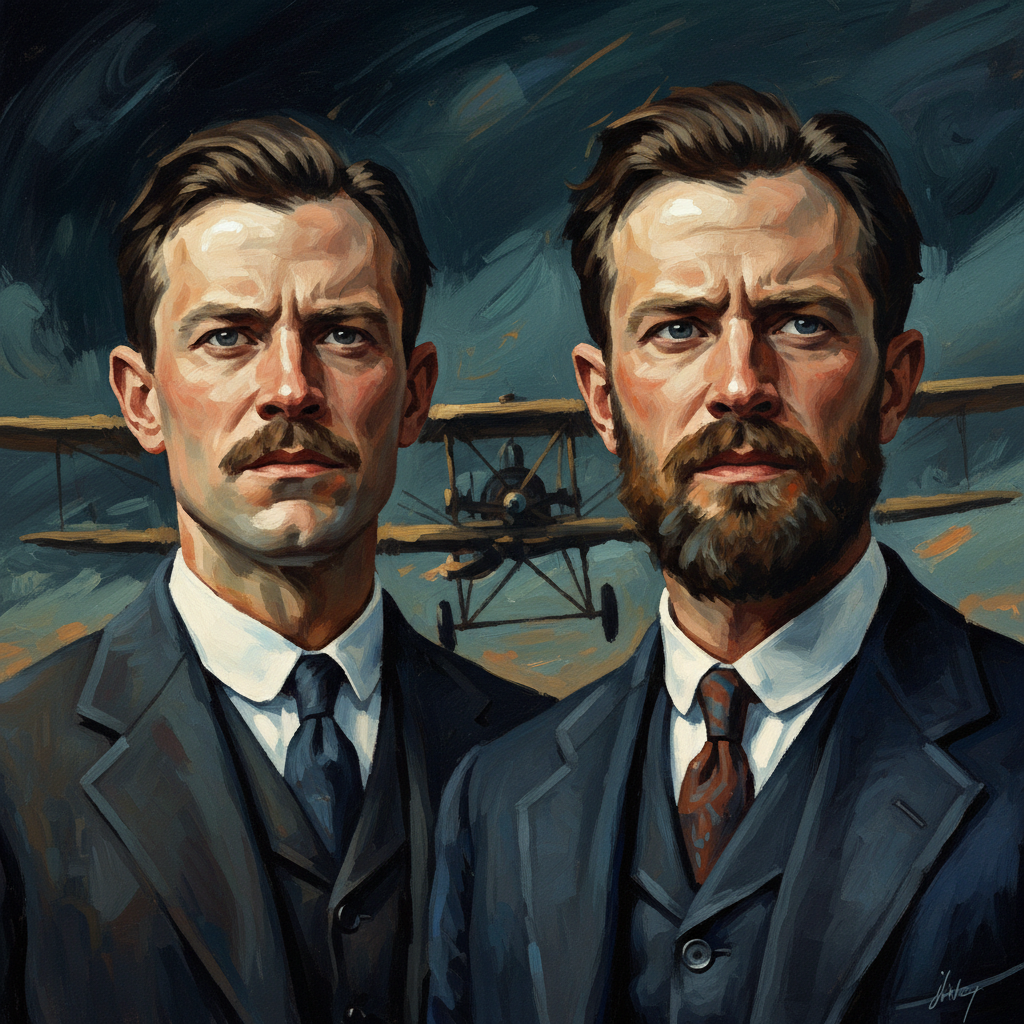
Wright Brothers (Orville & Wilbur) — "I confess that in 1901 I said to my brother Orville that man would not fly for f…"
I confess that in 1901 I said to my brother Orville that man would not fly for fifty years.
I confess that in 1901 I said to my brother Orville that man would not fly for fifty years.
Click any product to generate a realistic preview. Up to 3 at a time.
* Initial load can take up to 90 seconds — revising the preview in another color is nearly instant.
"We had taken up the invention of the flying machine as a sport."
"Our experiments were made on a larger scale than those of any other investigator."
"The flying machine which will really fly might be evolved by the combined and continuous efforts of mathematicians and mechanicians in from one million to ten million years — provided, of course, we c…"
"The machine is practically ready for its public demonstration."
"The machine is under perfect control and can be turned in any direction at will."
American aviation pioneers who achieved the first sustained powered controlled airplane flight at Kitty Hawk, NC, on December 17, 1903. Closely associated with Octave Chanute (their gliding mentor and aeronautical correspondent). For an intellectual contrast, see Samuel Pierpont Langley, Smithsonian Institution Secretary and government-funded aviation researcher — Langley's Aerodrome crashed twice into the Potomac in October-December 1903 with $50,000 of War Department funding; the Wright Brothers' bicycle-shop empiricism beat Langley's institutional Big Science by 9 days. The most-cited example in engineering history of empirical-tinkerer beating institution-funded credentialism.
Found in 1 providers: deepseek
1 source checked
Wilbur Wright admitted he once believed powered human flight was still fifty years away — yet just two years later, he and Orville achieved it. The quote captures how even the most capable people underestimate what's possible. It's a reminder that rational pessimism and relentless effort can coexist, and that progress rarely announces itself in advance, even to those making it happen.
After a disheartening 1901 glider test at Kitty Hawk, Wilbur genuinely doubted flight was imminent. Yet he and Orville continued refining wing warping, built their own wind tunnel, and corrected flawed aerodynamic tables. By December 17, 1903 — just 27 months after that bleak prediction — they flew at Kitty Hawk. Their success came not from confidence, but from methodical work that outlasted their own doubts.
In 1901, expert consensus held that heavier-than-air flight was impossible. Lord Kelvin had declared it so. Samuel Langley, lavishly funded by the Smithsonian and the U.S. War Department, was failing publicly. Aviation was considered the hobby of dreamers. Two self-taught bicycle mechanics from Dayton working without government money were the last people expected to crack it — which makes the 1903 breakthrough one of history's greatest upsets against institutional authority.
AI-generated insights based on extensive research and information for context. Factual errors? Email [email protected].
Your cart is empty