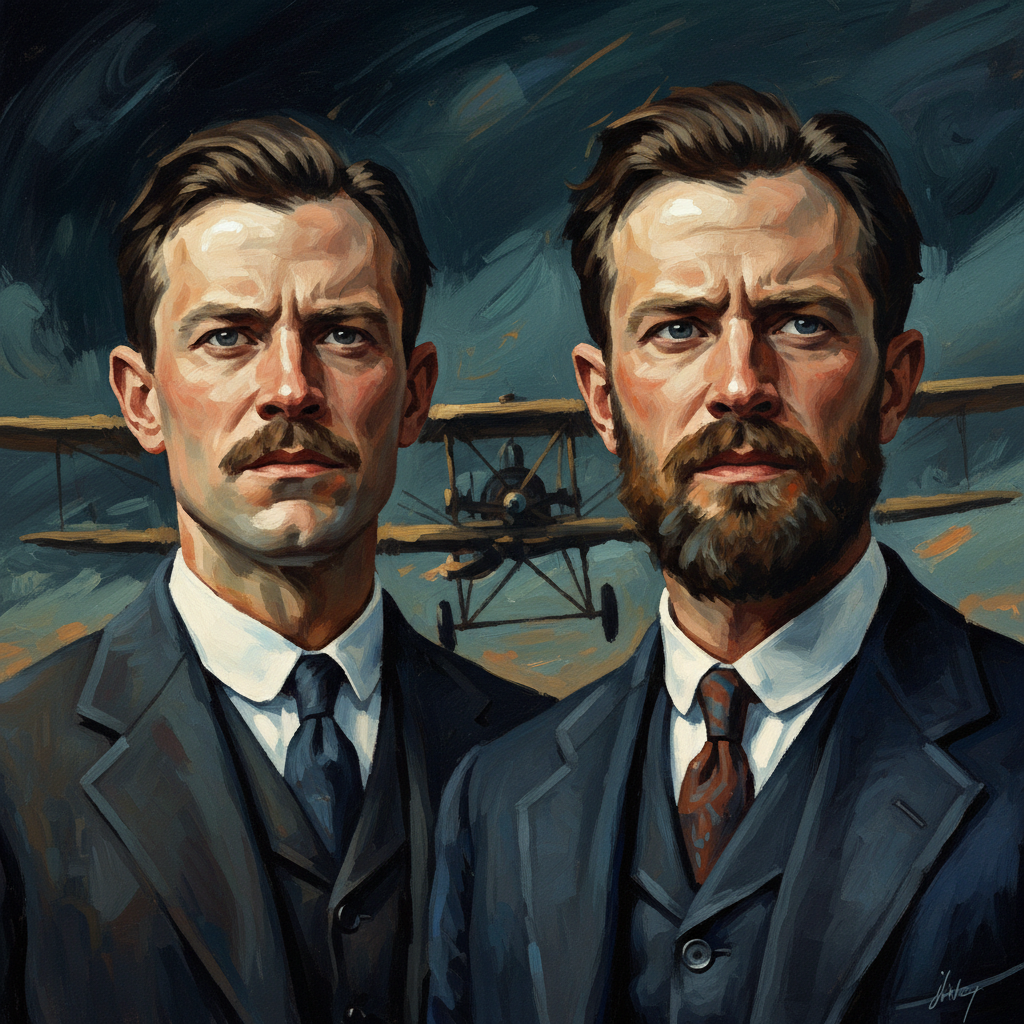
Wright Brothers (Orville & Wilbur) — "The machine has been flown in all sorts of weather."
The machine has been flown in all sorts of weather.
The machine has been flown in all sorts of weather.
Click any product to generate a realistic preview. Up to 3 at a time.
* Initial load can take up to 90 seconds — revising the preview in another color is nearly instant.
"We have been able to keep the machine in the air for longer periods than ever before."
"We do not believe that the difficulties are insurmountable, and we are confident that we shall yet succeed."
"The only way to learn to fly is to fly."
"I think it will be a long time yet before anyone will be flying at any great height or speed."
"The desire to fly is an idea handed down to us by our ancestors who, in their weary journeys over endless plains, yearned for a swifter and less laborious mode of travel."
American aviation pioneers who achieved the first sustained powered controlled airplane flight at Kitty Hawk, NC, on December 17, 1903. Closely associated with Octave Chanute (their gliding mentor and aeronautical correspondent). For an intellectual contrast, see Samuel Pierpont Langley, Smithsonian Institution Secretary and government-funded aviation researcher — Langley's Aerodrome crashed twice into the Potomac in October-December 1903 with $50,000 of War Department funding; the Wright Brothers' bicycle-shop empiricism beat Langley's institutional Big Science by 9 days. The most-cited example in engineering history of empirical-tinkerer beating institution-funded credentialism.
Found in 1 providers: grok
1 source checked
The quote plainly asserts that an aircraft has been successfully operated across varying weather conditions — not just calm, ideal days. It's a statement of proven reliability backed by real-world testing, not theory. The claim matters because it separates a fragile experimental curiosity from a genuinely practical machine. Weather is unpredictable and unforgiving; surviving it repeatedly is the difference between a stunt and a working invention.
The Wright Brothers were methodical engineers who logged every flight condition in careful notebooks. Their famous first flight on December 17, 1903 occurred in 27 mph winds and near-freezing temperatures at Kitty Hawk. They later tested at Huffman Prairie, Ohio in 1904–1905 through variable Midwestern weather. This quote embodies their core philosophy: trust accumulated data over theory, and prove a machine's worth through repetition under real conditions, not controlled demonstrations.
In the early 1900s, powered flight was widely dismissed as impossible by respected scientists, military officials, and newspapers. Even after Kitty Hawk, American press barely covered the achievement for years. Skeptics demanded proof beyond a single calm-day attempt. Flying successfully in varied weather directly countered that disbelief. Simultaneously, European aviators were racing to replicate and surpass the Wrights, making every demonstrated capability — especially all-weather reliability — a critical competitive and credibility claim.
AI-generated insights based on extensive research and information for context. Factual errors? Email [email protected].
Your cart is empty