Jane Goodall — "I think the biggest problem we face is this disconnect between our clever brains…"
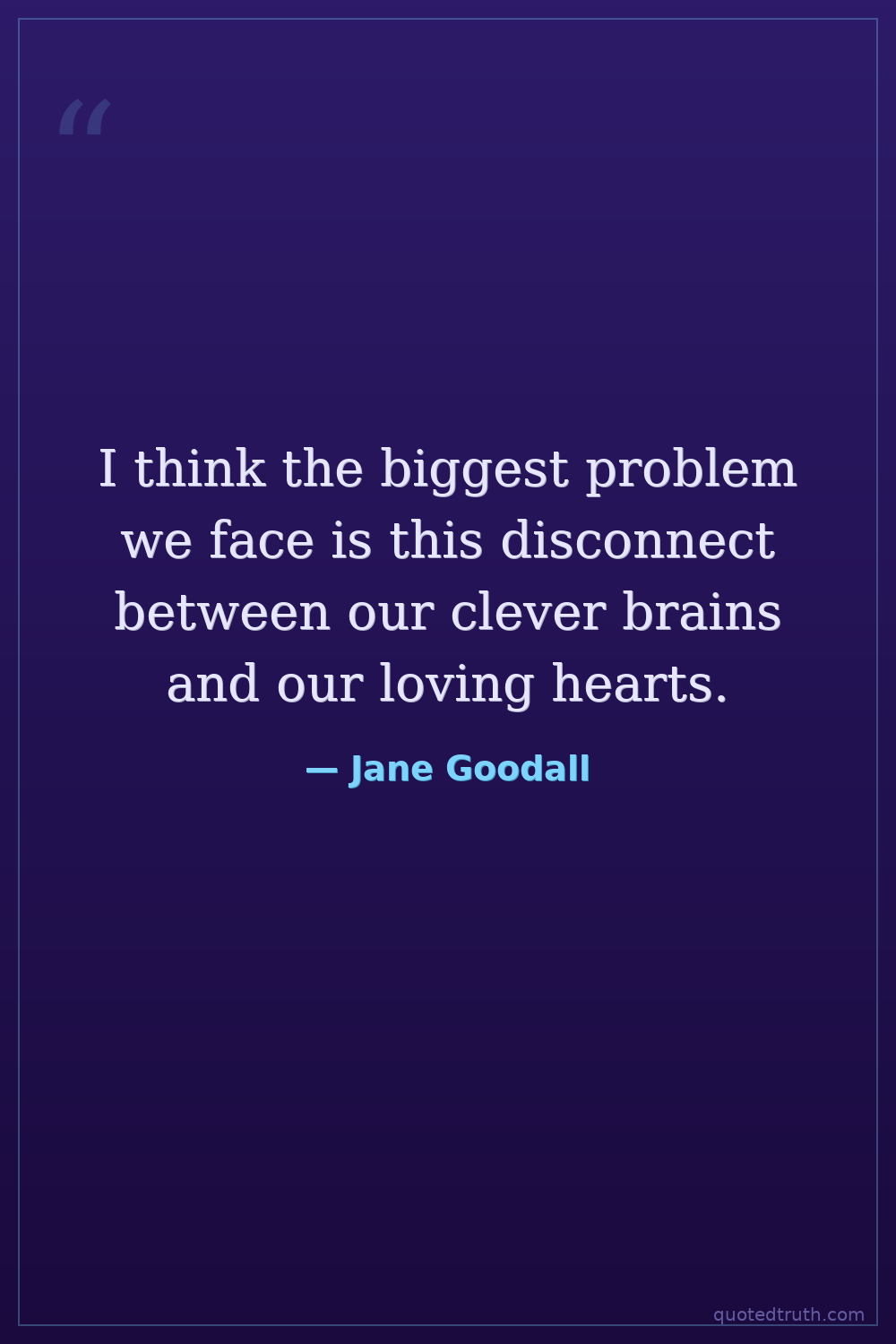
I think the biggest problem we face is this disconnect between our clever brains and our loving hearts.
I think the biggest problem we face is this disconnect between our clever brains and our loving hearts.
Click any product to generate a realistic preview. Up to 3 at a time.
* Initial load can take up to 90 seconds — revising the preview in another color is nearly instant.
"I have always believed that there is hope, even in the darkest of times."
"I'm not afraid of getting old. I'm afraid of not having enough time to do all the things I want to do."
"The more I learn about animals, the more I realize how much we have in common."
"I often feel like I'm a voice for the voiceless."
"I've learned that even the smallest actions can have a big impact."
British primatologist who in 1960 began the longest-running wild primate study at Gombe Stream, transforming our understanding of chimpanzees. Closely associated with Dian Fossey (mountain-gorilla researcher) and Birutė Galdikas (orangutan researcher; together with Goodall and Fossey one of Louis Leakey's 'Trimates'). For an intellectual contrast, see Walter Palmer, American dentist who killed Cecil the Lion in Zimbabwe in 2015 — Palmer represents the trophy-hunting tradition Goodall's life's work has been organized against — the colonial-era hunter-naturalist worldview that treated primates and big game as specimens or trophies, which Goodall's Roots & Shoots and Jane Goodall Institute exist specifically to displace.
Found in 1 providers: grok
1 source checked
Humanity's greatest crisis isn't a shortage of intelligence — we already know enough to address climate collapse, mass extinction, and poverty. The real failure is that our capacity for knowledge consistently outpaces our willingness to act with compassion. We build, exploit, and consume with brilliant efficiency, yet struggle to feel genuine responsibility for the consequences. Intelligence without empathy produces destruction; the two must work together.
Goodall witnessed this disconnect firsthand at Gombe — researchers who intellectually understood chimpanzee intelligence and social bonds yet watched their habitat disappear. In the late 1980s she abandoned full-time research to become an activist, concluding that scientific knowledge alone changes nothing. Her Roots & Shoots youth program specifically targets emotional connection to nature, not just education. Her entire post-Gombe career is a direct response to this quote's diagnosis.
Goodall speaks into an age of documented contradiction: climate science achieved near-total consensus by the 2000s, yet global emissions kept rising. Smartphone technology connected billions while loneliness and polarization deepened. The Sixth Mass Extinction is scientifically catalogued in real time as it unfolds. The information age delivered unprecedented cleverness — algorithms, gene editing, AI — while mental health crises and ecological destruction accelerated. Intelligence was never the bottleneck; moral will was.
AI-generated insights based on extensive research and information for context. Factual errors? Email [email protected].
Your cart is empty