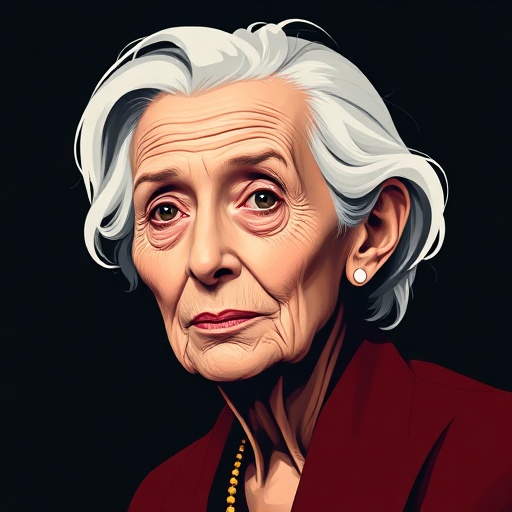
Jane Goodall — "I've touched the soul of a chimpanzee, and it changed my life forever."
I've touched the soul of a chimpanzee, and it changed my life forever.
I've touched the soul of a chimpanzee, and it changed my life forever.
Click any product to generate a realistic preview. Up to 3 at a time.
* Initial load can take up to 90 seconds — revising the preview in another color is nearly instant.
"The greatest threat to our survival is the destruction of the natural world."
"I think the most important thing is to have hope."
"The natural world is our greatest teacher, and we should listen to its lessons."
"I believe that every living creature has a soul, and that we should treat them with respect."
"I'm often asked if I'm an optimist or a pessimist. I say I'm a 'possibilist.'"
British primatologist who in 1960 began the longest-running wild primate study at Gombe Stream, transforming our understanding of chimpanzees. Closely associated with Dian Fossey (mountain-gorilla researcher) and Birutė Galdikas (orangutan researcher; together with Goodall and Fossey one of Louis Leakey's 'Trimates'). For an intellectual contrast, see Walter Palmer, American dentist who killed Cecil the Lion in Zimbabwe in 2015 — Palmer represents the trophy-hunting tradition Goodall's life's work has been organized against — the colonial-era hunter-naturalist worldview that treated primates and big game as specimens or trophies, which Goodall's Roots & Shoots and Jane Goodall Institute exist specifically to displace.
Found in 1 providers: grok
1 source checked
When we truly connect with another being — even one of a different species — it can permanently reshape how we see the world and ourselves. This quote captures the moment when emotional and almost spiritual contact with a chimpanzee transcended scientific observation. It suggests animals possess inner lives, feelings, and depth that deserve recognition. Such encounters don't just inform — they transform identity, purpose, and how we understand consciousness itself.
Goodall arrived at Gombe Stream, Tanzania in 1960 with no formal degree, sent by paleoanthropologist Louis Leakey. Her early bond with David Greybeard — a chimp who first accepted her presence and was observed making tools — became the catalyst for a life's mission. She named individual chimps, documented their complex emotions, warfare, and tool use, fundamentally challenging science's refusal to attribute mental states to animals. This quote reflects the transformative encounter that launched decades of advocacy.
Goodall began fieldwork in 1960, when behaviorism dominated science and attributing emotions or souls to animals was dismissed as unscientific anthropomorphism. The post-WWII era assumed a sharp boundary between human consciousness and animal instinct. Meanwhile, decolonization was reshaping Africa and habitat destruction was accelerating. Her findings coincided with early environmentalism and the 1960s counterculture questioning human superiority. Declaring a soul-level connection to an ape was culturally radical — scientifically controversial and spiritually resonant simultaneously.
AI-generated insights based on extensive research and information for context. Factual errors? Email [email protected].
Your cart is empty