Leonardo da Vinci — "The greatest pleasure and the greatest knowledge is to understand why everything…"
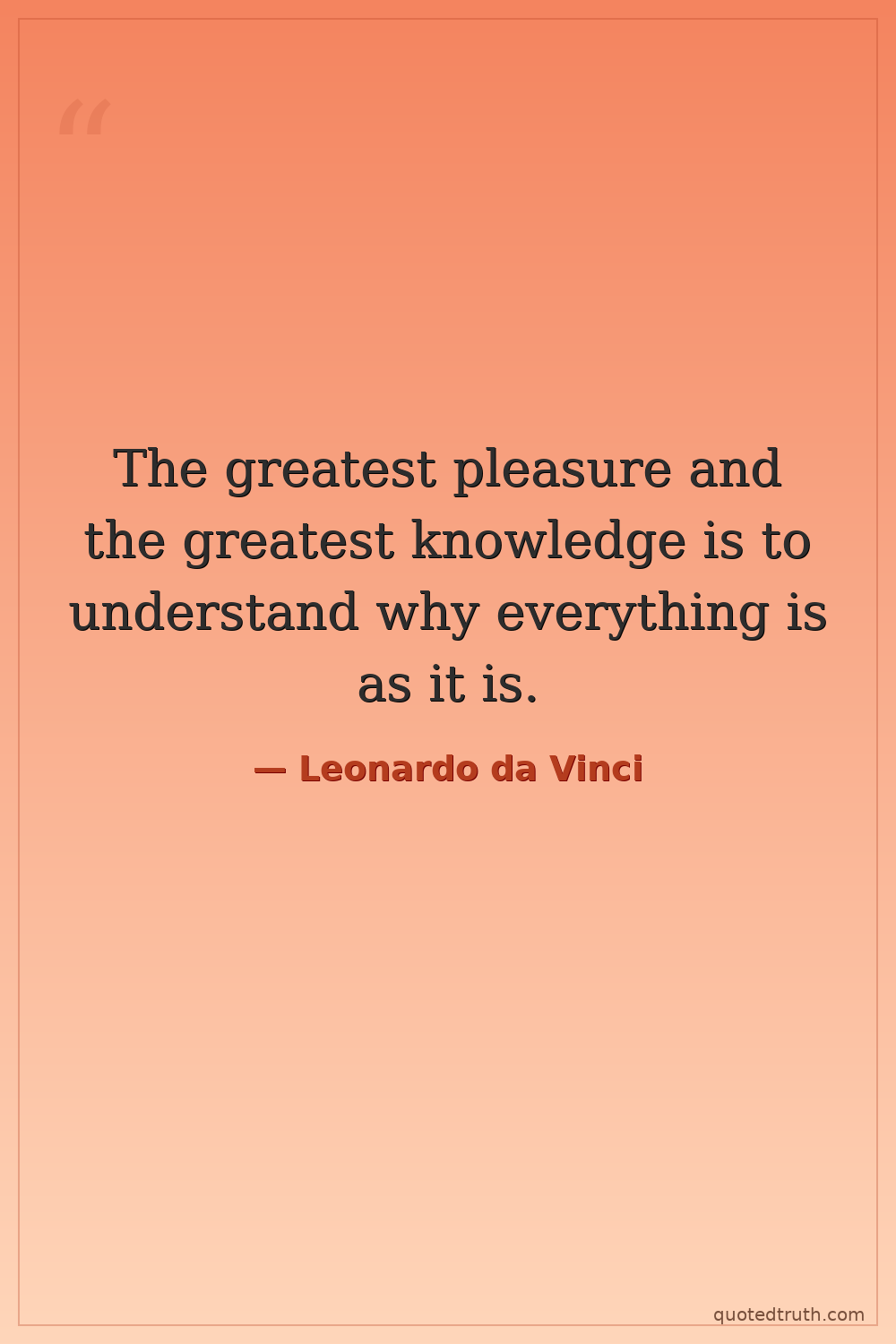
The greatest pleasure and the greatest knowledge is to understand why everything is as it is.
The greatest pleasure and the greatest knowledge is to understand why everything is as it is.
Click any product to generate a realistic preview. Up to 3 at a time.
* Initial load can take up to 90 seconds — revising the preview in another color is nearly instant.
"The greatest pleasure and the greatest knowledge is to understand how we are born."
"Water is the driving force of all nature."
"The earth is not the center of the sun, but the sun is the center of the earth."
"Blind ignorance misleads us and makes us content with this empty life."
"The natural desire of good men is knowledge."
Found in 1 providers: grok
1 source checked
True intellectual fulfillment comes not from memorizing facts but from grasping root causes — understanding why things work the way they do. This quote argues that curiosity-driven reasoning, the kind that connects observations to underlying principles, is simultaneously the deepest form of knowledge and the most satisfying human experience. It's a case for first-principles thinking: surface observations aren't enough; the real reward lies in uncovering the mechanisms behind them.
Leonardo spent decades dissecting cadavers not to paint better bodies but to understand how muscles actually function. His notebooks document obsessive inquiry into water flow, bird mechanics, optics, and geology — always pushing past surface observation to causal explanation. His dual identity as painter and engineer embodied this belief: his artistic mastery of light and shadow emerged directly from scientific investigation into how vision and physics actually operate.
Leonardo lived during the Italian Renaissance, when Europe was shifting from medieval scholasticism — accepting truth through religious authority — toward direct observation and empirical reasoning. Ancient Greek texts were being rediscovered; humanism placed human intellect at the center of inquiry. Yet causal explanation remained controversial, often clashing with Church doctrine on natural phenomena. His insistence on understanding why positioned him ahead of the formal Scientific Revolution that would follow by a full century.
AI-generated insights based on extensive research and information for context. Factual errors? Email [email protected].
Your cart is empty