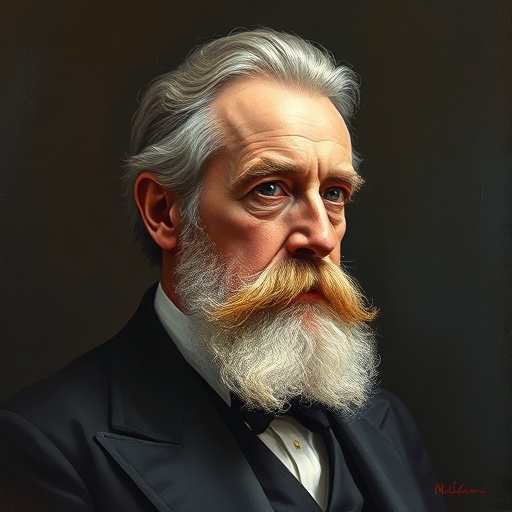
Alexander Graham Bell — "Before you can achieve anything, you must know what you want. And you must be pr…"
Before you can achieve anything, you must know what you want. And you must be prepared to sacrifice your comfort to get it.
Before you can achieve anything, you must know what you want. And you must be prepared to sacrifice your comfort to get it.
Click any product to generate a realistic preview. Up to 3 at a time.
* Initial load can take up to 90 seconds — revising the preview in another color is nearly instant.
"We should try ourselves to forget that they are deaf. We should try to teach them to forget that they are deaf."
"The most important thing is to keep on trying, to never give up."
"A man's own judgement should be the final appeal in all that relates to himself."
"The telephone will be a great convenience to business men, but it will never be used by the general public."
"The inventor looks at the world and is not contented with things as they are. He wants to improve them, he wants to change things, he is inspired by the desire to invent."
Widely attributed, but specific source is elusive. Sounds like a general inspirational quote.
Date: unknown
GeneralFound in 1 providers: grok
1 source checked
Real achievement starts with clarity — you can't work toward a vague aspiration. You need a specific, committed goal. Then comes the harder part: being willing to give up ease, routine, or safety to pursue it. Comfort and growth rarely coexist. This is a straightforward statement about deliberate ambition: define what you want, then accept that getting it will cost you something.
Bell spent years in financial precarity and grueling lab work before his 1876 telephone patent. Motivated partly by his deaf mother and deaf wife Mabel, he had a clear personal mission: make voice transmittable across distances. He sacrificed stable income and sleep for his experiments. After success he kept inventing — hydrofoils, metal detectors, aircraft — proof that his comfort never mattered as much as his next goal.
Bell's most productive years fell during the Second Industrial Revolution, when inventors competed fiercely to patent transformative technologies. The 1870s Gilded Age celebrated individual ambition and the self-made visionary. Bell raced against Elisha Gray to file the telephone patent — literally hours apart in 1876. In that era, the line between a celebrated inventor and an also-ran was precisely this: knowing your goal and outworking everyone else to reach it.
AI-generated insights based on extensive research and information for context. Factual errors? Email [email protected].
Your cart is empty