Wright Brothers (Orville & Wilbur) — "It was impossible to convince the people generally that we were not a pair of lu…"
It was impossible to convince the people generally that we were not a pair of lunatics.
It was impossible to convince the people generally that we were not a pair of lunatics.
Click any product to generate a realistic preview. Up to 3 at a time.
* Initial load can take up to 90 seconds — revising the preview in another color is nearly instant.
"We had no idea of the amount of publicity that would follow our flights."
"The machine is practically ready for its public demonstration."
"The greatest value of our experiments has been their negative results."
"The air, like the sea, is an untamed element."
"We have had considerable difficulty in getting the engine to work properly."
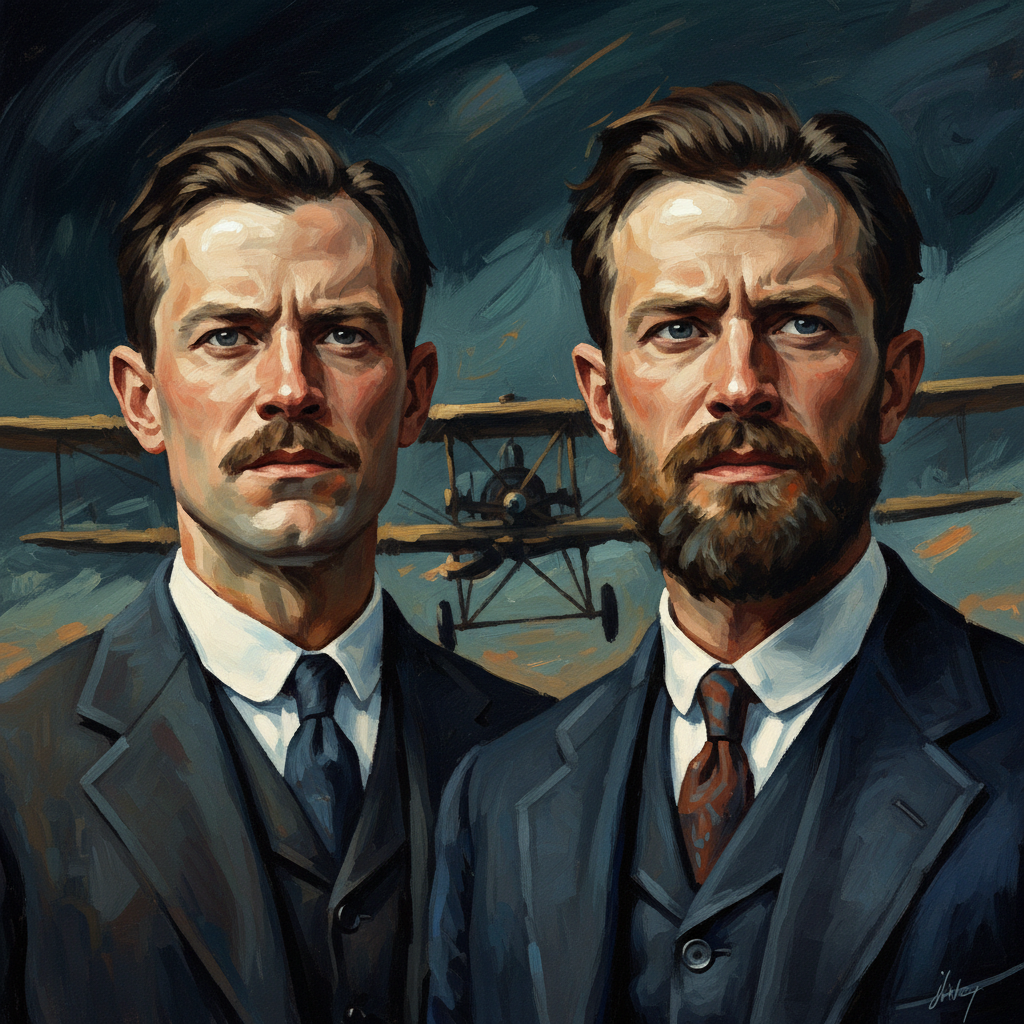
American aviation pioneers who achieved the first sustained powered controlled airplane flight at Kitty Hawk, NC, on December 17, 1903. Closely associated with Octave Chanute (their gliding mentor and aeronautical correspondent). For an intellectual contrast, see Samuel Pierpont Langley, Smithsonian Institution Secretary and government-funded aviation researcher — Langley's Aerodrome crashed twice into the Potomac in October-December 1903 with $50,000 of War Department funding; the Wright Brothers' bicycle-shop empiricism beat Langley's institutional Big Science by 9 days. The most-cited example in engineering history of empirical-tinkerer beating institution-funded credentialism.
Found in 1 providers: grok
1 source checked
Two visionaries pursuing something the world considered impossible are dismissed as madmen rather than pioneers. When your goal defies mainstream belief, public perception becomes an obstacle as real as any technical problem. The quote captures the painful isolation of genuine innovation — the gap between what you know to be achievable and what everyone around you insists is delusional. Being right before the proof arrives looks indistinguishable from being wrong forever.
The Wright Brothers were Dayton bicycle mechanics dismissed by the scientific establishment and press. After Kitty Hawk on December 17, 1903, newspapers barely covered the flight — the Associated Press declined the story as implausible. Even through 1904–1905 public demonstrations at Huffman Prairie, skepticism persisted. They had no university credentials, no government funding, and competed against Smithsonian-backed Samuel Langley, whose aerodrome crashed publicly days before their success. Their credibility gap was real and prolonged.
In 1903, heavier-than-air powered flight was considered scientifically impossible. Lord Kelvin had declared it unfeasible, and Samuel Langley's government-funded Aerodrome crashed spectacularly just nine days before Kitty Hawk, reinforcing public skepticism. The era was defined by steam, rail, and early automobiles — flight belonged to fantasy. When two bicycle mechanics claimed success, the press defaulted to disbelief. Scientific American refused to accept the claim for years without personally witnessing a sustained flight.
AI-generated insights based on extensive research and information for context. Factual errors? Email [email protected].
Your cart is empty