Wright Brothers (Orville & Wilbur) — "We have had considerable difficulty in getting the engine to work properly."
We have had considerable difficulty in getting the engine to work properly.
We have had considerable difficulty in getting the engine to work properly.
Click any product to generate a realistic preview. Up to 3 at a time.
* Initial load can take up to 90 seconds — revising the preview in another color is nearly instant.
"The machine has been working very nicely and we have been making several flights each day."
"The greatest pleasure in life is to do what people say you cannot do."
"The machine is under perfect control and can be turned in any direction at will."
"The desire for flight is the expression of a deep-seated human instinct."
"The only difference between us and others is that we have made a more thorough study of the problem."
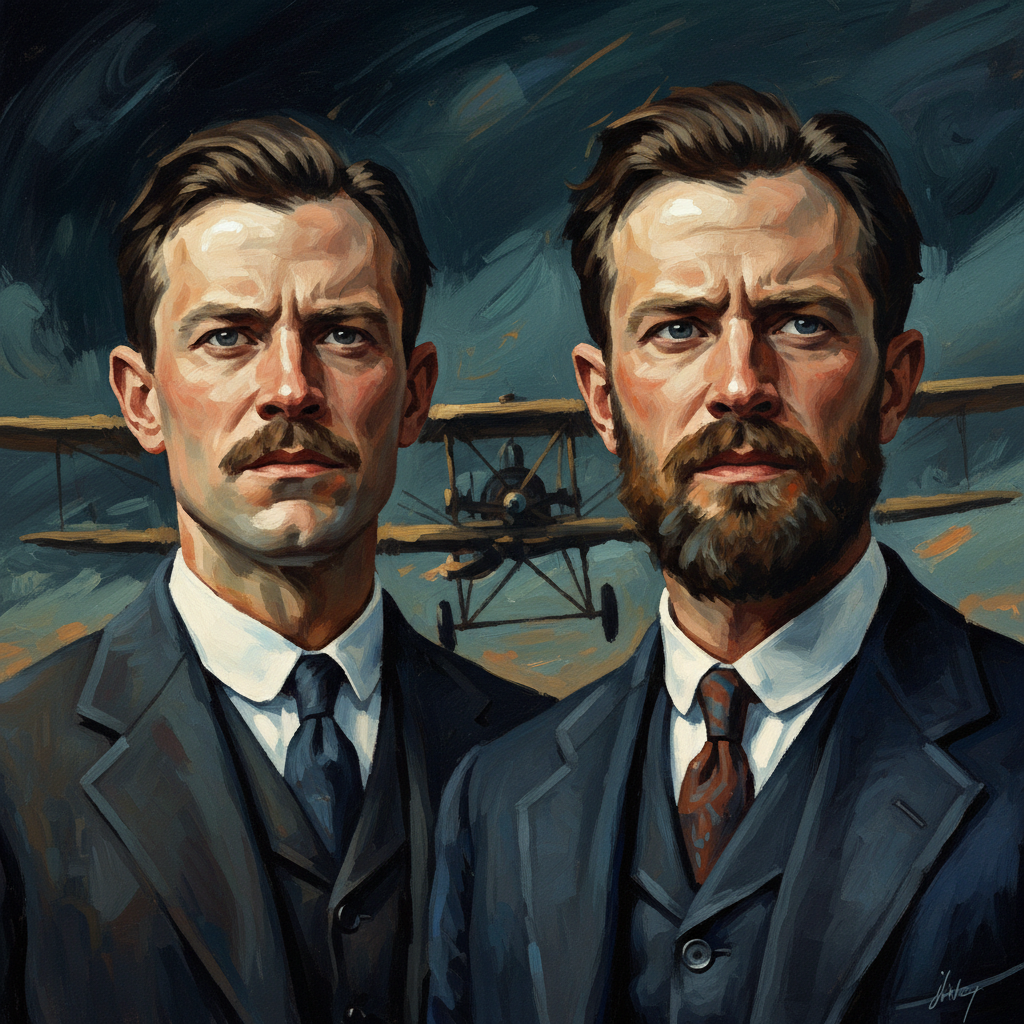
American aviation pioneers who achieved the first sustained powered controlled airplane flight at Kitty Hawk, NC, on December 17, 1903. Closely associated with Octave Chanute (their gliding mentor and aeronautical correspondent). For an intellectual contrast, see Samuel Pierpont Langley, Smithsonian Institution Secretary and government-funded aviation researcher — Langley's Aerodrome crashed twice into the Potomac in October-December 1903 with $50,000 of War Department funding; the Wright Brothers' bicycle-shop empiricism beat Langley's institutional Big Science by 9 days. The most-cited example in engineering history of empirical-tinkerer beating institution-funded credentialism.
Found in 1 providers: grok
1 source checked
Honest acknowledgment that a technical problem is real, stubborn, and unresolved. No spin, no blame — just a plain statement that the machine isn't working right yet. It captures the unglamorous core of engineering: most of the time is spent fighting problems, not celebrating breakthroughs. Progress requires admitting difficulty first, then grinding through it systematically until the thing actually works.
Orville and Wilbur built their 1903 Flyer engine themselves because no manufacturer could supply one light enough with adequate power. Self-taught bicycle mechanics with no formal engineering degrees, they machined parts by hand in their Dayton shop. Their notebooks are filled with terse, precise failure logs exactly like this — no dramatization, just documented fact. That unflinching honesty about what wasn't working was precisely how they succeeded where better-funded rivals failed.
In 1903, internal combustion engines were primitive, heavy, and wildly unreliable. The automobile was barely a decade old, and no established aerospace or aeronautical engineering field existed. Most powered-flight attempts collapsed at the engine stage — insufficient thrust-to-weight ratios, overheating, carburetion failures. Samuel Langley's well-funded Smithsonian project failed twice that same year. Getting a gasoline engine to run consistently was genuinely one of the hardest unsolved mechanical problems of the early twentieth century.
AI-generated insights based on extensive research and information for context. Factual errors? Email [email protected].
Your cart is empty