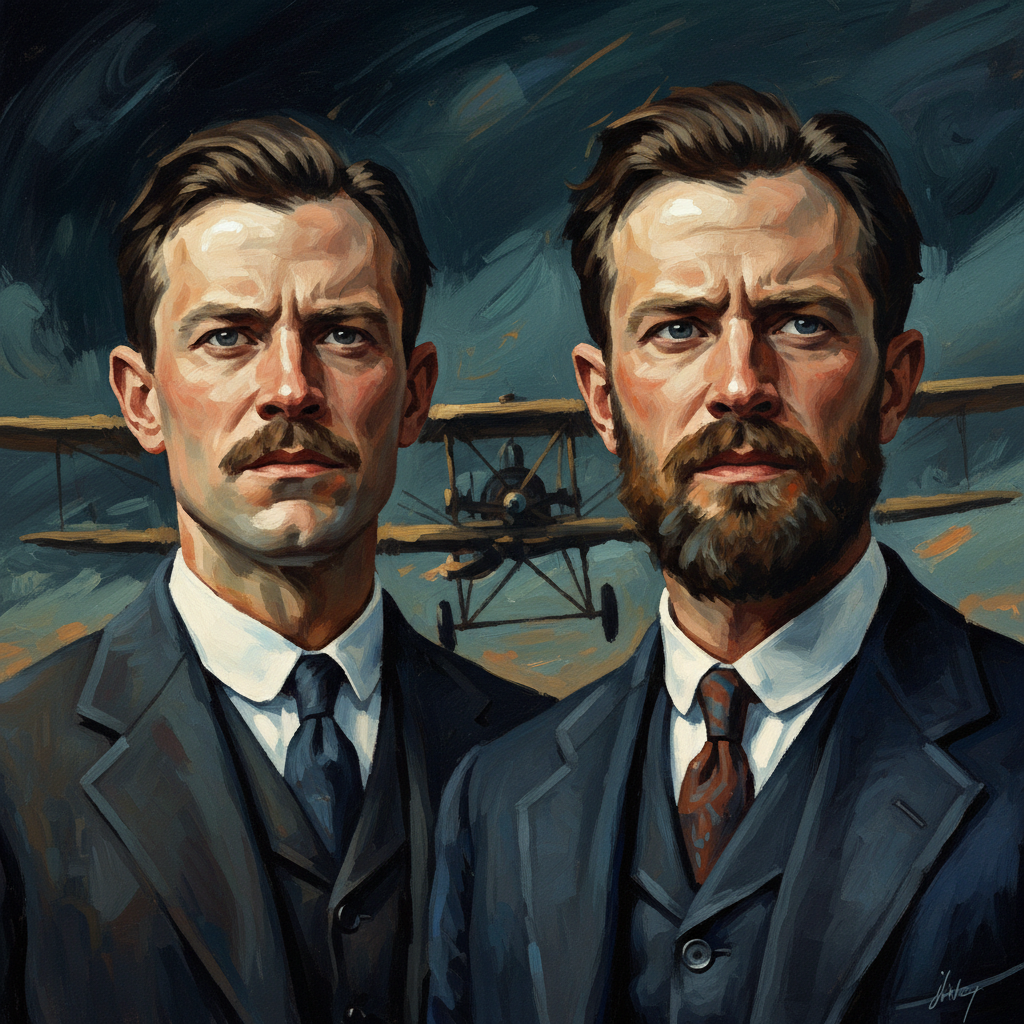
Wright Brothers (Orville & Wilbur) — "We do not intend to fly for money, but for the love of the art."
We do not intend to fly for money, but for the love of the art.
We do not intend to fly for money, but for the love of the art.
Click any product to generate a realistic preview. Up to 3 at a time.
* Initial load can take up to 90 seconds — revising the preview in another color is nearly instant.
"I confess that, in 1901, I said to my brother Orville that men would not fly for 50 years. Two years later, we were making flights. This demonstration of my inability as a prophet gave me such a shock…"
"The first great principle of success in flying is to learn to soar without power."
"I confess that in 1901 I said to my brother Orville that man would not fly for fifty years."
"Learning the secret of flight from a bird was a good deal like learning the secret of magic from a magician—something the magician won't tell, and the bird can't tell."
"We have been trying to solve the problem of aerial navigation, and we believe we have succeeded."
American aviation pioneers who achieved the first sustained powered controlled airplane flight at Kitty Hawk, NC, on December 17, 1903. Closely associated with Octave Chanute (their gliding mentor and aeronautical correspondent). For an intellectual contrast, see Samuel Pierpont Langley, Smithsonian Institution Secretary and government-funded aviation researcher — Langley's Aerodrome crashed twice into the Potomac in October-December 1903 with $50,000 of War Department funding; the Wright Brothers' bicycle-shop empiricism beat Langley's institutional Big Science by 9 days. The most-cited example in engineering history of empirical-tinkerer beating institution-funded credentialism.
Found in 1 providers: grok
1 source checked
The speaker declares that their work is driven by passion and devotion to the craft itself, not by profit or commercial reward. They value the creative and intellectual pursuit as an end in itself. Money may come or go, but the genuine motivation is the joy of mastering something difficult and beautiful. This is a statement about intrinsic motivation over financial gain.
The Wright brothers funded their aviation experiments from their modest Dayton bicycle shop profits, refusing outside investors who might dilute their vision. They spent years in isolated Kitty Hawk enduring sand, storms, and failure purely to solve controlled flight. Though they later defended patents fiercely, their foundational work at Kill Devil Hills in 1903 was driven by obsessive curiosity about aerodynamics, not commercial aviation, which barely existed as a concept.
At the turn of the 20th century, scientific achievement was still often pursued by gentleman-tinkerers and self-funded inventors rather than corporate labs. Samuel Langley's government-funded aerodrome had just failed spectacularly on the Potomac weeks before Kitty Hawk. The Progressive Era celebrated individual ingenuity, and pioneers like Edison and Marconi were cultural heroes. Flight itself was widely mocked as impossible, making the pursuit a labor of conviction rather than a viable business venture.
AI-generated insights based on extensive research and information for context. Factual errors? Email [email protected].
Your cart is empty