Wright Brothers (Orville & Wilbur) — "We have been trying to solve the problem of aerial navigation, and we believe we…"
We have been trying to solve the problem of aerial navigation, and we believe we have succeeded.
We have been trying to solve the problem of aerial navigation, and we believe we have succeeded.
Click any product to generate a realistic preview. Up to 3 at a time.
* Initial load can take up to 90 seconds — revising the preview in another color is nearly instant.
"It is a question of whether the machine was designed to be beautiful, or beautiful because it was well designed."
"The machine is capable of carrying a passenger."
"The airplane stays up because it doesn’t have the time to fall."
"Learning the secret of flight from a bird was a good deal like learning the secret of magic from a magician."
"It is our view that morally the world owes its almost universal use of our system of lateral control entirely to us. It is also our opinion that legally it owes it to us."
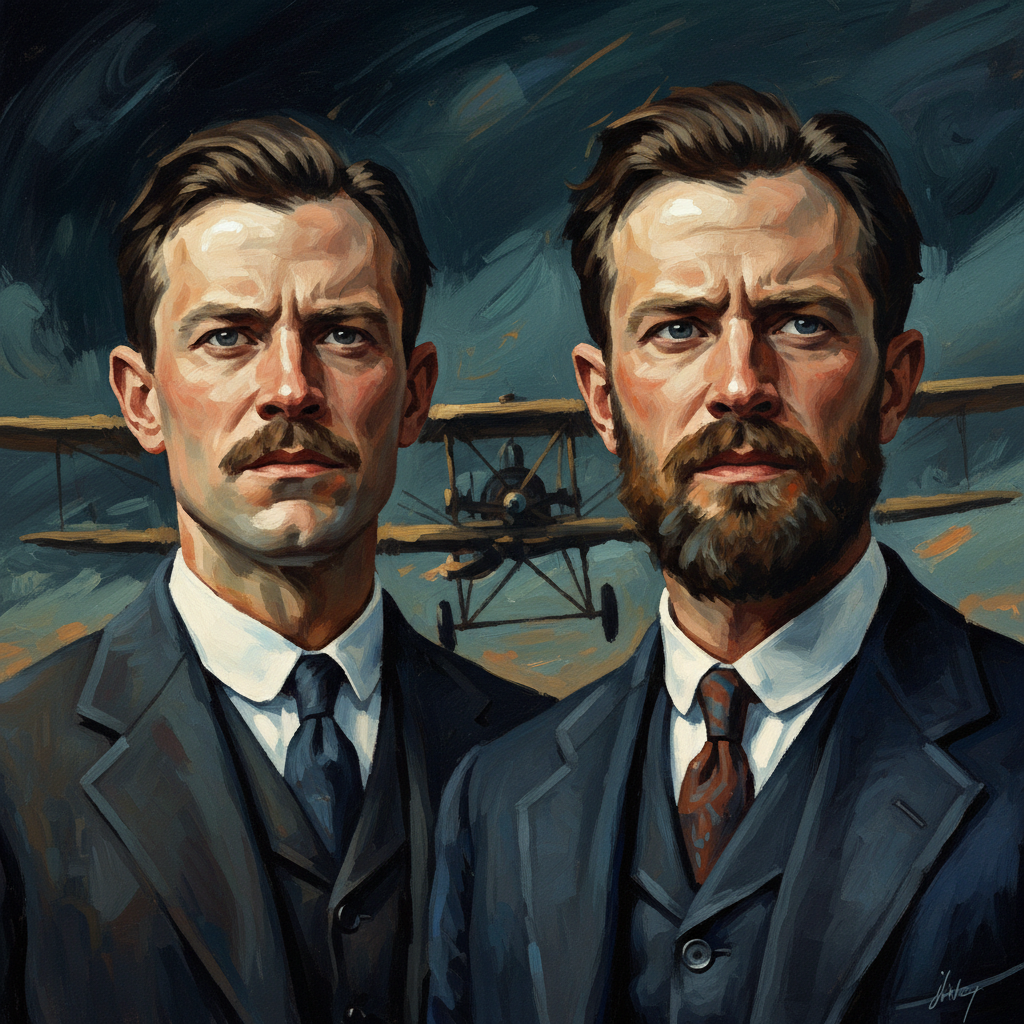
American aviation pioneers who achieved the first sustained powered controlled airplane flight at Kitty Hawk, NC, on December 17, 1903. Closely associated with Octave Chanute (their gliding mentor and aeronautical correspondent). For an intellectual contrast, see Samuel Pierpont Langley, Smithsonian Institution Secretary and government-funded aviation researcher — Langley's Aerodrome crashed twice into the Potomac in October-December 1903 with $50,000 of War Department funding; the Wright Brothers' bicycle-shop empiricism beat Langley's institutional Big Science by 9 days. The most-cited example in engineering history of empirical-tinkerer beating institution-funded credentialism.
Found in 1 providers: grok
1 source checked
The speaker announces that after sustained effort working on how to navigate through the air, they believe they have actually solved it. It's a calm, confident declaration of a breakthrough, framed not as luck but as the payoff of deliberate problem-solving. The tone is modest but firm: they are not bragging, just stating that a long-standing puzzle humanity had wrestled with appears to finally have a working answer.
Orville and Wilbur Wright spent years methodically tackling flight as an engineering problem, building wind tunnels, testing gliders at Kitty Hawk, and solving three-axis control when rivals focused on raw power. This quote mirrors their patient, experimental character: bicycle mechanics from Dayton who treated flight as a solvable system, not a mystical quest. Their 1903 Flyer success and subsequent public demonstrations embodied exactly this understated confidence, earned through rigorous testing rather than bold theatrical claims.
At the turn of the 20th century, powered human flight was widely considered impossible or decades away. Samuel Langley's funded attempts had just failed publicly, newspapers mocked would-be aviators, and scientists debated whether heavier-than-air machines could ever fly. Industrial progress was reshaping transport through trains, automobiles, and steamships, fueling appetite for conquering the sky. The Wrights' December 1903 achievement at Kitty Hawk arrived in this skeptical climate, transforming aviation from fringe speculation into a credible technology on the edge of a new era.
AI-generated insights based on extensive research and information for context. Factual errors? Email [email protected].
Your cart is empty