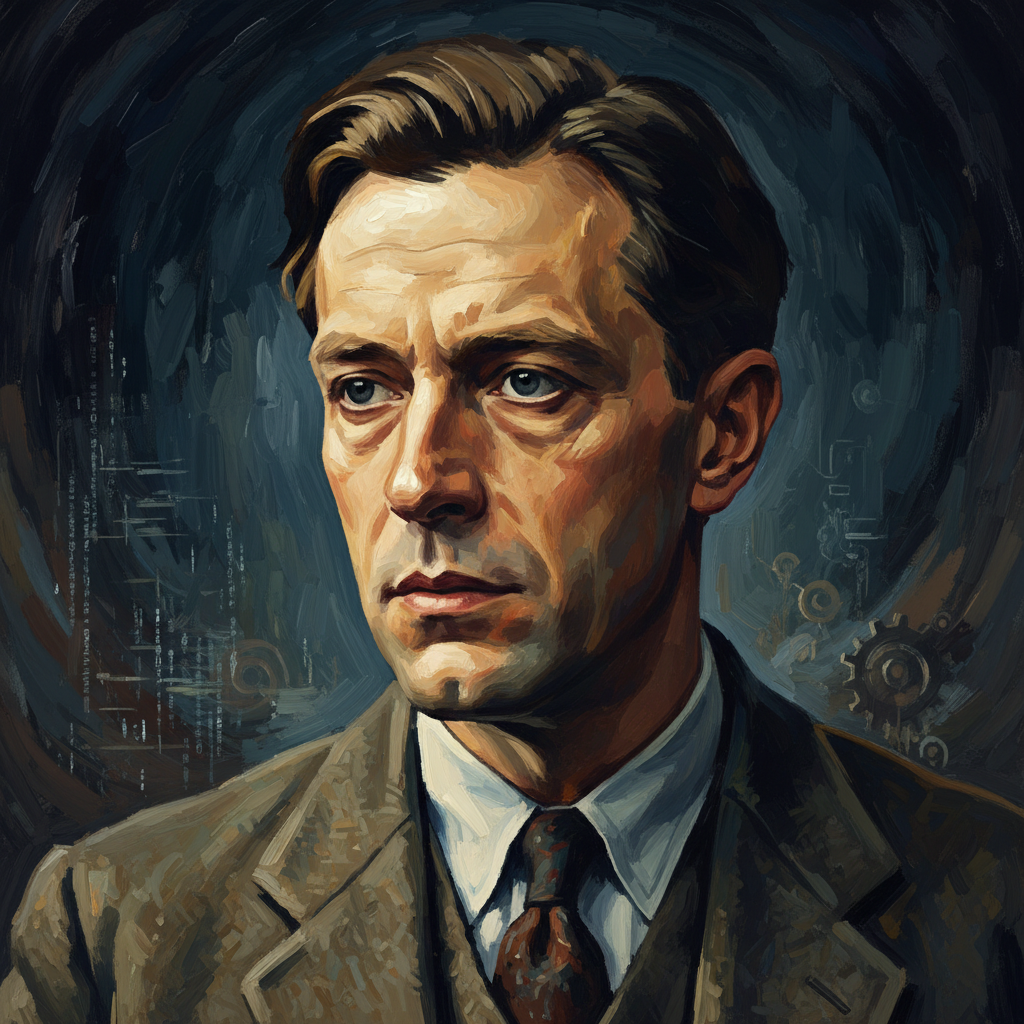
Alan Turing — "A human being is a machine for converting food into thoughts."
A human being is a machine for converting food into thoughts.
A human being is a machine for converting food into thoughts.
Click any product to generate a realistic preview. Up to 3 at a time.
* Initial load can take up to 90 seconds — revising the preview in another color is nearly instant.
"We are not interested in the fact that a machine can solve a problem, but in the fact that it can solve a problem that we cannot."
"The popular view is that the brain is a kind of telephone exchange. I believe that it is not quite as simple as that."
"One could say that a man can 'inject' an idea into the machine, and that it will respond to a certain extent and then drop into quiescence, like a piano string struck by a hammer. Another simile would…"
"Mathematical logic, as a subject, is going to have a great future."
"It is possible to invent a single machine which can be used to compute any computable sequence."
Found in 1 providers: grok
1 source checked
Humans are biological machines: we eat food, our bodies convert it to energy, and our brains use that energy to produce thought. There is no magic separating mind from body — thinking is simply what an organism does with the fuel it consumes. The quote strips away any mysticism around consciousness, reducing it to a straightforward physical process of input, transformation, and output.
Turing built his career on the premise that intelligence is mechanical, not mystical. His 1950 paper 'Computing Machinery and Intelligence' asked whether machines could think, and his Turing Test evaluated cognition purely by behavioral output. Framing humans as food-to-thought machines aligned exactly with his belief that a sufficiently complex artificial system could replicate human reasoning — biology and computation operating on the same underlying logic.
In the 1940s and 1950s, cybernetics and information theory — Wiener, Shannon — reframed both organisms and machines as information-processing systems. World War II had demonstrated that machines could perform codebreaking, work once considered uniquely human. This dissolved the old boundary between the biological and the mechanical, making Turing's reductive view of the human mind not a provocation but a scientifically credible and culturally timely proposition.
AI-generated insights based on extensive research and information for context. Factual errors? Email [email protected].
Your cart is empty