Linus Pauling — "The only way to cope with a problem is to go right at it, and the only way to so…"
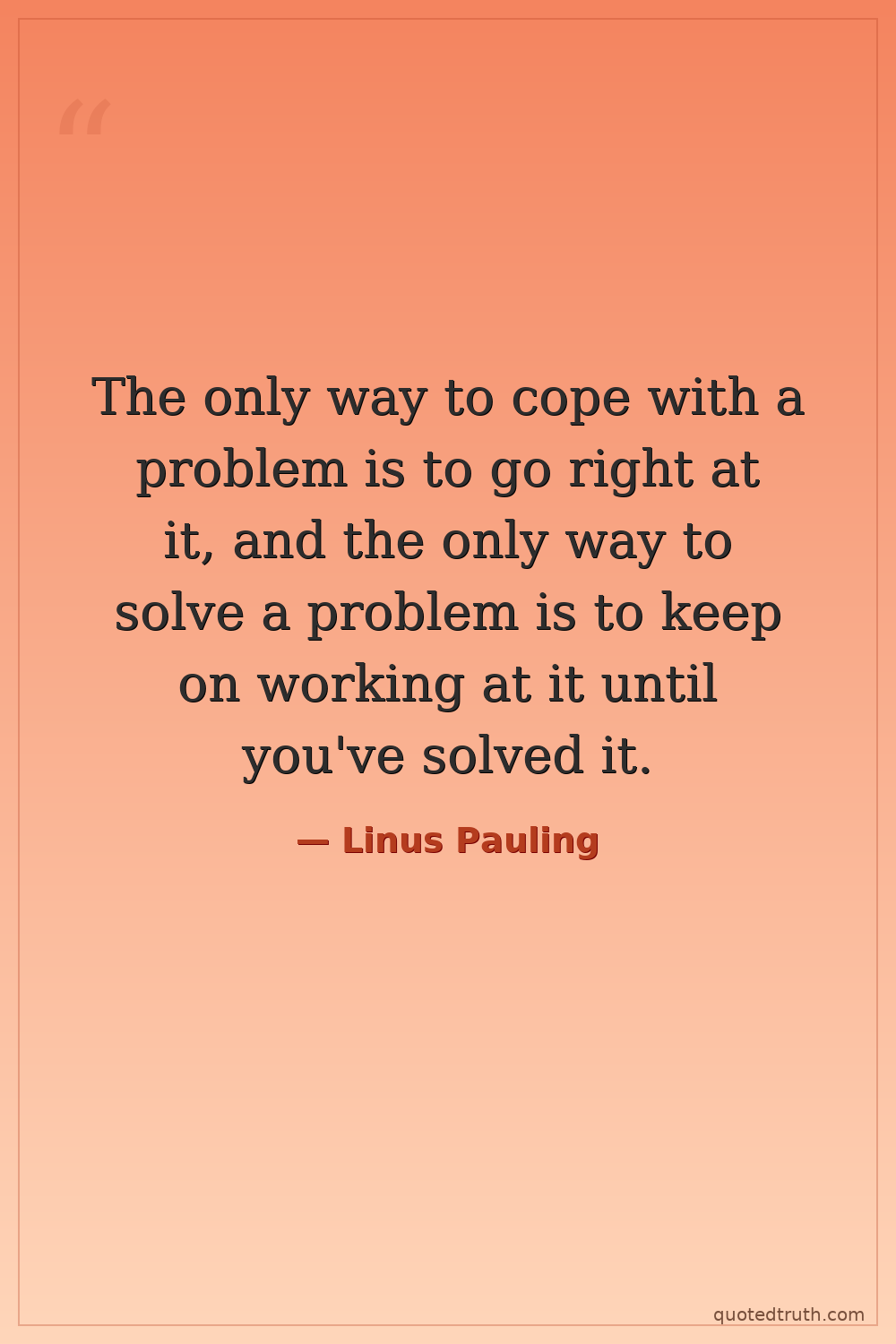
The only way to cope with a problem is to go right at it, and the only way to solve a problem is to keep on working at it until you've solved it.
The only way to cope with a problem is to go right at it, and the only way to solve a problem is to keep on working at it until you've solved it.
Click any product to generate a realistic preview. Up to 3 at a time.
* Initial load can take up to 90 seconds — revising the preview in another color is nearly instant.
"The most important thing in life is to be happy."
"I am convinced that there is no disease that cannot be cured by a proper intake of vitamin C."
"I believe that peace is not just the absence of war, but the presence of justice."
"The most important thing for a scientist is to be curious."
"I believe that there is no such thing as an 'unimportant' discovery."
Found in 1 providers: grok
1 source checked
When you face a problem, don't sidestep it—confront it directly. And once engaged, don't quit; sustained effort is the only real mechanism for resolution. Facing something head-on is how you manage it; working through it without stopping is how you solve it. No shortcut, no clever detour around the obstacle—just honest engagement and persistence until the problem gives way.
Pauling lived this way. He spent years unraveling chemical bonding theory before his 1954 Nobel Prize, then pivoted entirely to fight nuclear testing—facing government hostility, a revoked passport, and FBI surveillance—until winning the 1962 Peace Prize. His later vitamin C research drew ridicule from the medical establishment, yet he persisted until his death at 93. Direct engagement with hard problems, scientific or political, defined his entire career.
Pauling's most impactful decades spanned the Cold War, when the scientific community confronted the consequences of the Manhattan Project. Nuclear testing was poisoning the atmosphere with fallout; McCarthyism was silencing dissent. Scientists faced pressure to stay in their lanes. Pauling's refusal to separate his chemistry from his political conscience—and his insistence on facing both domains head-on—made his persistence both remarkable and politically dangerous.
AI-generated insights based on extensive research and information for context. Factual errors? Email [email protected].
Your cart is empty