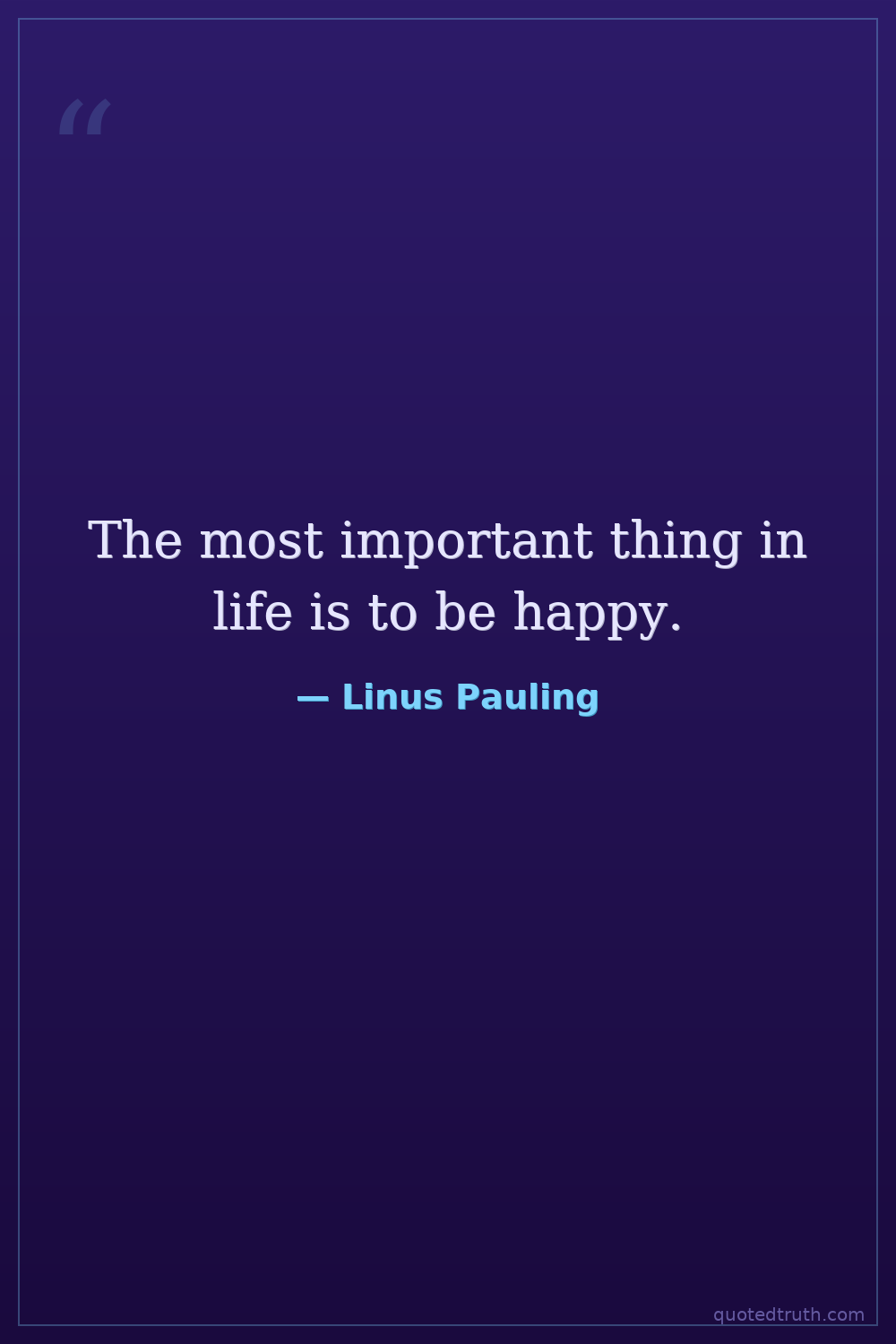
Linus Pauling — "The most important thing in life is to be happy."
The most important thing in life is to be happy.
The most important thing in life is to be happy.
Click any product to generate a realistic preview. Up to 3 at a time.
* Initial load can take up to 90 seconds — revising the preview in another color is nearly instant.
"Well, I thought, that's nice of the old guy to say that, but I'm a little skeptical myself. And as the years went by, I thought, I don't do the sort of work for which Nobel Prizes are given."
"The only way to discover the limits of the possible is to go beyond them into the impossible."
"I have always been a humanitarian, and I believe that we should all work to make the world a better place for everyone."
"You can't have a good idea unless you have a lot of ideas."
"I am not afraid of death. I am afraid of not living."
Found in 1 providers: grok
1 source checked
Happiness — not wealth, status, or achievement — is life's highest goal. This deceptively simple claim cuts against cultural pressure to define success through external metrics. In modern terms, it aligns with positive psychology's central finding: subjective wellbeing and life satisfaction matter more than accumulation or accomplishment. The statement invites a person to measure their life not by what they've built or earned, but by whether they genuinely feel fulfilled.
Pauling won two unshared Nobel Prizes — Chemistry in 1954 for his work on chemical bonding, and Peace in 1962 for anti-nuclear activism — making him uniquely qualified to assess what matters in life. Despite extraordinary achievement, he risked his career during McCarthyism to oppose nuclear weapons testing, suggesting his happiness was tied to moral purpose, not prestige. He found meaning in both laboratory discovery and fighting for human survival.
Pauling lived through the Cold War's peak anxiety — Soviet nuclear tests, the Cuban Missile Crisis, and McCarthyite persecution of dissidents. In 1950s America, happiness was marketed as suburban comfort and consumer goods, while existential dread of nuclear annihilation ran underneath. Pauling's Senate testimony and public campaigns against bomb testing occurred when asserting personal happiness over national security orthodoxy required genuine courage. The era made such a simple statement quietly radical.
AI-generated insights based on extensive research and information for context. Factual errors? Email [email protected].
Your cart is empty