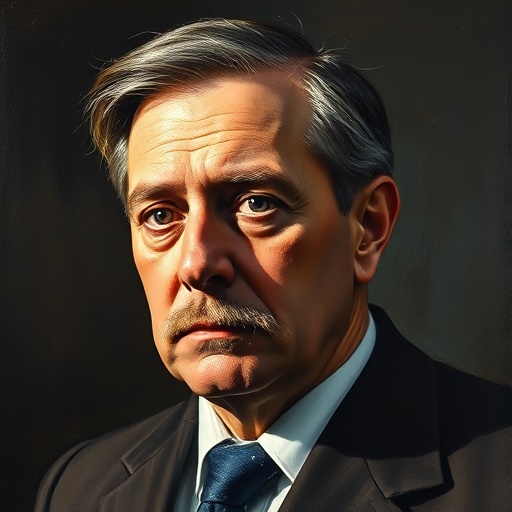
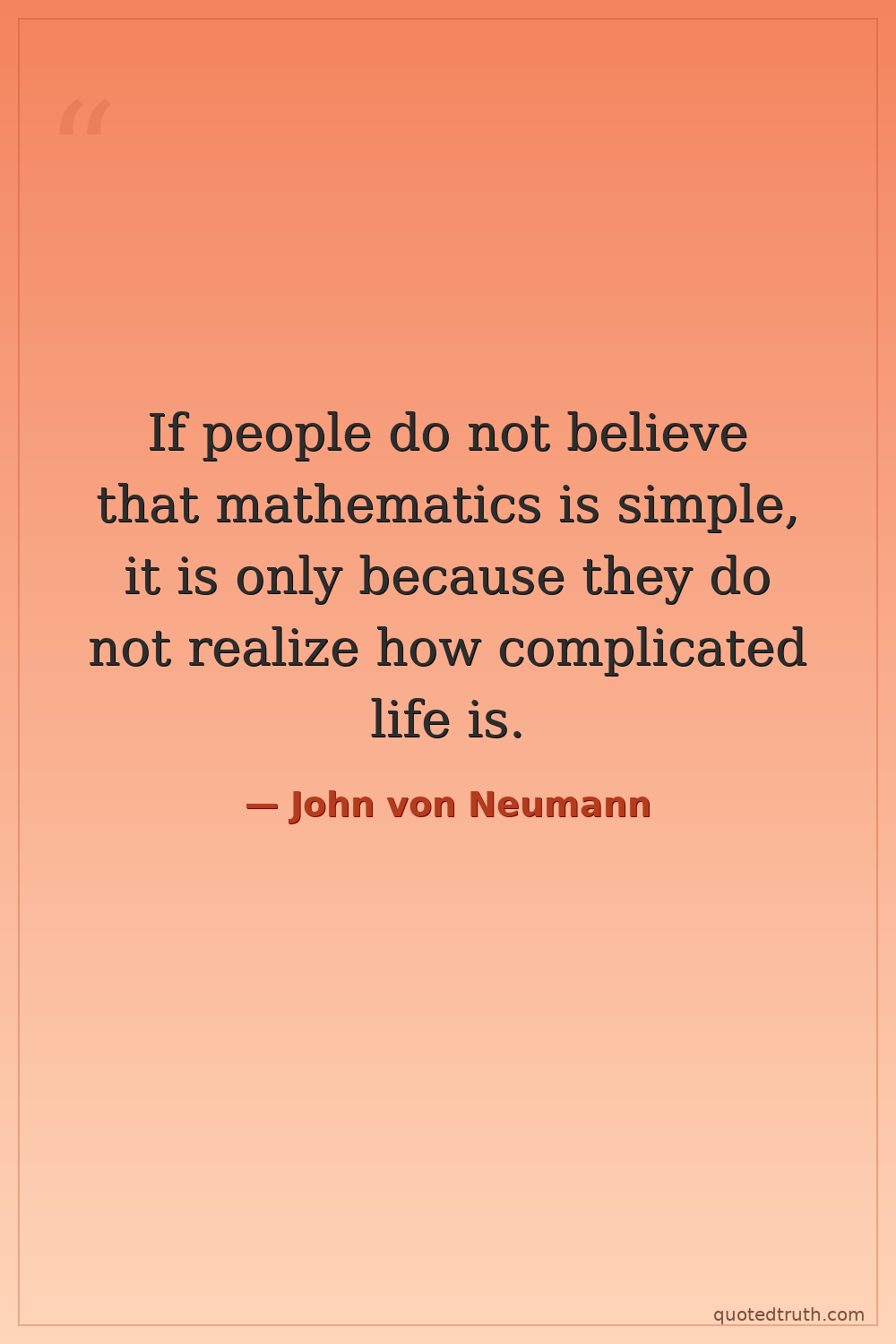
John von Neumann — "If people do not believe that mathematics is simple, it is only because they do …"
If people do not believe that mathematics is simple, it is only because they do not realize how complicated life is.
If people do not believe that mathematics is simple, it is only because they do not realize how complicated life is.
Click any product to generate a realistic preview. Up to 3 at a time.
* Initial load can take up to 90 seconds — revising the preview in another color is nearly instant.
"Anyone who considers arithmetical methods of producing random digits is, of course, in a state of sin."
"I am thinking about something much more important than bombs. I am thinking about computers."
"Anyone who attempts to generate random numbers by deterministic means is, of course, living in a state of sin."
"The computer is a universal machine. It can do anything that can be described algorithmically."
"The world is not logical, it is psychological."
Found in 2 providers: grok,gemini
2 sources checked
Mathematics operates by fixed rules — its logic is internally consistent, proofs either hold or they don't. Life, by contrast, is chaotic: human behavior, chance, social systems, and physical reality resist neat formulation. The quote flips the common assumption. People find math hard not because it is genuinely difficult, but because they haven't grappled with how much more intractable the real world actually is. Math, relative to life, is clarity.
Von Neumann spent his career translating messy reality into mathematical structure. He formalized game theory to model human strategic behavior, designed computer architecture to process information at scale, and helped engineer nuclear weapons using differential equations. Colleagues described him as someone who could absorb vast complexity and instantly reduce it to clean formalism. For a man who mathematized economics, warfare, and computation simultaneously, math was the simple part — life's disorder was the genuine challenge.
Von Neumann worked during a period of staggering systemic complexity: the Manhattan Project, World War II logistics, the Cold War arms race, and the emergence of digital computing all unfolded in his lifetime. The mid-20th century forced governments, scientists, and strategists to confront problems of enormous scale with limited tools. Mathematics — statistics, operations research, game theory — emerged as the only reliable compass. The sentiment carried real weight when the alternative to mathematical thinking was purely improvised chaos.
AI-generated insights based on extensive research and information for context. Factual errors? Email [email protected].
Your cart is empty