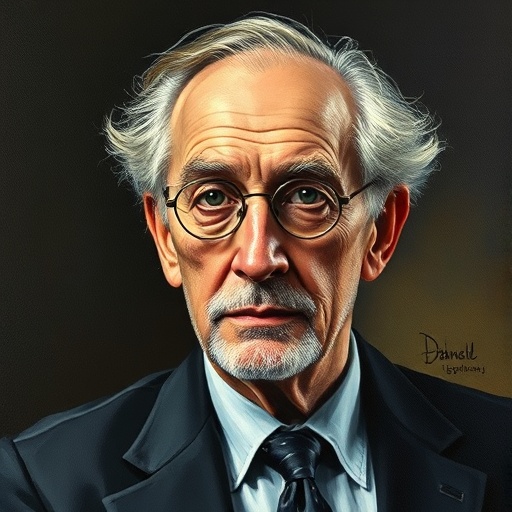
Francis Crick — "The Christian believer is like a tenant who is about to sign a lease on a flat w…"
The Christian believer is like a tenant who is about to sign a lease on a flat when someone tells him that the owner of the flat does not exist.
The Christian believer is like a tenant who is about to sign a lease on a flat when someone tells him that the owner of the flat does not exist.
Click any product to generate a realistic preview. Up to 3 at a time.
* Initial load can take up to 90 seconds — revising the preview in another color is nearly instant.
"I do not believe that God exists."
"The view of ourselves as 'persons' is just as erroneous as the view that the sun goes round the earth."
"The scientific method is a powerful tool, but it is not the only way to understand the world."
"It is essential to be a bit arrogant to do good science."
"The purpose of science is to make the mysterious obvious."
Found in 1 providers: deepseek
1 source checked
The quote uses an everyday analogy — renting a flat — to expose what Crick sees as religion's core absurdity. A tenant signing a lease commits to terms, payments, and obligations with someone who supposedly owns the property. If the owner doesn't exist, the arrangement collapses entirely. Crick argues Christian belief similarly obligates people to a moral and spiritual framework built around an entity whose existence is unverified, making the whole commitment foundationally irrational.
As co-discoverer of DNA's double helix in 1953, Crick became a committed scientific materialist who believed life requires no supernatural explanation. An outspoken atheist, he later wrote The Astonishing Hypothesis arguing consciousness is purely neural. He rejected vitalism and theology throughout his career, viewing religion as a pre-scientific framework superseded by molecular biology. This quote reflects his conviction that evidence-based reasoning makes religious commitment not merely mistaken, but practically absurd.
Crick worked during rapid postwar scientific acceleration — DNA's discovery, the space race, molecular biology's rise — that collectively challenged religion's explanatory authority. Logical positivism and secular humanism gained traction in British intellectual circles. Cold War existential anxiety prompted broader questioning of traditional faith. By the 1960s–70s, scientific rationalism increasingly competed with Christianity in public discourse, making Crick's sharp secular analogies part of a wider cultural debate about whether God remained intellectually credible.
AI-generated insights based on extensive research and information for context. Factual errors? Email [email protected].
Your cart is empty