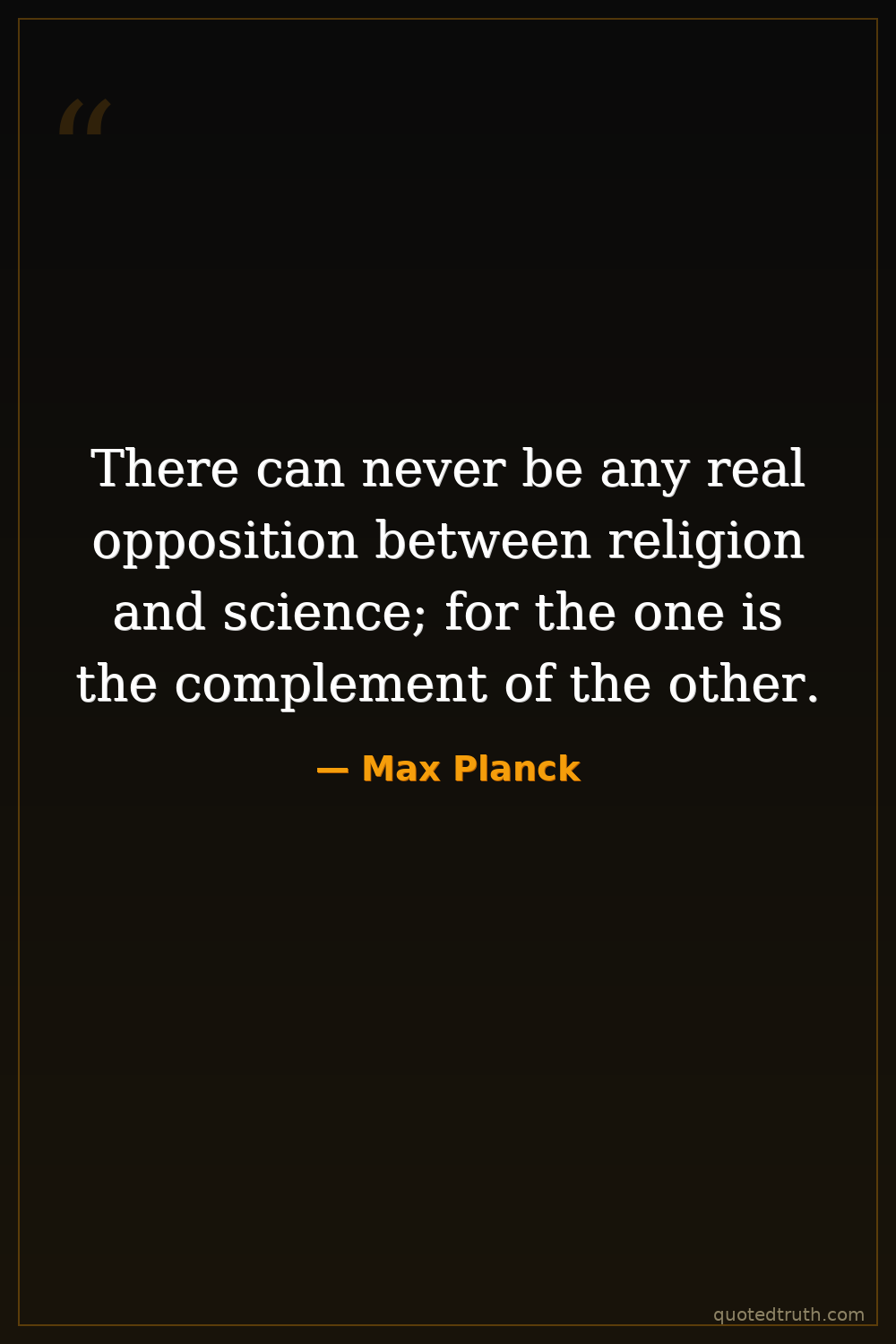
Max Planck — "There can never be any real opposition between religion and science; for the one…"
There can never be any real opposition between religion and science; for the one is the complement of the other.
There can never be any real opposition between religion and science; for the one is the complement of the other.
Click any product to generate a realistic preview. Up to 3 at a time.
* Initial load can take up to 90 seconds — revising the preview in another color is nearly instant.
"The most important task of science is to liberate man from the illusion that he is the center of the world."
"Science is not only a discipline of reason but also one of romance and passion."
"The human mind is capable of understanding the universe."
"Science advances funeral by funeral."
"The freedom of thought and speech must be preserved in all circumstances."
From 'Religion and Natural Science', expressing his view on the compatibility of these two domains.
Date: 1937
ShockingFound in 1 providers: gemini
1 source checked
Planck argues that religion and science are not enemies but partners. Science investigates the physical how of the universe through observation and measurement, while religion addresses questions of meaning, ethics, and ultimate purpose. Rather than competing for the same territory, they fill different gaps in human understanding. A complete worldview, he suggests, draws on both: empirical knowledge explaining mechanism, and spiritual conviction supplying values and significance that data alone cannot deliver.
Planck was both the father of quantum theory and a lifelong Lutheran who served as a church elder in Berlin. He wrestled publicly with the relationship between physics and faith, writing essays like Religion and Natural Science. Having overturned classical physics with the quantum, he knew science reshapes reality yet leaves moral and existential questions untouched. His personal losses, including sons killed in both world wars, deepened his conviction that faith complemented rigorous empirical work.
Planck lived through the collapse of classical determinism, two world wars, and the Nazi regime that murdered his son Erwin for resisting Hitler. Early twentieth-century Europe was torn between triumphant scientific materialism, retreating religious authority, and ideologies weaponizing both. Logical positivists dismissed theology as meaningless; fundamentalists rejected relativity and evolution. Planck's insistence on complementarity pushed back against this polarization, defending space for meaning alongside the quantum revolution he himself had ignited in 1900.
AI-generated insights based on extensive research and information for context. Factual errors? Email [email protected].
Your cart is empty