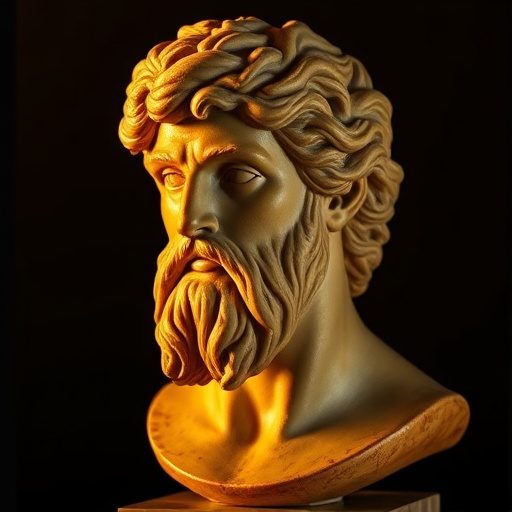
Pythagoras — "There are men and gods, and beings like Pythagoras."
There are men and gods, and beings like Pythagoras.
There are men and gods, and beings like Pythagoras.
Click any product to generate a realistic preview. Up to 3 at a time.
* Initial load can take up to 90 seconds — revising the preview in another color is nearly instant.
"Do not give sleep to your eyes nor slumber to your eyelids until you have balanced the account of your soul with what is right."
"Don't try to cover your mistakes with false words. Rather, correct your mistakes with examination."
"Neither be covetous nor stingy; a due measure is excellent in these things."
"The soul is a self-moving number."
"Friends are as companions on a journey, who ought to aid each other to persevere in the road to a happier life."
Greek philosopher and mathematician whose school in Croton combined geometry (the Pythagorean theorem), number-mysticism, and a religious-vegetarian way of life. Closely associated with Thales of Miletus (earlier pre-Socratic and the first philosopher). For an intellectual contrast, see Heraclitus, pre-Socratic Greek philosopher of flux — Heraclitus called Pythagoras 'the chief of swindlers' — among the founding insults of the philosophical-rivalry tradition. Their 'all is flux' vs 'all is number' poles still organize the philosophy of mathematics today (Platonist vs anti-realist).
A statement attributed to Pythagoras, suggesting a self-perception of being elevated.
Date: c. 570–495 BCE (approximate)
ShockingFound in 1 providers: gemini
1 source checked
The quote asserts a third category of existence between ordinary humans and the gods — a rare middle ground occupied by extraordinary individuals. Rather than claiming divinity outright, it positions certain beings as transcending normal human limitations through wisdom and insight. It implies that intellectual and spiritual achievement can elevate a person beyond the crowd, placing them in a class apart from both the common masses and the immortal divine.
Pythagoras founded a religious-philosophical brotherhood at Croton around 530 BCE where he was revered almost as a divine figure. He reportedly displayed a golden thigh as proof of semi-divine status and claimed to remember past lives through metempsychosis. His followers treated his words as sacred law. This quote — whether his own or attributed by admirers — reflects how he deliberately cultivated an image straddling the human and divine realms.
In 6th century BCE Greece, the boundary between mortal and divine was genuinely fluid. Heroes like Heracles occupied semi-divine status, and culture venerated figures demonstrating extraordinary wisdom. Pythagoras emerged as philosophy was splitting from religious tradition, with thinkers claiming special cosmic insight. At Croton, a Greek colony in southern Italy, he built a community where mathematical harmony and spiritual discipline were treated as legitimate paths to transcending ordinary human mortality.
AI-generated insights based on extensive research and information for context. Factual errors? Email [email protected].
Your cart is empty