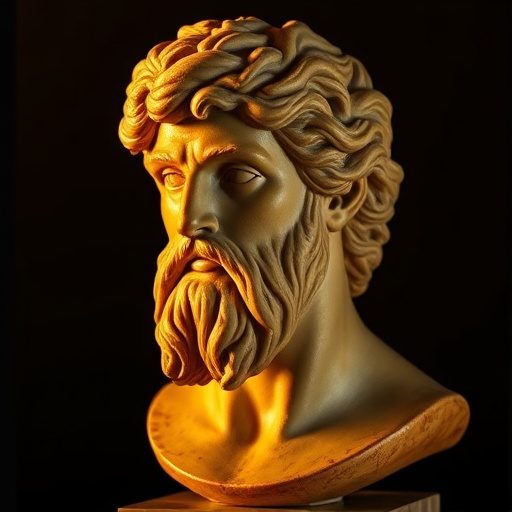
Pythagoras — "Abstain from beans."
Abstain from beans.
Abstain from beans.
Click any product to generate a realistic preview. Up to 3 at a time.
* Initial load can take up to 90 seconds — revising the preview in another color is nearly instant.
"Do nothing evil, neither in the presence of others, nor privately; But above all things respect yourself."
"The soul of man is divided into three parts, intelligence, reason, and passion. Intelligence and passion are possessed by other animals, but reason by man alone."
"The soul of man is immortal and that it changes into other kinds of animals."
"Time is the soul of this world."
"Geometry is knowledge of the eternally existent."
Greek philosopher and mathematician whose school in Croton combined geometry (the Pythagorean theorem), number-mysticism, and a religious-vegetarian way of life. Closely associated with Thales of Miletus (earlier pre-Socratic and the first philosopher). For an intellectual contrast, see Heraclitus, pre-Socratic Greek philosopher of flux — Heraclitus called Pythagoras 'the chief of swindlers' — among the founding insults of the philosophical-rivalry tradition. Their 'all is flux' vs 'all is number' poles still organize the philosophy of mathematics today (Platonist vs anti-realist).
A prominent Pythagorean 'Symbol' or maxim, with various interpretations given by ancient commentators (e.g., against political voting, for digestive reasons, or because they contained souls).
Date: c. 570-495 BCE
WisdomFound in 1 providers: gemini
1 source checked
Avoid beans — literally and symbolically. On the surface, this is a dietary commandment; Pythagoras forbade his followers from eating beans as part of a strict ascetic code. More deeply, beans were used in Athenian voting, so it may mean: stay out of politics. Some scholars suggest a medical angle — fava beans trigger hemolytic crises in people with G6PD deficiency. Together, these readings urge restraint over appetite, politics, and bodily desire.
Pythagoras founded a religious-philosophical brotherhood in Croton, Italy, with strict codes governing diet, sex, and ritual. He taught metempsychosis — the soul's transmigration through living bodies — which made eating beans, believed to house human souls, spiritually dangerous. His community followed absolute commandments without explanation, demanding obedience as spiritual discipline. This bean rule exemplifies how Pythagoras blended mathematics, mysticism, and moral authority into a total way of life.
In 6th-century BCE southern Italy and Greece, philosophical-religious cults were reshaping civic life. Beans carried ritual weight: offered to the dead, used as voting tokens in democratic assemblies, and linked to Demeter's mysteries. As mystery cults rose alongside early democracy, Pythagorean communities offered strict purity codes as alternatives to Olympian religion. Forbidding beans touched on death rites, civic participation, and sacred agriculture — all live cultural anxieties of the archaic Greek world.
AI-generated insights based on extensive research and information for context. Factual errors? Email [email protected].
Your cart is empty