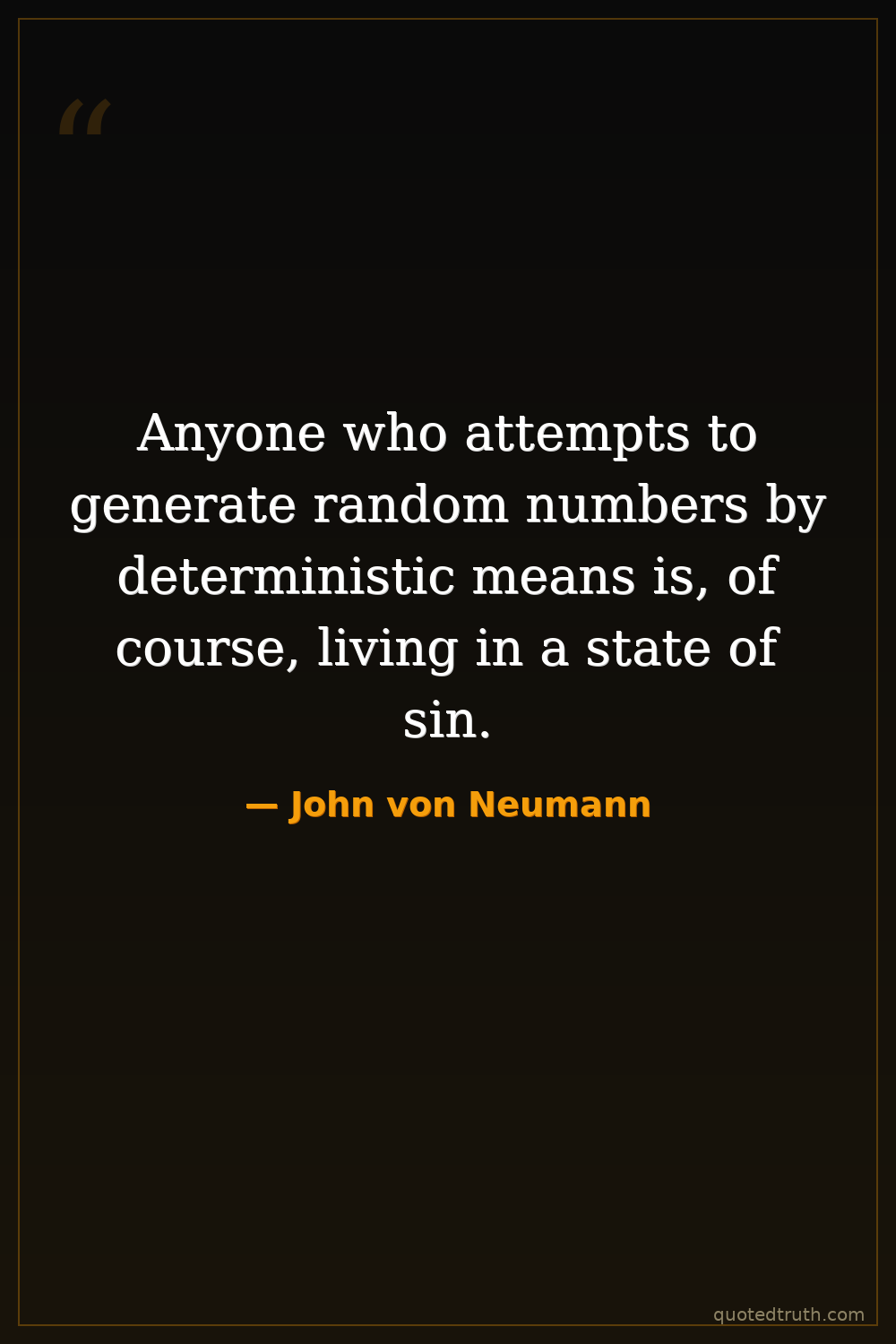
John von Neumann — "Anyone who attempts to generate random numbers by deterministic means is, of cou…"
Anyone who attempts to generate random numbers by deterministic means is, of course, living in a state of sin.
Anyone who attempts to generate random numbers by deterministic means is, of course, living in a state of sin.
Click any product to generate a realistic preview. Up to 3 at a time.
* Initial load can take up to 90 seconds — revising the preview in another color is nearly instant.
"It is not a question of whether we will be able to build a computer that can think. It is a question of whether we will be able to build a computer that can think as fast as we do."
"The computer is the only machine that can be taught to do anything."
"The only difference between a madman and a genius is that the genius is lucky."
"I would like to make a confession which may seem immoral: I do not believe absolutely in Hilbert space any more."
"There probably is a God. Many things are easier to explain if there is than if there isn't."
A humorous but pointed remark on the inherent contradiction of trying to create true randomness with predictable algorithms.
Date: Mid-20th century
ShockingFound in 1 providers: gemini
1 source checked
True randomness cannot emerge from a fixed, predictable process. Deterministic algorithms follow rules — they produce sequences that appear random but are entirely predictable given the starting seed. Calling such output genuinely random is a convenient fiction. The quote captures a real mathematical paradox: computers, by design fully deterministic, cannot create true randomness, yet we rely on pseudorandom numbers constantly in statistics, cryptography, and simulation.
Von Neumann personally invented the middle-squares method, one of the first pseudorandom number algorithms, used for Monte Carlo simulations in nuclear weapons design at Los Alamos. He also established the logical foundations of modern computer architecture — inherently deterministic systems. The quote reflects his characteristic sharp wit alongside intellectual honesty: he deployed these flawed methods himself while never pretending they produced what they claimed to produce.
The 1940s and 1950s saw the first practical electronic computers emerge, creating an urgent need for random numbers to power Monte Carlo simulations essential to nuclear weapons design, statistical physics, and operations research. Hardware sources of true randomness were impractical at scale, forcing an uncomfortable compromise: deterministic machines generating fake randomness for real-world calculations. Von Neumann's quip captured the philosophical unease that defined early computational science.
AI-generated insights based on extensive research and information for context. Factual errors? Email [email protected].
Your cart is empty