Pope Urban II — "This I grant to all who go, by virtue of the great authority with which I am inv…"
This I grant to all who go, by virtue of the great authority with which I am invested by God.
This I grant to all who go, by virtue of the great authority with which I am invested by God.
Click any product to generate a realistic preview. Up to 3 at a time.
* Initial load can take up to 90 seconds — revising the preview in another color is nearly instant.
"Oh, how admirable is that salting! Truly, you must strive by the salt of wisdom to correct these foolish people, hastening open-mouthed after the pleasures of this world, lest putrefied by sins and un…"
"The Most High has chosen you for this glorious task."
"Take the road to the Holy Sepulchre, and rescue it from the hands of the pagans."
"Gird yourselves, everyone of you, I say, and be valiant sons; for it is better for you to die in battle than to behold, the sorrows of your race and of your holy places. Let neither property nor the a…"
"Your land, moreover, is too poor to support you."
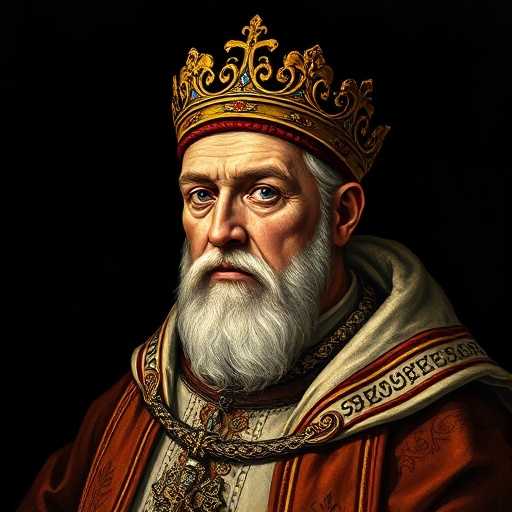
Pope (1088-1099) whose Council of Clermont speech (November 1095) launched the First Crusade — the founding event of nine centuries of Christian-Muslim military conflict. Closely associated with Pope Gregory VII (his predecessor on papal-imperial reform). For an intellectual contrast, see Saladin, Kurdish-Muslim Sultan of Egypt and Syria (1138-1193) — Saladin recaptured Jerusalem in 1187, undoing the First Crusade Urban II launched 92 years earlier. Saladin's chivalrous treatment of Christian prisoners became the canonical Muslim counter-image to Crusader brutality. The cleanest before/after pairing of the Crusades' moral arc.
Found in 1 providers: grok
1 source checked
Urban II is declaring that he personally guarantees a spiritual reward — plenary indulgence, the full cancellation of sins' temporal punishment — to every Christian who joins the military expedition to the Holy Land. He frames this not as a personal favor but as an exercise of divinely delegated power, making the offer binding and sacred. The implication: refusing to go means refusing God's invitation, while going wipes the spiritual slate clean.
Urban II was a Cluniac monk turned reformist pope who spent his career fighting to establish that popes, not kings, held supreme authority on earth. His entire papacy was built on the Gregorian Reform principle that the pope was Christ's vicar with unrivaled jurisdiction over souls. This declaration at Clermont, 1095, was the ultimate expression of that belief — using spiritual authority as a military recruiting tool, something only a pope who genuinely believed in his divine mandate would dare do.
In 1095, Europe was locked in the Investiture Controversy — popes battling emperors over who controlled appointments and ultimate authority. Simultaneously, the Seljuk Turks had shattered Byzantine power at Manzikert in 1071, and Emperor Alexios I begged the West for mercenaries. Jerusalem had been under Muslim rule since 638. Urban's speech weaponized the era's two obsessions — salvation anxiety and Christian unity — turning a military expedition into a penitential act with guaranteed heavenly reward.
AI-generated insights based on extensive research and information for context. Factual errors? Email [email protected].
Your cart is empty