What it means
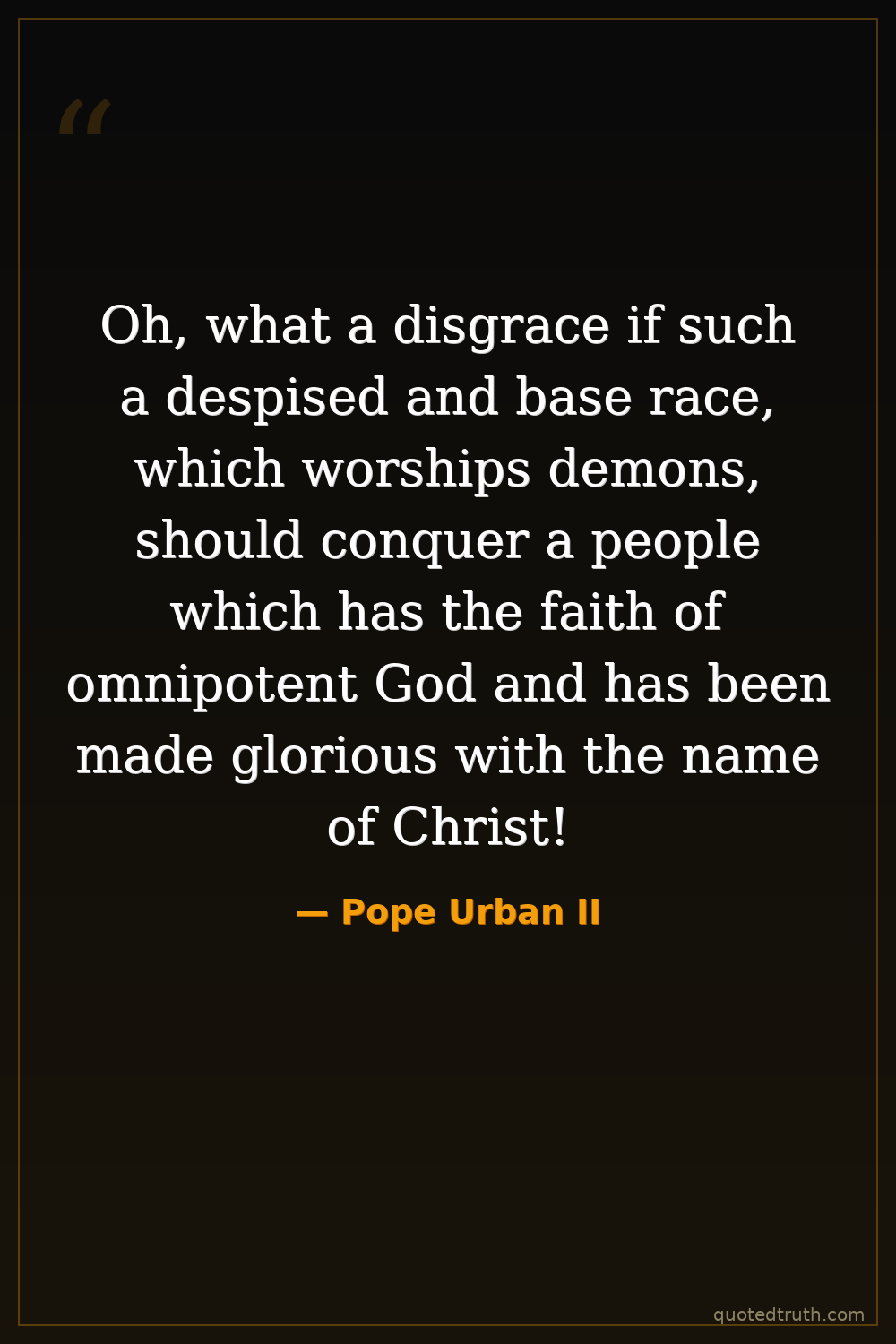
The speaker expresses outrage that Christians — God's chosen, Christ-bearing people — might be defeated by those he considers spiritually inferior and false in their worship. It frames military defeat as religious humiliation, arguing that losing to such an enemy would be a disgrace to Christian identity itself. The rhetoric weaponizes shame and group pride to demand action, essentially saying: your faith demands you fight back.
Relevance to Pope Urban II
Urban II delivered this at the Council of Clermont in 1095, directly launching the First Crusade. As pope, his authority rested on defending Christendom, and he genuinely viewed Islam as demonic error. His papacy focused on church reform and asserting papal supremacy. This speech was his defining act — using humiliation rhetoric to unify fractious European nobles under a single holy mission, turning religious identity into a military recruitment tool.
The era
In 1095, Seljuk Turks controlled Jerusalem and had crushed Byzantine forces at Manzikert (1071). Emperor Alexios I begged Urban for help. Medieval Europeans understood the world as an ongoing spiritual war between Christianity and false religion. Knights lacked a sanctioned outlet for endemic violence. Urban's speech reframed war as penance and honor, arriving at a moment when shame over lost holy sites and fear of Islamic expansion made his appeal explosively effective.
AI-generated insights based on extensive research and information for context. Factual errors? Email [email protected].